
Job or business: what is the right choice for you?
Your birth chart should not be used as a simple verdict that you are “meant for a job” or “born to do business.” In Vedic astrology, practitioners may examine the 6th house, 7th house, 10th house, their lords and the relevant planetary periods to interpret themes associated with service, enterprise and professional responsibility. But your skills, financial position, market opportunity and appetite for uncertainty are essential to the decision.
You may have a good salary but feel restricted by office politics, fixed working hours or decisions made by others. Perhaps you have a business idea you cannot stop thinking about.
Or you may already be running a small venture on the side and wonder whether it is time to leave your job.
The difficult part is not imagining either future. It is deciding which risk you can realistically afford.
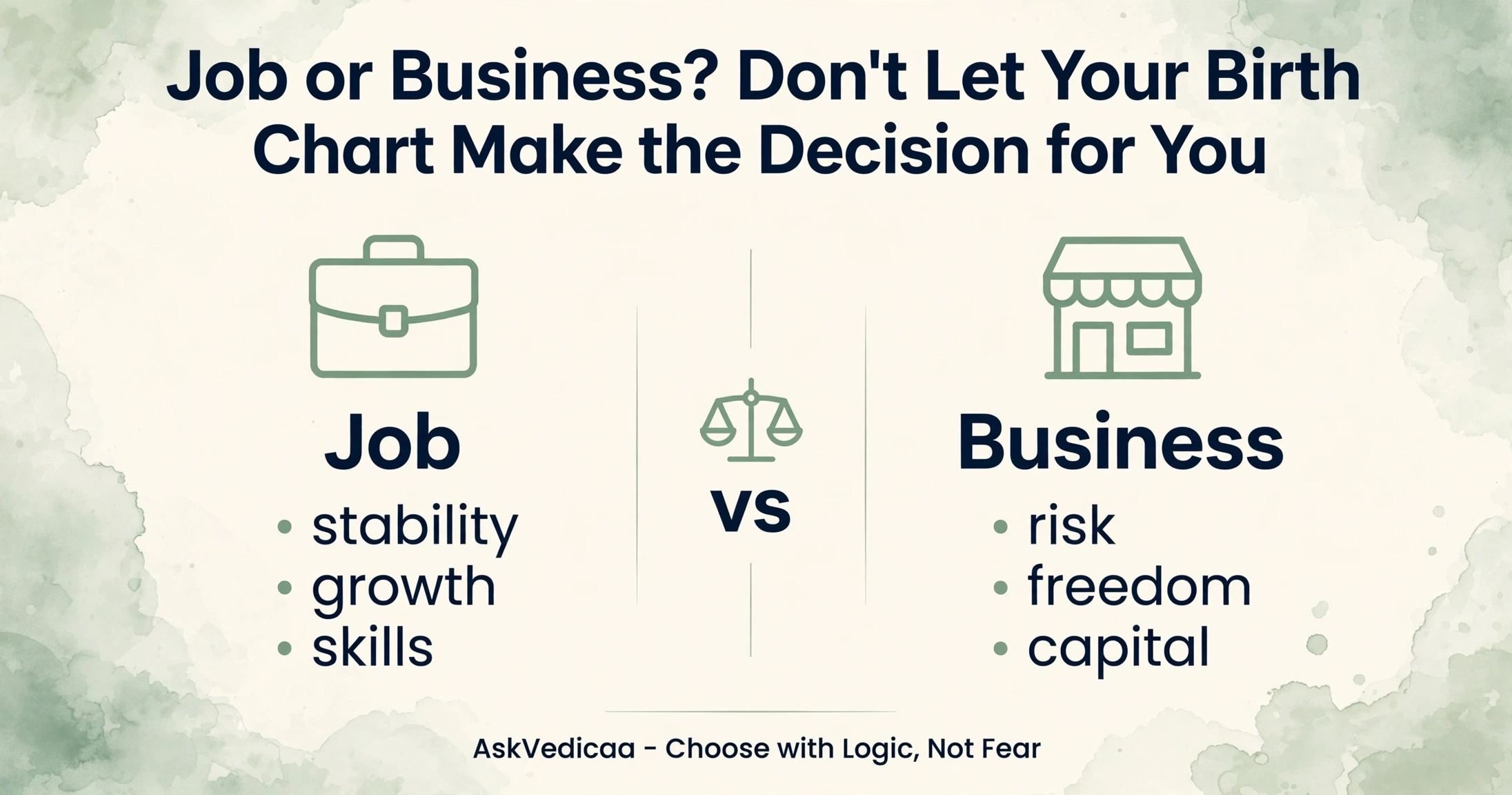
A job can offer structure and predictable income, but it may limit your independence. A business can offer autonomy and growth, but it can also bring irregular cash flow, long hours and responsibilities you cannot easily switch off.
Astrology can be one lens for reflection. It cannot remove those trade-offs.
What does Vedic astrology examine when comparing a job and a business?
A Vedic career reading considers the birth chart as a whole. No single house or planet can reliably settle the question on its own.
The 6th house: employment, service and daily responsibilities
The 6th house is traditionally associated with service, work-related duties, competition and challenges. Its condition and connections may be considered when exploring how a person approaches structured work and professional obligations.
This does not mean that a strong 6th house automatically makes someone a successful employee—or that a difficult one rules out employment.
The 7th house: business, trade and partnerships
The 7th house is associated with partnerships, trade and dealings with others. Practitioners may examine it when considering business relationships and commercial activity.
However, a chart cannot establish whether a particular business idea has paying customers, whether a proposed partner is trustworthy or whether a venture will make a profit.
The 10th house: career, work and professional standing
The 10th house is an important factor in traditional Vedic career interpretation. Its lord, planetary influences and relationship with other houses may be examined to understand professional responsibilities, ambitions and career direction.
It should not be interpreted in isolation as a job-versus-business test.
Mercury, Saturn and the relevant planetary periods
Mercury is traditionally associated with communication, calculation and commerce. Saturn is associated with discipline, responsibility and sustained effort. Their roles depend on the full chart rather than a simple label.
Mahadasha and Antardasha are also considered in traditional timing analysis. They may provide a framework for discussing periods of reassessment or professional change, but they cannot guarantee that a business launched during a particular period will succeed.
The key point: a responsible reading explores patterns and possibilities. It does not assign you a career identity that you must follow.
Job vs business: which fits your present situation?
Your actual circumstances should lead the decision. Use this comparison before interpreting the chart.
|
Factor |
A job may suit you better when… |
Business may suit you better when… |
|---|---|---|
|
Income |
You need dependable monthly earnings. |
You can manage uncertain or irregular income. |
|
Financial position |
You have limited savings or substantial obligations. |
You have sufficient runway and a realistic financial plan. |
|
Work preference |
You value defined responsibilities and an established team. |
You enjoy making decisions and carrying responsibility across functions. |
|
Opportunity |
Your current skills are valued in the employment market. |
You have evidence of a customer need and a viable offer. |
|
Risk tolerance |
Uncertainty would create serious financial or personal strain. |
You understand the downside and can absorb a realistic loss. |
|
Readiness |
You need more experience, skills or industry knowledge. |
You have the skills, resources and evidence to take the next step. |
Neither option is inherently more ambitious, independent or successful. A good job can provide a strong foundation for wealth and professional growth. A business can create opportunities, but ownership alone does not guarantee freedom or income.
Five reality checks before leaving your job
Before resigning to start a business, answer these five questions.
1. Has anyone shown a willingness to pay?
Positive feedback from friends is not the same as market demand. Speak to prospective customers, test your offer and, where possible, secure paying customers before making a major commitment.
2. How long can you support yourself?
Calculate essential household expenses, debt repayments, insurance, business costs and other obligations. Estimate how long your accessible savings can support you if revenue takes longer than expected.
3. Can you start smaller?
A side business, freelance assignment or limited pilot may help you test demand without immediately giving up your salary. Check your employment contract for restrictions on outside work and conflicts of interest.
4. Do you understand the work of running a business?
Being good at your profession is not the same as being ready to sell, manage cash flow, handle customer complaints, comply with regulations and maintain records.
5. What would make you stop or change direction?
Define measurable milestones in advance: customer demand, revenue, costs and available cash. Decide when you would reassess the business rather than continuing simply because you have already invested money or time.
If you cannot answer these questions yet, that does not mean you should abandon the idea. It means you have a preparation plan to complete.
What your chart cannot decide
Even a detailed Vedic reading cannot establish:
-
Whether your business idea will find enough customers.
-
Whether you will earn more as an entrepreneur than as an employee.
-
Whether a particular business partner will act honestly.
-
Whether your savings will last through a difficult period.
-
Whether you should resign immediately without examining the consequences.
Be cautious of anyone who says you are destined to be a business owner or that your chart guarantees financial success.
Astrology should never be used to bypass market research, legal checks, financial planning or professional advice.
Should you choose a job or a business according to your birth chart?
Vedic astrology traditionally examines the 6th, 7th and 10th houses, their lords, planetary influences and relevant Dashas when interpreting employment and business themes. These factors may provide a perspective on your professional preferences and timing.
They cannot establish which path will make you successful.
If you need stable income, have significant financial obligations or have not tested your business idea, keeping your job while preparing may be the more prudent option. If you have proven demand, sufficient financial runway and a clear plan, a business may be worth exploring.
Do not resign because a chart tells you to. Build a case for the decision, then use astrology as a secondary perspective if it is meaningful to you.
Frequently asked questions
Which house indicates a job in Vedic astrology?
The 6th house is traditionally associated with service and employment-related responsibilities, while the 10th house relates to career and professional standing. The full chart must be considered rather than relying on one house.
Which house indicates business?
The 7th house is traditionally associated with trade, business dealings and partnerships. Other houses and planetary connections also matter in a complete career interpretation.
Can my birth chart tell me whether I will succeed in business?
No chart reading can guarantee business success. It may offer a traditional interpretive perspective, but commercial success depends on demand, execution, resources, competition and other real-world factors.
Should I start a business during a favourable Dasha?
A traditionally favourable period should not be treated as permission to ignore risk. Assess the business model, customer demand, capital and financial runway first. Timing is secondary to readiness.
Can I keep my job while testing a business idea?
Yes, if your employment terms permit it and you can manage the additional workload. A small pilot can help you test demand before making an irreversible career change.
Your next step: test the choice before making the leap
You do not have to decide your entire professional future today.
Write down what you want from your work, compare the risks of both paths, and identify what evidence would make you confident enough to act. If business appeals to you, start by testing the idea rather than treating resignation as the first step.
If you are still uncertain about how your career patterns and current planetary periods are traditionally interpreted, explore AskVedicaa for personalised Vedic guidance.
Bring a specific question, such as whether to continue in employment while building a business, and use the reading to explore the considerations—not to replace your own judgment.
Your goal is not to discover whether you are destined for a job or a business. It is to choose a path that fits your ambitions, responsibilities and present readiness.