
Articles
Browse by topic or search for what you want to learn.
Astrology
20 articles shown
You Earn Enough. Why Do You Still Feel Financially Insecure?
You earn a reasonable salary. Your bills are paid, you may have savings and your lifestyle appears comfortable. Yet a sudden expense, a job uncertainty or an unexpected family responsibility can make you feel as though your financial security could disappear overnight. Why does earning enough not always translate into feeling secure? The answer may involve more than your income. Family experiences, financial responsibilities, lifestyle inflation, debt, inadequate emergency savings and fear of losing control can all influence how safe money feels. Vedic astrology offers a traditional framework for examining wealth-related themes through the second and eleventh houses, their lords, planetary influences and relevant Dashas. But a horoscope cannot create financial security or replace practical planning. The real question is whether your financial position is as secure as your income makes it appear—and what you can do to strengthen it.
Read article
What Astrology Can Never Guarantee About Your Marriage
You may have checked your Kundli, consulted an astrologer, compared compatibility scores and even looked at your current Mahadasha. Yet one question may still trouble you: Will my marriage actually be happy? Perhaps the chart looks favourable, but you are worried about your partner's behaviour. Or perhaps an astrologer has warned you about a difficult planetary combination, leaving you anxious about a relationship that otherwise feels healthy. This is where we need to be honest about the role of Vedic astrology. A birth chart can offer a traditional perspective on marriage, relationship tendencies and timing. But it cannot guarantee fidelity, happiness, lifelong commitment, emotional safety or peace between families. Understanding this distinction does not make astrology less meaningful. It helps you use it more responsibly.
Read article
Second Marriage in Vedic Astrology: Houses, Navamsa (D9) & Timing
Vedic astrology does not have one universally accepted house or planetary combination that independently establishes a second marriage. Astrologers generally examine the seventh house and its lord, Navamsa (D9), Venus, Jupiter, the second house and Upapada Lagna. Some traditions also examine the ninth house as the seventh from the seventh, using the principle of derived houses. The interpretation depends on the complete horoscope, the astrological tradition being followed and relevant planetary periods. No single combination should be treated as proof of remarriage.
Read article
Second marriage in vedic astrology
Vedic astrologers may examine the seventh house and its lord, the Navamsa (D9), Venus, Jupiter, relevant planetary periods and other marriage-related factors when considering the possibility and timing of another marriage. Some traditions also examine the second house, Upapada Lagna and other chart combinations. Their interpretation varies, and no single placement or combination should be treated as proof of a second marriage. A chart can be explored as one perspective on relationship themes and timing. The decision to marry again must also account for emotional readiness, compatibility, legal circumstances, children, finances and the behaviour of the person you are considering.
Read article
Same Fights in Marriage? Compatibility or an Unfinished Pattern
Before you question the entire marriage, understand what keeps going wrong. And if the relationship is unsafe, remember that protecting yourself matters more than repairing it.
Read article
Feeling Distant From Your Spouse While Still Loving Them?
Emotional distance does not automatically mean love has ended. It often develops through stress, unresolved hurt, changing responsibilities, or communication patterns. Vedic astrology may examine the Moon, Venus, the 7th house, and current planetary periods for relationship themes, but it cannot replace an honest conversation or guarantee that closeness will return. Start by understanding what changed and whether both of you are willing to reconnect.
Read article
Love Marriage vs Family Opposition: Vedic Astrology
Love, family expectations and marriage can create difficult choices. Discover what Vedic astrology can explain and what you should consider before deciding. Credibility comes not from making astrology sound more certain, but from clearly explaining what it can interpret, what it cannot establish, and how the reader should use that information.
Read article
Right person chemistry Kundli score
You like someone. You feel understood, enjoy being together and can imagine a future with them. Then the Kundli matching report arrives, and the score is lower than expected. Suddenly, something that felt right begins to feel uncertain. Should you trust your connection or listen to the report? In Vedic tradition, Guna Milan is one way of assessing compatibility, but it does not capture every part of a relationship. A high score cannot guarantee a happy marriage, and a low score does not, by itself, prove that a relationship will fail. Your decision also needs to consider shared values, emotional safety, communication, family expectations and the ability to work through disagreements. Vedic astrology can offer a traditional perspective, but it should not replace honest conversations or personal judgment. Before saying yes or walking away, understand what the score tells you, what it leaves unanswered and what you need to discover about the person you may marry.
Read article
Why Your Marriage Feels Delayed
When marriage seems delayed, it can feel as though everyone else is moving forward while you remain in the same place. Family questions, social expectations and uncertainty about the future can make the experience even harder. But a delayed marriage does not automatically mean something is wrong with you, your birth chart or your future. Several factors may be involved: the opportunities you encounter, your expectations, emotional readiness, family preferences, compatibility concerns and the practical realities of finding a suitable partner. Vedic astrology offers a traditional framework for reflecting on relationship themes and timing, but it cannot guarantee a marriage date or replace your judgment. The more useful approach is to understand what is actually creating the delay, distinguish genuine obstacles from social pressure, and identify the steps you can take. Your goal is not to marry simply to stop the questions. It is to make a thoughtful decision about the relationship and life you want to build.
Read article
5 Things a Career Chart Reading Can Never Fix
A Vedic career chart reading may help you reflect on professional themes, possible timing considerations and questions about your direction. But even a detailed reading cannot build your skills, create a professional network, develop your portfolio, regulate your emotions or guarantee that employers will need your expertise. These outcomes depend on your actions, circumstances and the opportunities available to you. Use astrology as a tool for reflection, not as a substitute for preparation or decision-making. Before seeking a reading, identify the career decision you are facing and the practical information you still need. After receiving guidance, translate useful insights into specific actions, such as improving a skill, seeking feedback, strengthening professional relationships or researching the job market. A responsible reading should help you think more clearly, not make you dependent on repeated predictions. The real value of career guidance lies in helping you understand your options and take informed action. Your chart may offer a perspective, but you remain responsible for what you build with it.
Read article
Should You Relocate for a Job?
A job transfer or relocation can create valuable career opportunities, but it can also affect your finances, family relationships, daily routine and long-term plans. Before accepting, compare the professional benefits with the full cost of moving. Consider the role's future prospects, salary after living expenses, relocation support, family needs, schooling, housing and the stability of the opportunity. Ask your manager clear questions and explore whether a trial period, delayed move or hybrid arrangement is possible. In Vedic astrology, practitioners may examine career-related houses, planetary periods and traditional indicators associated with travel or relocation. These interpretations can offer an additional perspective on timing, but they cannot guarantee success or determine whether the move is right for your family. Avoid treating every foreign-travel or relocation combination as proof that you should move. Make the practical assessment first, identify your non-negotiables and use astrology only if timing remains an important unanswered question.
Read article
Repeated Workplace Conflict: Is It Your Chart or Your Boundaries?
Repeated workplace conflict can arise from poor management, unhealthy team cultures, unclear responsibilities, communication problems or boundaries that are difficult to maintain. When similar disputes occur across different jobs, examine the pattern rather than assuming every colleague is the problem—or that you are somehow destined for conflict. Keep a record of triggers, your response and the outcome. Practise clear communication, document important agreements and use appropriate management or HR channels when necessary. In Vedic astrology, planetary influences such as Mars, Saturn and Rahu may be interpreted in relation to conflict, pressure, frustration or recurring challenges. These interpretations cannot establish why a specific dispute happened or excuse harmful behaviour. Use a chart as a reflective lens alongside observable evidence. If the environment is unsafe, discriminatory or persistently damaging, prioritise appropriate support and a practical plan to protect yourself. Understanding a pattern should help you respond more effectively, not convince you to accept mistreatment.
Read article
Job Timing and Vedic Astrology
Any job preparation demands patience, discipline and a realistic understanding of competition. If you are wondering whether Vedic astrology can help you choose the right time to attempt an examination, it is important to understand its limits. Traditional chart interpretation may examine career-related houses, planetary periods and other factors to reflect on professional themes and timing. However, a favourable period cannot guarantee selection, and a difficult period does not automatically mean you should stop trying. Your eligibility, preparation, examination performance, vacancies, cut-offs and competition remain decisive practical factors. Before making another attempt, assess your mock-test scores, knowledge gaps, age and attempt limits, financial situation and willingness to continue. Decide whether you should attempt again, change your preparation strategy or pause based on evidence—not fear. Use astrology as optional context, never as a substitute for a study plan or a promise of success. The aim is to make a better-informed decision about your next attempt, whatever your chart may suggest.
Read article
Good at Your Job but Unhappy?
Being good at your job does not necessarily mean the job is right for you. When work feels increasingly unsatisfying, the cause may be burnout, a mismatch between your values and daily responsibilities, or a temporary period of professional difficulty. Vedic astrology can offer a traditional perspective on career themes, personal inclinations and timing, but it cannot decide whether you should remain in a role. Start by examining what drains you, what still gives you energy and whether the problem is temporary or persistent. Consider your financial commitments, alternative opportunities and the changes you could make before resigning. The concept of dharma can help you reflect on alignment and responsibility, but it should not be treated as a fixed career destiny. Clarify your values first, explore practical options and use astrology as an additional perspective—not as a substitute for evidence, personal judgement or responsible planning.
Read article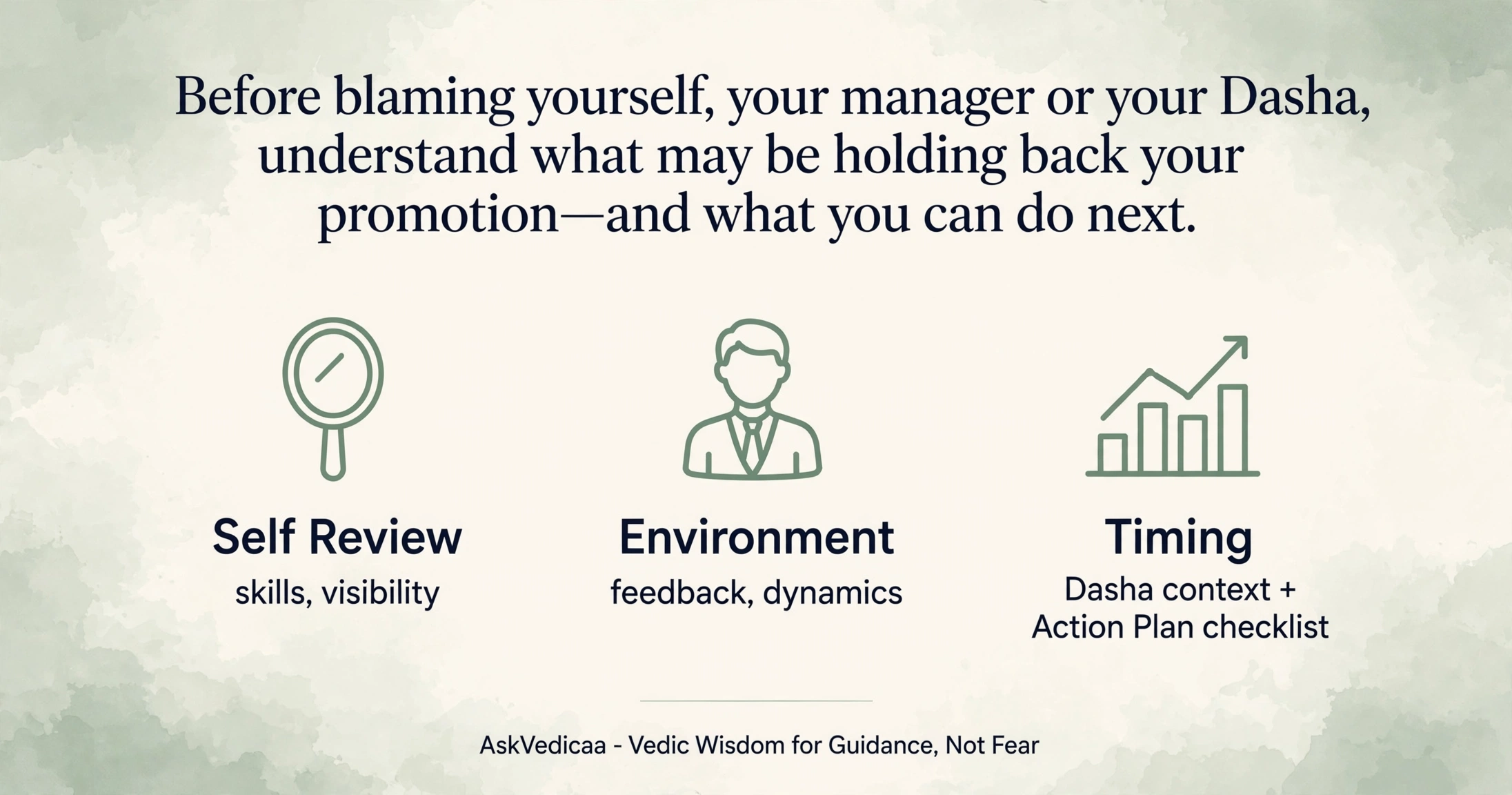
Why Promotion Keeps Getting Delayed
A delayed promotion can make you question your skills, your manager’s intentions and your future at work. But the reason may not be what you think. Promotion delays can result from organisational constraints, low visibility, gaps in next-level skills or workplace politics. Before blaming yourself or deciding to leave, ask your manager for clear promotion criteria, measurable expectations and a realistic review date. Track your achievements, demonstrate your impact and assess whether your organisation offers a genuine path forward. From a Vedic astrology perspective, the 10th house, relevant planetary influences and Mahadasha–Antardasha periods may offer a traditional framework for reflecting on career themes and timing. However, astrology cannot guarantee a promotion or determine an employer’s decision. A difficult planetary period is not a reason to stop taking action. The practical approach: understand the workplace evidence first, take steps within your control, and use personalised Vedic guidance only as an additional perspective when career direction or timing remains unclear.
Read article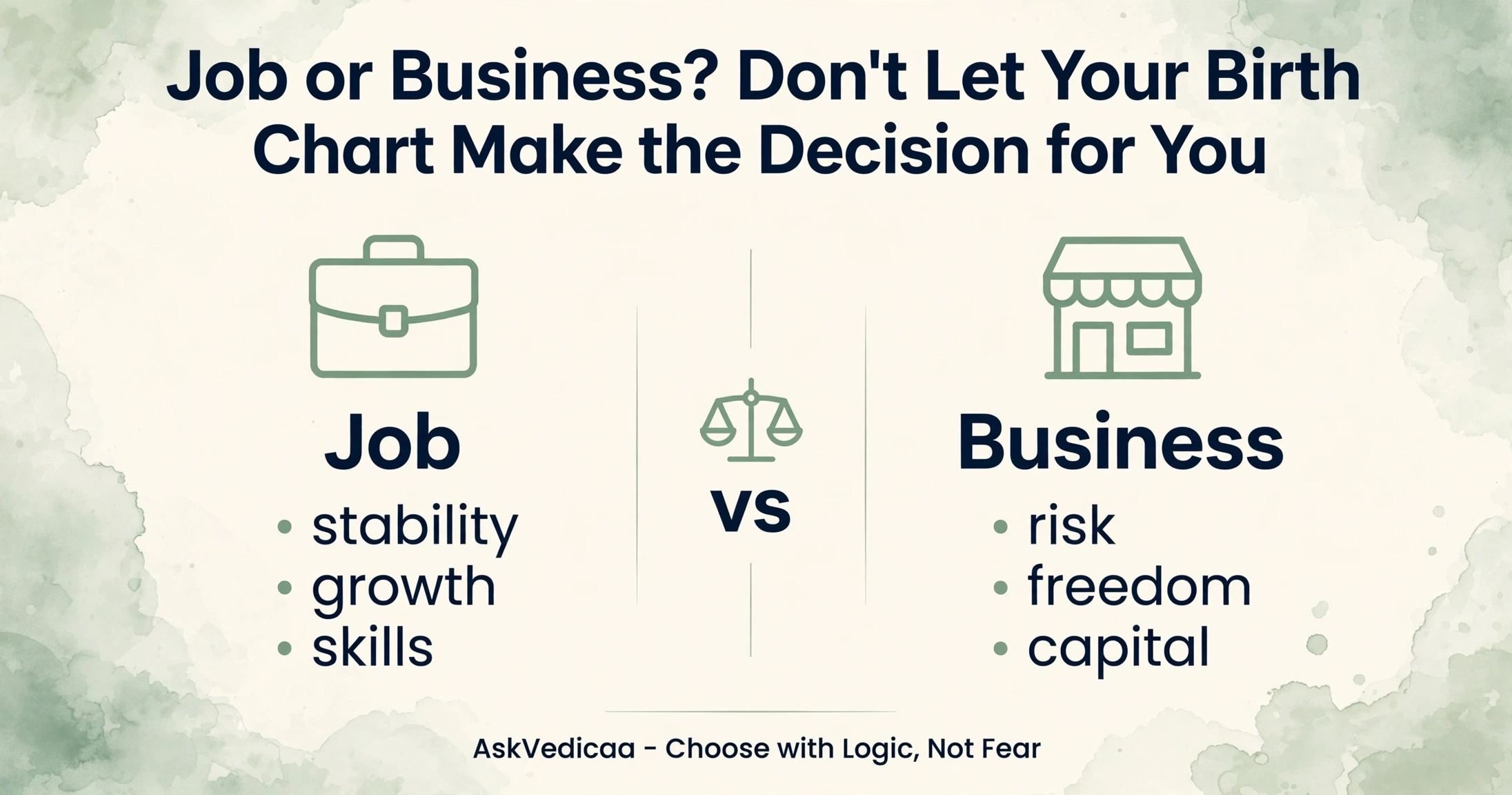
Job or business as per Vedic astrology
Vedic astrology traditionally examines the 6th, 7th and 10th houses, their lords, planetary influences and relevant Dashas when interpreting employment and business themes. These factors may provide a perspective on your professional preferences and timing. They cannot establish which path will make you successful. If you need stable income, have significant financial obligations or have not tested your business idea, keeping your job while preparing may be the more prudent option. If you have proven demand, sufficient financial runway and a clear plan, a business may be worth exploring. Do not resign because a chart tells you to. Build a case for the decision, then use astrology as a secondary perspective if it is meaningful to you.
Read article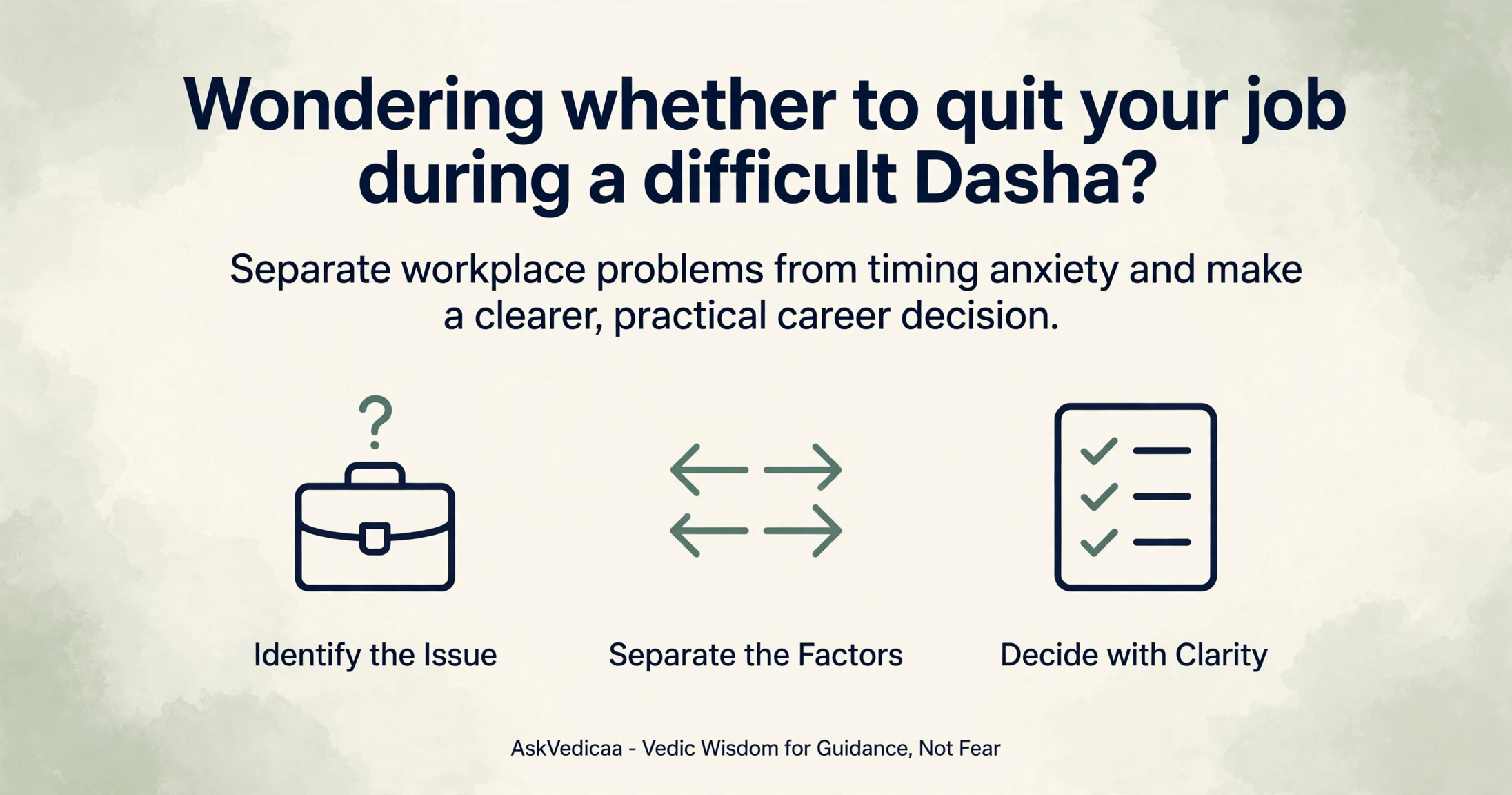
Quit Your Job in a Hard Dasha?
A difficult Dasha alone is not a sufficient reason to resign or remain employed. Identify the actual workplace problem, assess whether it can be improved, review your financial readiness and decide on a practical next step. Vedic astrology may provide a traditional perspective on career themes and timing. It cannot guarantee the outcome of resignation or determine whether a job is right for you. The goal is not to make a decision without fear. It is to make one without letting fear make the decision for you.
Read article
Why Do I Spend Money When I Feel Stressed?
You may spend money when stressed because shopping offers temporary distraction, anticipation or relief from uncomfortable emotions. Emotional spending becomes concerning when it is frequent, difficult to control or interferes with bills, savings and other priorities. Try identifying the feeling before buying, waiting 24 hours before non-essential purchases, tracking discretionary spending and finding other ways to manage stress. Vedic concepts such as artha and kama offer a reflective perspective on material wellbeing and desire, but they do not diagnose spending behaviour.
Read article
Why Do I Feel Uncomfortable Accepting Compliments
Feeling uncomfortable when someone compliments you may reflect learned habits, self-criticism, discomfort with attention or the belief that accepting praise is arrogant. Research suggests that people may struggle to accept positive feedback when it conflicts with their existing view of themselves. Vedic teachings on humility and self-study offer a complementary perspective. Try pausing before dismissing the compliment, saying thank you and considering whether the appreciation reflects something you genuinely did well.
Read article
Why Am I Afraid of Success?
Fear of success can arise when achievement brings concerns about responsibility, visibility, criticism, changing relationships or losing personal freedom. It does not necessarily mean you are incapable or pursuing the wrong goal. The Bhagavad Gita offers a perspective on purposeful action and attachment to outcomes, while dharma and artha provide a framework for reflecting on values and material progress. Identify your specific concern, assess the practical risks and take a manageable next step. The research also calls for an important nuance: fear of success is not necessarily one single psychological trait. Research has explored different concerns, including evaluation, anxiety, social consequences and the perceived costs of achievement. A 2026 study of emerging adults also examined associations between fear of success, self-efficacy and life satisfaction, but such associations do not establish causation.
Read article