
You have been doing the work. You have taken on more responsibility, delivered results and waited for the next step in your career.
Yet the promotion keeps getting delayed.
Perhaps your manager says, “You’re doing well, but it’s not the right time.” Maybe someone with less experience gets promoted before you. Or perhaps nobody explains what you need to do differently.
After a while, the questions become personal.
Am I not good enough? Is office politics holding me back? Is this simply a difficult phase in my career?
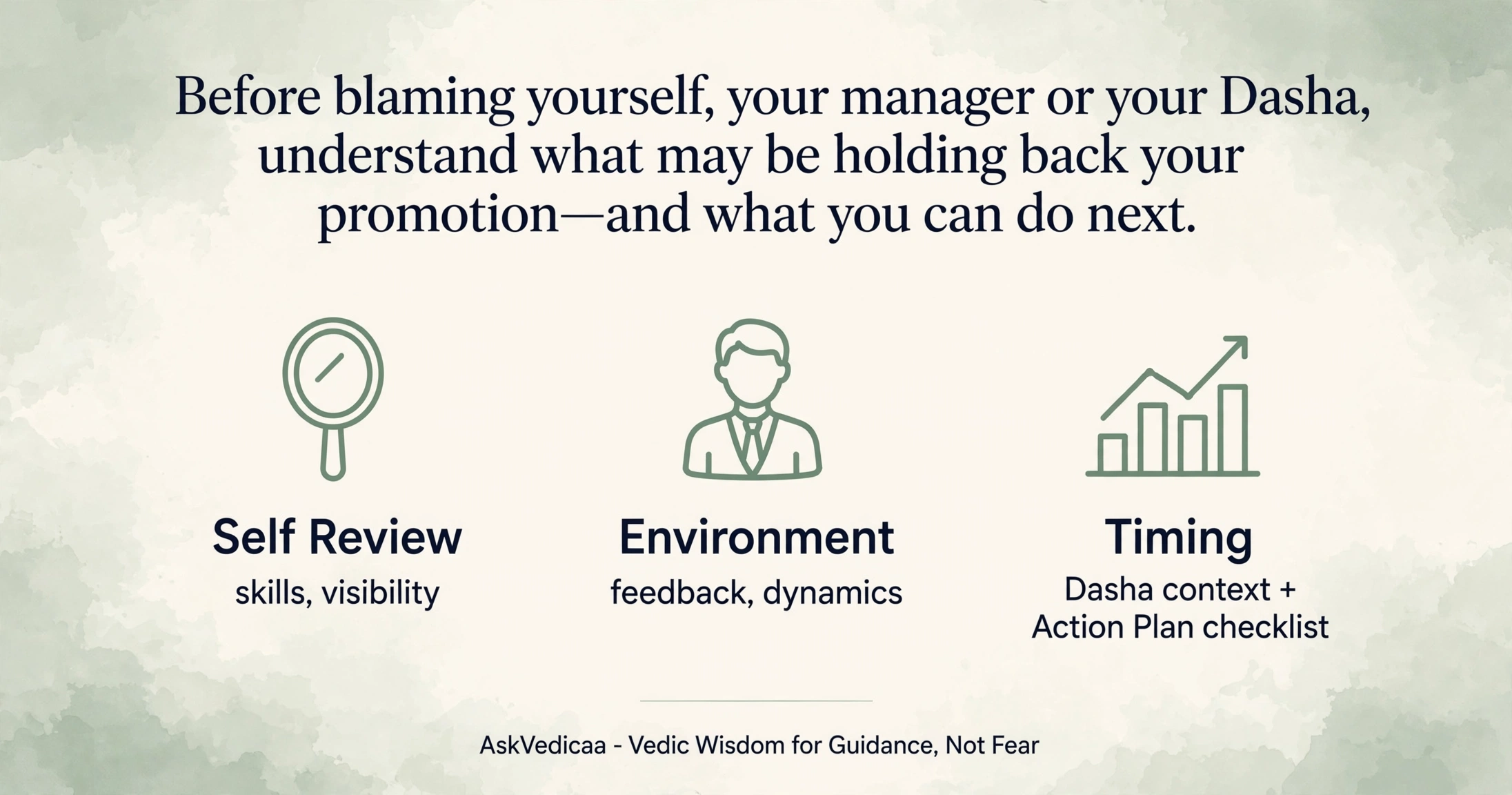
Before blaming yourself, your manager or your planetary period, separate the possible causes. Each one requires a different response.
Why does your promotion keep getting delayed?
A delayed promotion usually deserves investigation across four areas: organisational reality, visibility of your work, professional relationships and—if Vedic astrology matters to you—the traditional interpretation of career timing.
These factors can overlap, but they are not interchangeable. A chart cannot fix an unclear promotion policy, and working harder will not necessarily solve a lack of available positions.
1. The organisation may not have room for you
Sometimes, the problem is not your performance.
Your company may have a limited number of senior positions. Budgets may be frozen. A restructuring may have changed reporting lines, or leadership may be prioritising a different team.
You might be ready for the next level while the organisation is not ready to offer it.
What to check:
-
Have promotions been delayed across your team or department?
-
Is there an approved position at the next level?
-
Are the promotion criteria clear and consistently applied?
-
Has your manager explained the business constraints?
If several capable colleagues are facing the same delay, look at the system before assuming you are personally falling short.
2. Your work may be good, but your impact may not be visible
Being dependable is valuable. But there is a difference between doing excellent work and making its impact visible to decision-makers.
You may solve problems quietly, rescue difficult projects and help colleagues succeed. Yet the people involved in promotion decisions may not understand the scale of your contribution.
This is particularly common when someone assumes that hard work will automatically speak for itself.
It may not.
Try a visibility audit.
Write down three important contributions from the past six months. For each, record:
-
The problem you addressed.
-
What you personally contributed.
-
The result, using numbers where available.
-
How that result helped your team, customer or business.
Instead of saying, “I managed an important project,” explain what changed because you managed it.
The aim is not self-promotion for its own sake. It is to make your contribution clear enough to be evaluated fairly.
3. You may be meeting today's expectations, not demonstrating readiness for the next role
A promotion often requires evidence of a different level of responsibility, not simply more years in the same position.
An excellent individual contributor may need to demonstrate leadership. A strong manager may need to show broader business thinking. Someone seeking a senior role may need to influence decisions beyond their immediate team.
You could be performing well and still have a gap between your current responsibilities and the expectations of the next level.
That gap should be specific—not an endless instruction to “do more.”
Ask your manager:
“What are the two or three outcomes I need to demonstrate to be considered ready for the next level? How will we measure them, and when can we review my progress?”
Then ask for examples of what good performance at that level looks like.
If the answers remain vague, request clearer criteria in writing. You need a development plan, not an indefinite waiting period.
4. Workplace relationships and politics may be affecting the outcome
Promotion decisions are not always based on performance alone.
Trust, communication, sponsorship, reputation and the ability to work across teams can influence how decision-makers view a candidate. In some workplaces, unfair favouritism or inconsistent standards may also play a role.
But be careful about assuming politics is the explanation before you have evidence.
Look for patterns. Are promotion criteria applied differently to comparable employees? Are your contributions regularly overlooked? Are important decisions made without your involvement, even when your role should include you?
Build professional relationships beyond your immediate manager. Seek feedback from people who understand the next level. Keep a record of your contributions and important discussions.
If you see credible evidence of discrimination, retaliation or policy violations, consider the appropriate internal reporting or employee-support channels.
You cannot control every decision. You can, however, improve your understanding of how decisions are made and where you have room to act.
What does Vedic astrology say about delayed promotions?
In Vedic astrology, career interpretation commonly considers the 10th house and its lord, the 6th house, relevant planetary influences and the running Mahadasha and Antardasha. Depending on the question and the chart, a practitioner may also examine supporting divisional charts and relevant transits.
Saturn is traditionally associated with discipline, responsibility, sustained effort and delay. However, it is misleading to conclude that Saturn alone is responsible whenever a promotion does not happen.
A responsible reading considers the chart as a whole and explains the reasoning behind its interpretation.
A planetary period may be interpreted traditionally as a time for consolidating skills, handling greater responsibility or reassessing professional direction. That interpretation is not proof that a promotion will happen—or fail to happen—within a particular period.
Most importantly, a difficult Dasha does not mean you should stop asking for feedback, building skills or pursuing opportunities.
Use astrological timing as a possible perspective on your circumstances, not as an excuse to become passive.
What your chart cannot tell you
Even a detailed Vedic reading cannot establish with certainty:
-
Whether your manager will recommend you for promotion.
-
Whether your company has budget or an approved vacancy.
-
Whether another candidate will be selected.
-
Whether your organisation's evaluation process is fair.
-
The exact date on which a promotion will happen.
These questions depend on decisions and circumstances outside the birth chart.
Your professional record, workplace evidence and conversations with decision-makers remain essential.
A practical promotion checklist: What should you do now?
Before deciding whether to wait, push for change or explore another employer, answer these five questions.
1. Do I know the promotion criteria?
If not, ask for them. You cannot reliably close a gap that has never been explained.
2. Can I demonstrate results at the next level?
Identify evidence of greater scope, leadership, judgement or business impact—not just effort.
3. Have I had a direct conversation with my manager?
Ask what is holding the decision back, what must change and when progress will be reviewed.
4. Is there a realistic path forward here?
Find out whether a suitable position is likely to become available and whether your organisation has a credible development path for you.
5. What will I do if nothing changes?
Set a reasonable review date. If you continue to receive vague assurances without measurable progress, consider internal transfers, external opportunities or a role with clearer advancement prospects.
You do not have to resign immediately. But you also do not have to wait indefinitely.
A feedback script you can use with your manager
If you have been waiting for a promotion and do not know what is missing, try this:
“I’d like to understand where I stand regarding progression to the next level. Could we review the expectations for that role, identify any gaps in my current performance and agree on measurable outcomes? I’d also appreciate clarity on the decision process and when we can formally review my readiness.”
After the discussion, send a short written summary of the agreed actions and review date.
This creates a shared understanding of what needs to happen next. It also helps you distinguish between a genuine development opportunity and repeated postponement without a clear path.
When should you wait, and when should you reconsider?
Consider waiting with a plan when your manager provides specific feedback, a realistic development path exists and there is a credible date to review progress.
Push for greater clarity when the criteria keep changing, your contribution is not being recognised or the explanation for the delay remains vague.
Explore alternatives when you have repeatedly met agreed expectations but no realistic opportunity exists, or when the organisation offers no credible path forward.
These are practical decision signals, not guarantees. Your financial responsibilities, current job market, personal circumstances and available alternatives matter too.
Frequently asked questions
Why do I keep getting overlooked for promotion?
Possible reasons include limited vacancies, unclear promotion criteria, gaps in next-level skills, low visibility or workplace dynamics. Ask for specific feedback and look for evidence before deciding which explanation fits your situation.
Can office politics prevent a promotion?
Workplace relationships and perceptions can influence decisions, and unfair practices sometimes occur. Document your contributions, understand the formal process and seek advice through appropriate channels if you have evidence of unfair treatment.
Does Saturn delay promotions in Vedic astrology?
Saturn is traditionally associated with discipline, responsibility and gradual progress. Its interpretation depends on the full chart and relevant planetary periods. Saturn's influence should not be treated as a guaranteed explanation for a delayed promotion.
Should I change jobs if my promotion keeps getting delayed?
Not automatically. First establish whether the delay has a clear explanation and whether a credible path forward exists. If repeated discussions produce no measurable progress, exploring other opportunities can help you assess your options.
Can Vedic astrology predict when I will be promoted?
Vedic astrology offers traditional methods for interpreting career themes and timing. It cannot guarantee a promotion or determine an employer's decision with certainty. Use a reading as context alongside evidence from your workplace.
Your next step
A delayed promotion can leave you questioning your ability, your workplace and even your professional direction. But uncertainty is not evidence that you have failed.
Start by finding out what is actually holding you back. Make your results visible, ask for measurable feedback and establish a realistic review date.
If you have addressed the practical issues and still feel uncertain about career direction or timing, AskVedicaa can offer a personalised Vedic perspective on the question you are facing.
The purpose is not to tell you to wait because of a planetary period. It is to help you examine your circumstances more clearly while keeping your decisions in your own hands.
A promotion may be delayed for reasons you cannot control. Your next step should still be something you can choose.
Career Stagnation: Why You Feel Stuck