
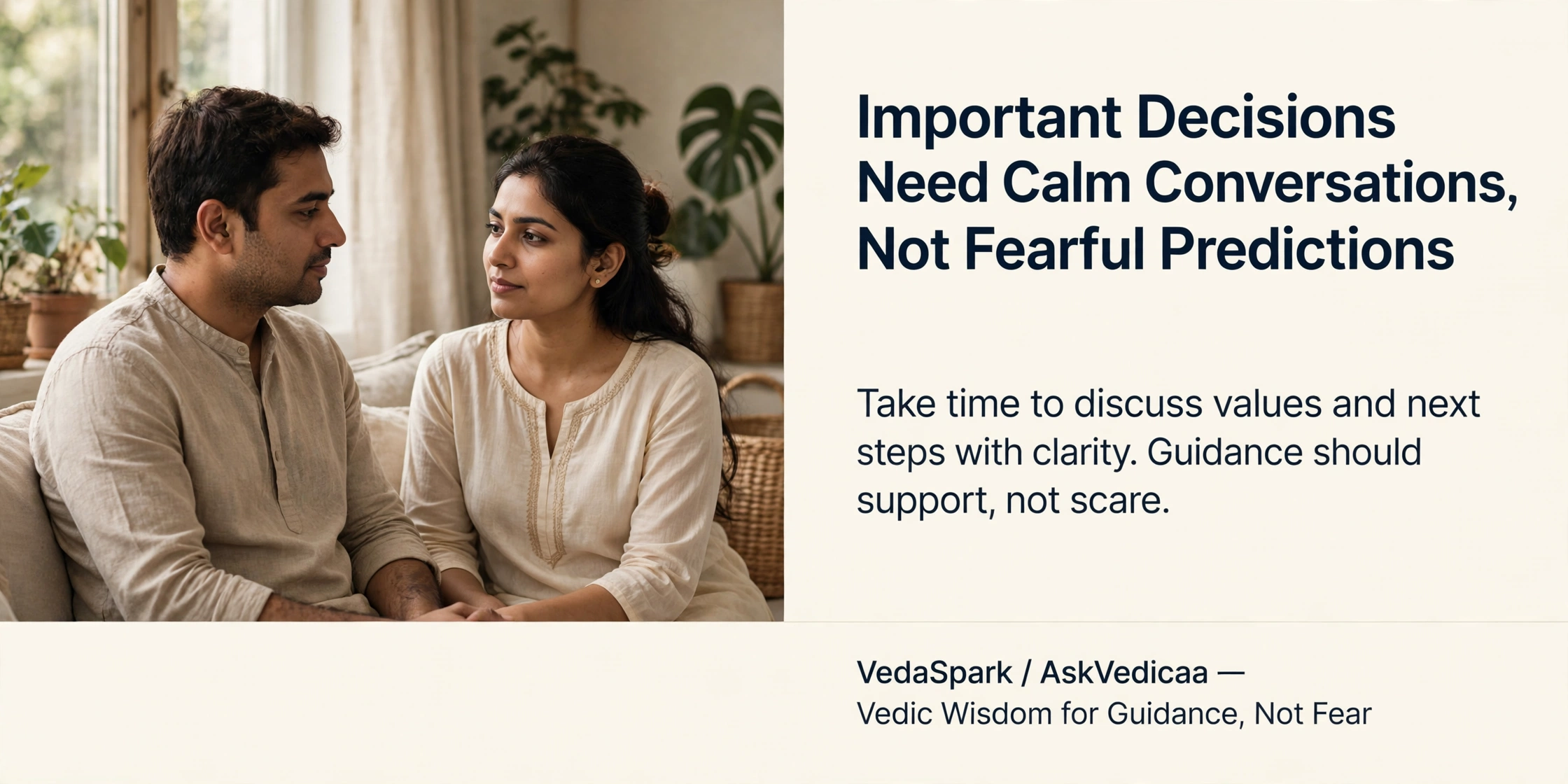
Is This the Right Person? When Chemistry and Kundli Scores Don't Match
When the report says one thing and your heart says another
You have met someone you genuinely like. Conversations feel natural. You look forward to their messages. Perhaps you have started imagining ordinary things together: where you might live, how you would spend weekends or what life could look like as a couple.
Then someone checks your Kundli.
The score is low. A relative becomes worried. Someone suggests that you reconsider before becoming too attached.
Now you are questioning something that felt promising.
Am I ignoring a warning? Will I regret this later? What if I walk away from the right person because of a number?
This is a difficult place to be because both choices seem to carry risk.
A Kundli matching score should not make the decision for you. Guna Milan offers one traditional perspective on compatibility, but a relationship also needs to be assessed through the people involved, their behaviour, their values and their readiness to build a life together.
The question is not whether you should blindly follow your heart or blindly follow the report. It is how to make a thoughtful decision when the two appear to disagree.
1. What does Kundli matching actually measure?
In many Vedic marriage-matching traditions, Guna Milan compares aspects of two birth charts using eight categories, commonly called the Ashta Koota system. These are traditionally associated with different dimensions of compatibility.
The resulting score is often presented out of 36 points. Families may use it as an initial reference when considering a marriage proposal.
But a score is a summary of a particular method. It is not a complete assessment of two people or a scientifically validated prediction of how their marriage will turn out.
A matching score cannot tell you with certainty:
-
Whether your partner will treat you with respect.
-
Whether you can discuss money without hostility.
-
Whether you share compatible expectations about children, careers and family responsibilities.
-
Whether either person will take responsibility after hurting the other.
-
Whether you will feel emotionally safe in the relationship.
These things become clearer through conversations, observation and experience.
A high score does not remove the need to ask difficult questions. A low score does not remove the need to understand what is actually happening between you.
2. What if your Kundli score is high but something feels wrong?
Imagine that your families are pleased with the matching score. The charts appear compatible, and everyone is encouraging you to proceed.
Yet you feel uneasy.
Perhaps the person dismisses your opinions, becomes controlling when you disagree or avoids conversations about the future. Maybe you feel that you must constantly prove your worth to earn their approval.
Do not ignore these experiences because a report looks favourable.
A high Kundli score cannot compensate for disrespect, dishonesty, coercion or an absence of trust.
Look at how the person behaves when things do not go their way. Can they listen without humiliating you? Can you express a different opinion without fearing their reaction? Do their actions match their promises?
Attraction matters. Traditional matching may matter to you and your family. But neither should be used to explain away behaviour that makes you feel unsafe or consistently undervalued.
3. What if the score is low but the relationship feels right?
Now consider the opposite situation.
You have met someone who listens to you, respects your independence and shares your hopes for the future. You can disagree without feeling threatened. You are able to talk about uncomfortable subjects.
Then the matching report raises concerns.
Before making a decision, find out what the report actually says and how the conclusion was reached. Is the concern based only on the total Guna Milan score? Does the astrologer explain the wider traditional interpretation, including its limitations? Are family members treating the score as an absolute verdict?
In Vedic astrology, some practitioners examine additional chart factors rather than relying exclusively on Guna Milan. Approaches vary, and interpretations are not guarantees of relationship outcomes.
It is reasonable to seek a careful explanation if astrology is important to you. It is not reasonable to turn uncertainty into a claim that your relationship is destined to fail.
Equally, do not dismiss every concern simply because you are emotionally invested. A low score should prompt a considered discussion if it matters to you—not an automatic rejection, and not an automatic excuse to ignore other problems.
4. Five questions that matter beyond the score
Before deciding whether to proceed, discuss these subjects with the person.
1. Do we share the same broad vision for life?
Talk about children, career ambitions, where you want to live, finances and responsibilities toward parents. You do not need identical preferences, but major differences need honest discussion.
2. Can we disagree respectfully?
Every couple experiences disagreements. Notice whether you can discuss them without insults, threats, manipulation or prolonged punishment through silence.
3. Do I feel free to be myself?
Can you express your opinions, maintain friendships, pursue your career and set reasonable boundaries? Or do you find yourself shrinking to avoid conflict?
4. Are we honest about difficult subjects?
Ask about debt, previous commitments where relevant, expectations around household responsibilities and anything that could materially affect married life. Avoiding these conversations does not make the differences disappear.
5. Can we repair problems together?
A healthy relationship is not one without conflict. It is one in which both people can acknowledge mistakes, listen and make genuine efforts to resolve them.
These questions cannot guarantee a successful marriage either. But they help you evaluate the relationship in ways a compatibility score alone cannot.
5. How to make a decision when the score and chemistry conflict
Use this simple decision filter before accepting or rejecting a proposal.
| What you observe | A sensible next step |
|---|---|
| High score, but repeated disrespect or dishonesty | Take the behaviour seriously. Do not let the score override your safety or judgment. |
| Low score, but strong mutual respect and shared values | Understand the report's limitations and discuss the concern without rushing. |
| Low score and unresolved differences about children, finances or family roles | Address the real-life differences directly before making a commitment. |
| High score and genuine uncertainty about compatibility | Continue asking questions. A favourable score is not a substitute for knowing the person. |
| Family pressure is making the decision for you | Ask for time and make space for an honest assessment of the relationship. |
If you feel pressured to decide immediately, slow the process down where possible. A decision about marriage deserves enough time for both people to understand what they are agreeing to.
If there are threats, coercion or abuse, prioritise your safety and seek appropriate support. A matching score should never be used to justify remaining in an unsafe relationship.
6. Where can personalised Vedic guidance help?
Sometimes the difficult part is not the score itself. It is understanding what to do with the uncertainty it creates.
You may want to know how a traditional astrologer interprets the matching results, whether the report considers more than Guna Milan, or which questions deserve attention before the marriage decision.
Personalised Vedic guidance can offer a framework for exploring those questions. It should explain the reasoning behind its interpretation and acknowledge what cannot be established from a chart.
It cannot guarantee marital happiness, determine another person's character with certainty or make the decision on your behalf.
If astrology is part of your decision-making, use it alongside what you know about the relationship—not instead of that knowledge.
Before you say yes or walk away, get clarity on your actual concern
Perhaps the score has made you doubt a relationship you value. Perhaps your family is worried and you do not know how to respond. Or perhaps the report is favourable, but something in the relationship still troubles you.
You do not have to make a lifelong decision from a single number—or from the fear of losing someone.
AskVedicaa offers personalised Vedic guidance based on your question and birth details. If you are struggling to reconcile your relationship experience with your Kundli matching report, use it to explore the astrological perspective, understand the questions that remain and consider your next step more carefully.
You may already know that you care about this person. What you need now is not another voice telling you to obey your heart or fear your chart. You need a clearer way to think about the decision in front of you.
Bring your question to AskVedicaa, then weigh the interpretation against your conversations, shared values, lived experience and judgment.
The goal is not to find a score that makes the decision for you. It is to move forward knowing why you are making it.
Frequently asked questions
Is a low Kundli matching score a reason to reject someone?
Not by itself. Guna Milan is one traditional compatibility assessment. Consider the interpretation in context, alongside values, behaviour, communication and practical compatibility. No score can guarantee or rule out a successful marriage.
Is a high Kundli matching score enough for a happy marriage?
No. A high score does not guarantee trust, respect, emotional safety or shared goals. Those aspects require real conversations and observation.
What is Guna Milan in Vedic astrology?
Guna Milan is a traditional method of comparing birth charts for marriage compatibility. In the commonly used Ashta Koota system, eight categories contribute to a score out of 36. The score represents that method of assessment, not a complete prediction of married life.
Should I trust my feelings or my Kundli matching report?
Neither should automatically overrule everything else. Feelings can be influenced by attraction and anxiety, while a matching report has limits. Assess the relationship through behaviour, shared values and honest conversations, and consider the astrological interpretation as one perspective if it matters to you.
Can Vedic astrology predict whether a marriage will succeed?
Vedic astrology offers traditional interpretations of compatibility and relationship themes, but these are not scientifically established guarantees of marital outcomes. A chart cannot establish with certainty how two people will behave or whether their marriage will succeed.
What should I do if my family opposes my relationship because of Kundli matching?
Ask them to explain their specific concerns, and distinguish the astrological concern from practical questions about compatibility. If astrology is important to you, you may seek a careful second interpretation. Make space for your own judgment, and do not let pressure force you into either marriage or separation.
Manglik Dosha Explained: The Truth About Mars and…