
Job Timing: What Astrology Can Promise — and What It Absolutely Can’t
Preparing for a government job can take years. You study after work, sacrifice weekends, wait for notifications and sit through competitive examinations where even well-prepared candidates may not succeed.
When the result does not go your way, it is natural to wonder: Was my timing wrong? Will I ever get selected? Should I attempt the exam again?
Vedic astrology may offer a traditional framework for reflecting on career-related periods and choosing when to focus your efforts. But it cannot guarantee selection, replace preparation or tell you to keep attempting an examination indefinitely.
The important distinction is this: use astrology, if it is meaningful to you, to reflect on timing—not to predict a result with certainty.
Why government job aspirants look for astrological timing
Government employment can represent more than a salary. For many families, it means stability, social respect, predictable benefits and a sense of having secured the future.
That is why repeated unsuccessful attempts can feel deeply personal. You may start questioning your ability, your luck or whether you are meant for this path.
Astrology can become attractive because it appears to offer a clear answer to an uncertain question.
But be careful of any interpretation that says you will definitely get a government job in a particular year, or that you should abandon your preparation because your current planetary period is unfavourable.
Neither conclusion is justified by timing alone.
A more useful approach is to separate three questions:
-
Can I realistically compete for this job? This depends on eligibility, preparation and the selection process.
-
Should I attempt again? This depends on your progress, available opportunities, constraints and alternatives.
-
How might I use astrological timing? If you follow Vedic astrology, it may provide a traditional perspective—but not a guaranteed outcome.
What Vedic astrology traditionally examines
Vedic astrologers may consider several chart factors when examining government employment and career prospects. Interpretations vary by tradition and practitioner, so no single factor should be treated as a definitive answer.
The 10th house: Career and public responsibility
The 10th house is traditionally associated with career, professional standing, responsibilities and public activity.
An astrologer may examine the house, its lord and relevant planetary influences when discussing career direction. However, these factors do not independently establish that someone will secure a government position.
The 6th house: Service, competition and routine
The 6th house is traditionally associated with service, effort, competition, obligations and the handling of challenges.
In a government-job reading, an astrologer may consider its relationship with career indicators. This is an interpretive framework, not a substitute for examining your actual examination performance.
The 11th house: Goals and gains
The 11th house is traditionally connected with gains, fulfilment of ambitions and the results of sustained efforts.
An astrologer may assess its relationship with career-related factors. It would be misleading, however, to interpret a single house or planetary combination as proof of selection.
Mahadasha and Antardasha: Interpreting timing
Vedic astrology uses planetary periods called Mahadasha and Antardasha to interpret different phases of life.
A practitioner may examine these periods alongside the broader chart to discuss whether a phase is traditionally interpreted as supportive of career development, demanding sustained effort or encouraging a reassessment of direction.
But a favourable period does not guarantee an appointment. Likewise, an unfavourable interpretation does not prove that you will fail.
A timing interpretation is not an examination result.
What does a “favourable period” actually mean?
This is one of the most important questions to ask before relying on an astrological reading.
A favourable period, within a traditional interpretation, may suggest that certain career themes are considered more supportive at that time. It does not mean that the selection process will become easy, that competition will disappear or that preparation is less important.
Consider two candidates.
-
Candidate A is in a period an astrologer considers favourable but has weak fundamentals and performs poorly in mock examinations.
-
Candidate B is in a period interpreted as challenging but has strong preparation, meets every eligibility requirement and consistently scores above the expected cut-off range in practice tests.
The astrological interpretation alone cannot establish which candidate will be selected. Their preparation, examination performance and the actual selection process matter.
This is why a responsible reading should explain its reasoning, acknowledge uncertainty and avoid making guarantees.
Should you attempt the examination again or pause?
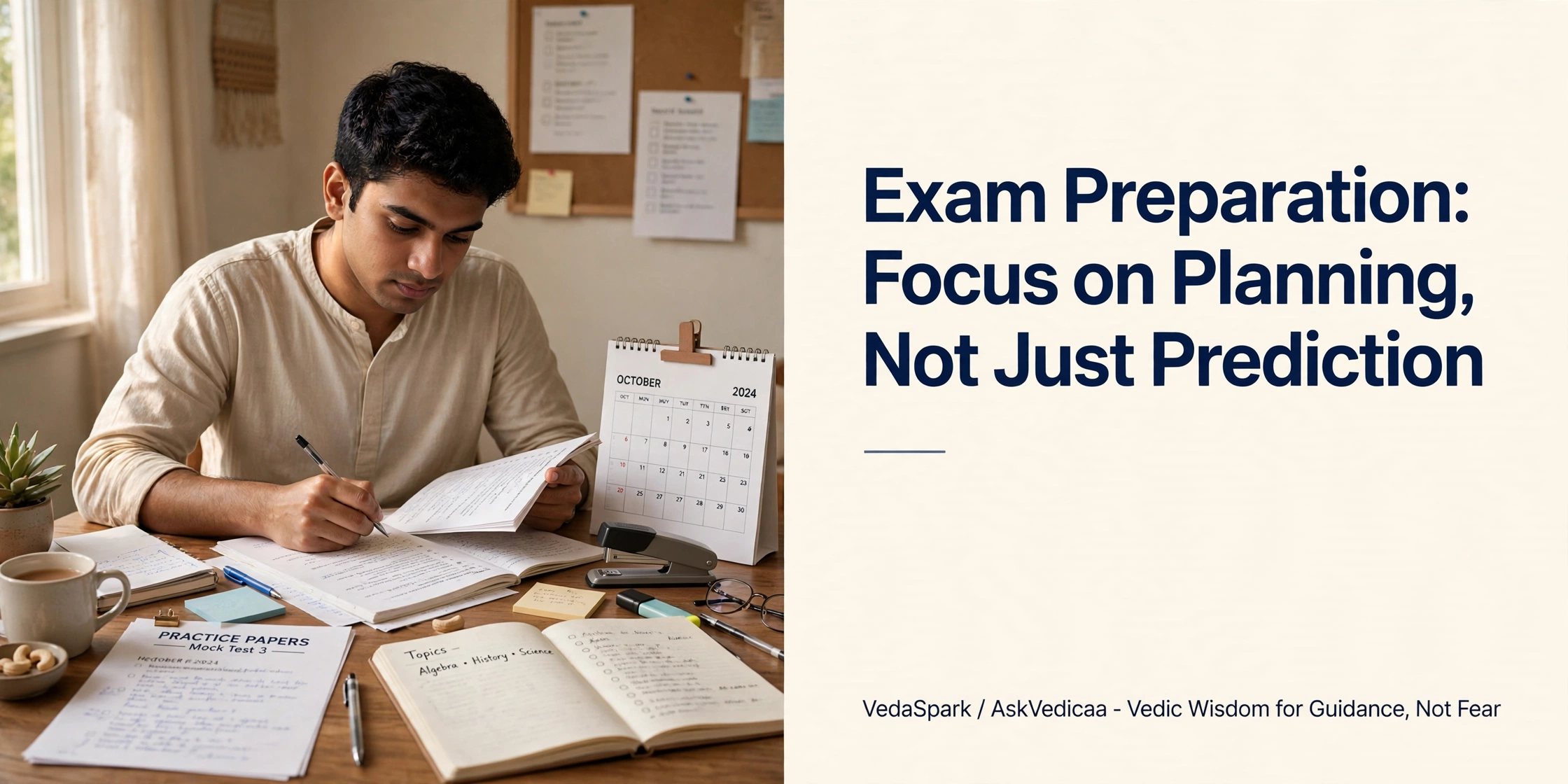
Rather than asking astrology to make the entire decision, begin with evidence from your preparation.
Your performance is improving
You meet the eligibility requirements, your mock scores are moving towards the required range, and you can identify specific areas to improve. A further attempt may be reasonable if the time and financial commitment are manageable.
Effort is high, but results are not improving
Review your preparation method, weak subjects, time management and examination strategy. Consider structured coaching or targeted practice if appropriate. Repeating the same approach may not be enough.
The cost of continuing is becoming too high
If you are approaching an age or attempt limit, struggling financially, or seeing little progress despite sustained preparation, compare the remaining opportunities with other career options. Pausing or changing direction is not a personal failure.
These are practical decision signals, not guarantees. The right choice depends on the particular examination and your circumstances.
The five-point checklist before your next attempt
Before deciding to continue, pause or change your approach, answer these five questions honestly.
1. Am I eligible for the next attempt?
Check the official notification for age limits, qualifications, category-specific rules and the number of permitted attempts. Never rely on an astrological interpretation to establish eligibility.
2. What do my mock-test scores tell me?
Review your scores across several practice tests. Identify your strongest and weakest areas, and compare your performance with credible previous cut-offs where available. Remember that cut-offs vary by examination, year, category and vacancy.
3. What will I do differently?
Write down two or three concrete changes to your study plan. These might include improving a weak subject, taking timed tests, revising more systematically or getting feedback on your preparation.
4. Can I afford another preparation cycle?
Consider savings, household commitments, income requirements and the time available before the next examination. If necessary, explore employment or another income source alongside preparation.
5. What is my review point?
Set a date to evaluate progress. For example, review your mock-test trend after a defined preparation cycle rather than continuing indefinitely without measurable evidence of improvement.
Your answers should form the basis of your decision. Astrological timing, if you choose to consider it, comes after these practical checks.
When can astrology be useful in this decision?
Astrology may be meaningful to you as a way of reflecting on professional direction, periods of effort or when to reassess your plans.
For example, you might use a chart reading to explore whether your current priorities are consistent with your longer-term career goals. You might also want to understand how a practitioner interprets career-related planetary periods.
But the reading should help you ask better questions—not remove your responsibility to answer them.
A responsible interpretation should distinguish traditional astrological principles from verified facts about your situation. It should not invent planetary-period dates, promise selection or encourage repeated attempts without considering your circumstances.
If the practical evidence suggests that you need to change your preparation, changing your preparation is more useful than waiting for a different planetary period.
What astrology cannot promise
No chart reading can reliably guarantee:
-
Selection in a specific examination or year.
-
A particular rank, cut-off score or interview outcome.
-
That a government vacancy will be available when you are ready.
-
That a favourable planetary period will compensate for inadequate preparation.
-
That continuing to attempt the examination is better than pursuing another career.
Selection depends on a process involving eligibility, performance, competition, vacancies and applicable rules. These factors cannot be replaced by an astrological interpretation.
Be cautious of anyone who guarantees a government job or uses fear about an unfavourable period to pressure you into purchasing remedies or additional services.
Frequently asked questions
Can Vedic astrology predict a government job?
Vedic astrology offers traditional methods for interpreting career themes and timing. It cannot guarantee that you will secure a government job or establish the outcome of a competitive examination with certainty.
Which houses are considered for government jobs in Vedic astrology?
Practitioners commonly examine the 10th house for career, the 6th for service and competition, and the 11th for gains and ambitions, alongside other relevant chart factors. Interpretations depend on the complete chart and the practitioner's method.
Should I avoid government examinations during a difficult Dasha?
Do not automatically avoid an examination because of a planetary period. Check your eligibility, preparation, examination schedule and practical circumstances. Astrological timing can be optional context, not a reason to abandon a viable opportunity.
Does a favourable Dasha guarantee selection?
No. A favourable period within an astrological interpretation is not a guarantee of selection. Your preparation, performance, eligibility and the actual selection process remain essential.
When should I stop preparing for government jobs?
Consider reassessing when you have little measurable improvement, limited attempts or time remaining, mounting financial pressure or stronger alternative opportunities. Review the evidence and your personal circumstances rather than continuing solely because you have already invested years.
Your next step
If you are preparing for a government job, your immediate task is not to find a perfect prediction. It is to make your next attempt—or your decision to pause—as informed as possible.
Review your eligibility, mock-test performance, preparation gaps and financial runway. Set a clear point at which you will assess progress and decide what comes next.
If you have completed this practical assessment and still want to explore the question of career timing, AskVedicaa can offer a personalised Vedic perspective. Treat that perspective as an additional lens, not a promise of selection.
Your future should not depend on a prediction alone. Let preparation guide your effort, evidence guide your decisions and astrology remain a matter of informed personal choice.