Understanding Emotional Spending Through Vedic Wisdom
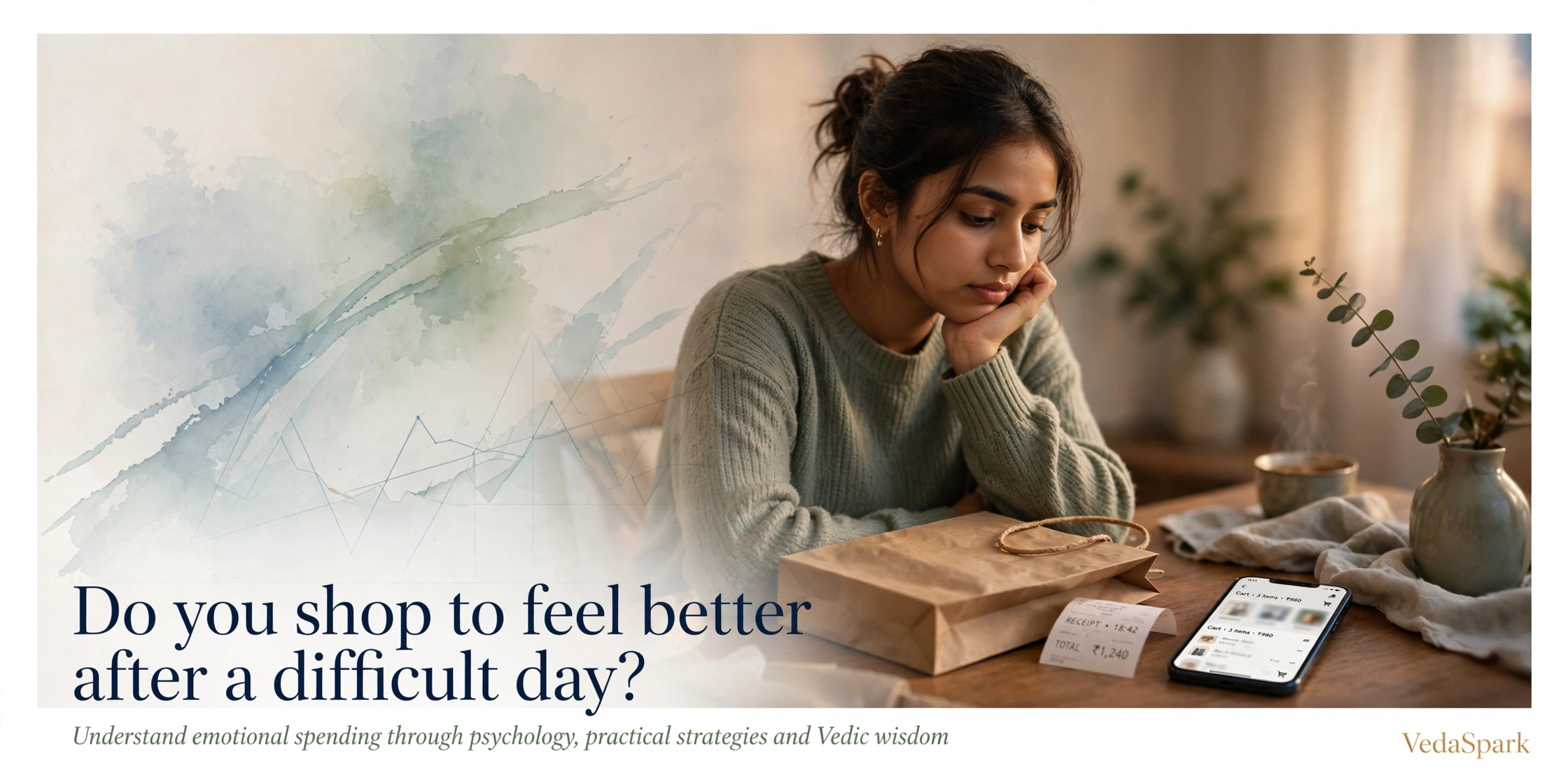
You have had a difficult day. Work has been exhausting, an argument has left you upset, or you simply feel that you deserve something good.
So you order something online.
For a few minutes, you feel better. There is something to look forward to, something new to open or a small reward after a demanding day.
Then the excitement fades. Sometimes, you even wonder why you bought it.
Why do you spend money when you feel stressed, even when you know you do not really need anything?
One possible explanation is emotional spending: buying things partly to change how you feel rather than because you genuinely need or want the item itself. Occasional treats are normal. The concern arises when shopping becomes your regular response to stress, sadness, boredom or frustration—and starts affecting your finances.
Why Do You Shop When You Feel Bad?
Spending is not always a purely practical decision. It can also become a way of responding to uncomfortable emotions.
You might recognise these patterns:
-
Stress spending: Shopping after a difficult day to feel temporary relief.
-
Reward spending: Buying something because you believe you deserve a treat.
-
Boredom spending: Browsing shopping apps for stimulation or excitement.
-
Comfort spending: Purchasing things when you feel lonely, disappointed or unsettled.
-
Social spending: Spending to keep up with friends, colleagues or lifestyles you see online.
These behaviours do not automatically indicate a problem. Enjoying a purchase is normal.
The concern is when spending becomes your default emotional response, especially when you repeatedly regret purchases or struggle to meet your financial priorities.
Why Does Shopping Feel Good at First?
A purchase can offer anticipation, novelty and a sense of control. When life feels difficult, choosing something new can provide a temporary change in mood.
Research published in Comprehensive Psychiatry in 2024 reviewed 16 studies examining stress and compulsive buying-shopping disorder. The review found evidence of an association between stress and problematic buying behaviour, although the studies varied and much of the evidence could not establish cause and effect. This does not mean ordinary shopping is a disorder.
For some people, the pattern looks like this:
Stress → shopping urge → purchase → temporary relief → regret or renewed discomfort.
The original problem may still be there after the excitement fades.
The useful question is not simply, “How can I stop shopping?” It is, “What am I trying to feel, avoid or change when I shop?”
What Does Vedic Wisdom Say About Desire and Money?
Vedic philosophy offers a framework for reflecting on material wellbeing, desire and deliberate action.
Artha, one of the four Purusharthas, concerns material resources, security and the means to sustain life. Material wellbeing is a legitimate part of life. The broader framework also includes dharma, kama and moksha.
Kama broadly concerns desire and enjoyment. The practical question is not whether you should enjoy material things, but whether your choices support a balanced life.
In Bhagavad Gita 2.62, the progression from repeatedly contemplating sense objects to attachment and desire is discussed.
Applied as a reflective exercise—not as a direct statement about modern shopping—the teaching invites you to notice how repeatedly thinking about something can strengthen the desire to possess it.
You see a product. You imagine how good it would feel to own it. You revisit it several times. Eventually, buying it feels almost automatic.
The goal is not to eliminate pleasure. It is to create space between desire and action.
Five Practical Ways to Change Emotional Spending
1. Identify the feeling before buying
Before a non-essential purchase, pause and ask: “What am I feeling right now?”
Are you bored, frustrated, lonely, tired or disappointed?
You do not need to judge the feeling. Naming it can help you distinguish an emotional urge from a genuine need.
2. Create a waiting period
Consider waiting 24 hours before making a non-essential purchase. For larger purchases, use a longer period that fits your budget.
Ask yourself whether you still want the item and whether it supports your priorities.
The aim is not to forbid yourself from buying things. It is to create space between the urge and the decision.
3. Find another way to meet the need
If you shop when stressed, try a short walk, music or a conversation with someone you trust.
If boredom triggers shopping, choose an activity that genuinely engages you.
If purchases are your reward after a difficult day, plan treats that fit your budget.
Different emotions may need different responses.
4. Make your money visible
Set a realistic budget for discretionary spending and review purchases regularly.
Notice which purchases you genuinely value. Consider removing saved payment details or shopping notifications if they encourage unplanned buying.
These small changes can make it easier to follow your own intentions.
5. Treat a setback as information
If you make an unplanned purchase, examine what happened beforehand.
Were you tired? Had something upsetting occurred? Were you browsing without a clear purpose?
Use the experience to identify a trigger rather than labelling yourself irresponsible.
If spending feels uncontrollable or causes significant debt, distress or relationship conflict, consider speaking with a qualified financial counsellor or mental-health professional.
Can Vedic Astrology Explain Emotional Spending?
Vedic astrology offers a traditional framework for reflecting on material priorities, desires and personal tendencies.
Depending on the question, a Vedic astrologer may examine the 2nd house in relation to accumulated resources, the 11th house in relation to gains and aspirations, and the 5th house in relation to judgement and discernment. Venus may be considered in discussions of pleasure and enjoyment, while Jupiter may be examined in relation to growth and values.
A broader reading may also consider the complete birth chart and current Mahadasha and Antardasha.
However, no single planetary placement can establish why you spend impulsively. Astrology should not replace a practical review of income, expenses, debt, spending triggers and financial goals.
The most useful question is not whether a planet makes you spend. It is how you can understand your behaviour and make choices that support your wellbeing.
AskVedicaa: Understand the Pattern Behind Your Choices
Sometimes, the question is not simply, “How can I spend less?”
It is: “Why do I keep reaching for shopping when I am stressed, and what might help me change that pattern?”
AskVedicaa lets you explore personal questions through a Vedic framework and ask follow-up questions connected to your circumstances.
You might explore how you approach material security, what your current planetary period traditionally represents or how to reflect on your priorities during a period of change.
Your question. Your birth chart. Your context.
Use Vedic perspectives as a source of reflection—not as a substitute for practical financial planning or personal responsibility.
You do not have to give up the things you enjoy. You can learn to choose them consciously, rather than relying on them to make difficult feelings disappear.
Quick Answer: Why Do I Spend Money When I Feel Stressed?
Emotional spending occurs when buying things becomes a way to manage feelings such as stress, boredom, loneliness or disappointment. Shopping may provide temporary pleasure or relief, but repeated purchases can lead to regret or financial strain. To change the pattern, identify your triggers, introduce a waiting period for non-essential purchases, create a realistic discretionary budget and find other ways to meet the underlying emotional need. Vedic concepts such as artha and kama offer a framework for reflecting on material wellbeing and enjoyment, but they do not diagnose spending behaviour.
Frequently Asked Questions
Is emotional spending the same as compulsive shopping?
No. Emotional spending describes purchases influenced by feelings. Compulsive buying involves more persistent difficulty controlling buying behaviour and may cause significant distress or harm. If you repeatedly cannot control spending despite serious consequences, professional support may help.
Why do I shop when I am sad or stressed?
Shopping can offer distraction, anticipation or temporary pleasure. If it repeatedly helps you avoid uncomfortable feelings, the behaviour may become a habit.
How can I stop impulse buying?
Identify common triggers, wait before making non-essential purchases, limit shopping notifications and track discretionary spending. Choose changes that are realistic enough to maintain.
What does Vedic wisdom say about money and desire?
Vedic concepts such as artha and kama provide a framework for considering material wellbeing and enjoyment alongside other life aims. The Bhagavad Gita also invites reflection on the relationship between attention, attachment and desire.
Can Vedic astrology predict my spending habits?
Vedic astrology offers a traditional interpretive framework for reflecting on resources and desires. It cannot reliably diagnose compulsive spending or replace an evidence-based assessment of your financial behaviour.
Before life’s biggest decisions, ask Vedicaa. Chart-backed guidance rooted in authentic Vedic wisdom—and translated into your next practical step.
You never know what can happen
Why Does Life Feel Empty Even When Everything Is…
1. Scientific research
Thomas, T. A., Schmid, A. M., Kessling, A., Wolf, O. T., Brand, M., Steins-Loeber, S., & Müller, A. (2024). “Stress and compulsive buying-shopping disorder: DOI: https://doi.org/10.1016/j.comppsych.2024.152482
2. Hindu scripture
The Bhagavad Gita, Chapter 2, Verse 62 (BG 2.62). Read the verse: Bhagavad Gita 2.62 — Gita Supersite