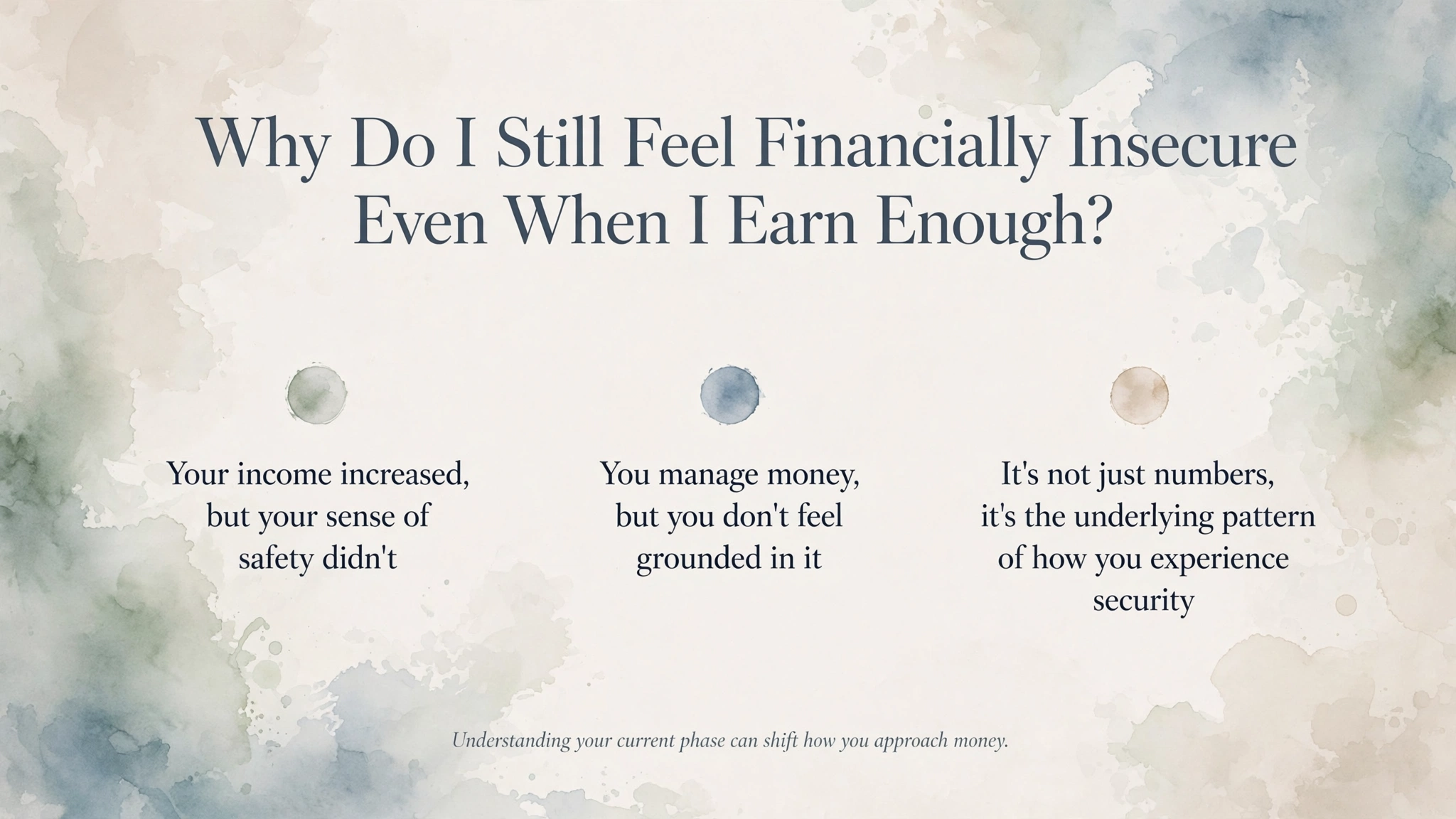
You earn a decent income.
Your bills are paid.
You may even have savings.
From the outside, there is no obvious financial crisis.
Yet you still check your bank balance.
You still worry about the future.
A large expense makes you uncomfortable.
You hesitate before spending money on yourself.
And somewhere in your mind is the question:
“What if I don't have enough later?”
This is a strange kind of financial anxiety.
Because your actual financial situation and your emotional experience of money don't seem to match.
You may be earning more than you did five years ago.
But you don't necessarily feel more secure.
That raises a deeper question:
Is financial security only about how much money you have—or also about how safe you feel having it?
Earning More Does Not Automatically Create Security
There is a common assumption:
More income = less financial anxiety.
Sometimes it works.
Sometimes it doesn't.
Income rises.
Lifestyle rises.
Expectations rise.
Responsibilities rise.
Then the definition of “enough” moves again.
You earn ₹50,000 and worry about ₹70,000.
Then you earn ₹1 lakh and worry about ₹1.5 lakh.
Then ₹2 lakh feels necessary.
The number changes.
The anxiety remains.
This is sometimes called lifestyle inflation, but there can be something deeper underneath it.
You may not actually be chasing money.
You may be chasing the feeling of safety that you believe money will eventually provide.
What Does Financial Insecurity Actually Feel Like?
It can look very different from obvious financial hardship.
You might:
-
constantly worry about unexpected expenses
-
feel guilty spending on yourself
-
save aggressively but still feel unsafe
-
compare your wealth with people around you
-
avoid financial decisions because they feel risky
-
feel that one setback could destroy your security
-
keep thinking you should have accumulated more by your age
-
struggle to enjoy money even after earning it
You may technically be doing well.
But internally, you are still preparing for disaster.
Where Did Your Money Beliefs Come From?
Before looking at your income, look at your history.
What did money mean in your family?
Was it scarce?
Was there frequent financial uncertainty?
Did your parents argue about money?
Were you taught that spending was dangerous?
Did you see someone lose everything?
Were you praised for being financially responsible?
Did you grow up believing:
“You never know what can happen.”
These experiences can shape your relationship with money long after your circumstances improve.
Your bank balance may have changed.
Your emotional relationship with money may not have.
The Difference Between Financial Prudence and Financial Fear
Saving money is sensible.
Planning for emergencies is sensible.
Investing for the future can be sensible.
But there is a difference between:
“I am preparing responsibly.”
and
“I will never be safe unless I accumulate more.”
The first creates preparedness.
The second can create permanent scarcity.
You can have ₹10 lakh and feel terrified.
Someone else can have less and feel relatively secure.
This doesn't mean one person is financially smarter.
It means money is partly a psychological experience, not just a number.
Vedic Wisdom Has a Different Question
Vedic thought does not treat wealth simply as accumulation.
One of the four Purusharthas is Artha—material prosperity, resources and the ability to support life and responsibilities.
Artha matters.
Money matters.
Material stability matters.
But wealth exists within a larger framework of life.
The question is not simply:
“How much can I accumulate?”
It can also be:
“What is wealth meant to support in my life?”
That distinction can completely change your relationship with money.
Your Wealth Story Is Not Only About Income
From a Vedic perspective, financial matters can be explored through the broader horoscope.
Traditionally, several houses are particularly relevant.
2nd House
Associated with accumulated wealth, family resources, possessions and financial sustenance.
11th House
Associated with gains, income, networks and fulfilment of material desires.
5th House
Can be relevant to intelligence, judgement, creativity and certain forms of financial decision-making.
9th House
Associated with fortune, higher principles, blessings and opportunities.
10th House
Relates to profession, work, reputation and the actions through which resources may be generated.
But one house never tells the complete financial story.
The condition of relevant houses, their lords, planets, aspects and the overall chart must be considered together.
What About Jupiter, Venus and Saturn?
Different planets can become relevant to financial questions for different reasons.
Jupiter is traditionally associated with expansion, wisdom, prosperity and abundance.
Venus can relate to comforts, resources, enjoyment and material refinement.
Saturn is associated with discipline, responsibility, delay, structure and sustained effort.
But avoid simplistic astrology such as:
“Jupiter means you will be rich.”
or
“Saturn means you will struggle financially.”
Neither is responsible interpretation.
A planet's significance depends on its role in the individual horoscope.
Sometimes the Issue Is Not Wealth. It Is Timing.
You may be financially capable but wondering:
“Why does money feel harder during this phase?”
This is where Mahadasha and Antardasha can add a timing dimension.
A planetary period may coincide with greater focus on:
-
income
-
expenses
-
career
-
assets
-
family responsibilities
-
financial restructuring
-
delayed gains
-
new opportunities
The purpose of looking at timing is not to promise a specific amount of money.
It is to understand which financial themes may deserve attention during a particular phase.
Stop Asking Only “How Much Money Do I Need?”
Try a better question:
“What does financial security actually mean to me?”
For one person, it means six months of emergency savings.
For another, it means owning a home.
For another, it means freedom from debt.
For someone else, it means being able to support parents.
And for another, it means having enough freedom to leave a job they dislike.
Without defining security, you can spend your entire life accumulating toward an undefined target.
Three Money Questions Worth Answering
1. What number would genuinely make me feel safer?
Be specific.
2. What is this money supposed to protect?
Your family?
Your independence?
Your lifestyle?
Your future?
3. What am I sacrificing while trying to feel secure?
This is the uncomfortable one.
Are you postponing every pleasure?
Avoiding reasonable risks?
Working constantly?
Refusing to spend on meaningful experiences?
Security should support life.
It should not quietly replace it
Turn Financial Anxiety Into a Financial Plan
If money worries you, don't simply tell yourself to “think positively.”
Create visibility.
Know:
-
your monthly essential expenses
-
your emergency reserve
-
your debt obligations
-
your recurring investments
-
your major upcoming expenses
-
your realistic income requirements
Then separate facts from fears.
For example:
Fact: “My monthly expenses are ₹80,000.”
Fear: “One unexpected expense will destroy everything.”
Now you can address the fear practically.
Perhaps you need a larger emergency fund.
Perhaps insurance needs reviewing.
Perhaps debt needs restructuring.
Perhaps income diversification is worth considering.
Financial clarity is often more calming than financial reassurance.
Don't Let Astrology Replace Financial Discipline
This is particularly important.
A Vedic financial reading should not become:
“My chart says money is coming, so I don't need to plan.”
That is dangerous.
Astrology can be used as a framework for reflection around financial tendencies, timing and priorities.
But budgeting, saving, investing appropriately and managing risk remain practical responsibilities.
Artha requires both wisdom and action.
AskVedicaa: Why Does Money Still Feel Uncertain?
Perhaps your real question isn't:
“Will I become rich?”
It may be:
-
“Why do I always feel financially insecure?”
-
“Why does money come but never feel sufficient?”
-
“What does my Vedic chart indicate about wealth and financial stability?”
-
“Why has my financial situation become difficult during this phase?”
-
“What does my current Mahadasha and Antardasha indicate about money?”
-
“Which periods may require greater financial discipline?”
-
“What does my chart suggest about my relationship with wealth?”
AskVedicaa allows you to bring the actual financial question and your personal circumstances into a Vedic conversation.
Your birth chart, planetary positions, Mahadasha, Antardasha, numerology and the context you provide can be considered together.
Not as a promise of wealth.
Not as a substitute for financial advice.
But as a personalised way to explore timing, tendencies, priorities and the larger Vedic perspective on your question.
Because perhaps the goal isn't simply to earn more.
Perhaps it is to reach a point where you can honestly say:
“I know what enough means for me.”
That is a very different kind of wealth.
Your question. Your chart. Your financial phase.
Frequently Asked Questions
Why do I feel financially insecure even when I earn well?
Financial security is influenced by more than income. Past experiences, responsibilities, spending expectations and fear of future uncertainty can all affect how secure you feel.
Why does my income increase but I still don't feel wealthy?
Lifestyle inflation can increase alongside income. If your definition of “enough” keeps moving, higher earnings may not create greater psychological security.
What does Vedic astrology say about wealth?
Vedic astrology traditionally examines financial themes through factors including the 2nd and 11th houses, their lords, relevant planets and broader planetary periods.
Which houses represent wealth in Vedic astrology?
The 2nd and 11th houses are particularly important in traditional Vedic financial analysis, while the 5th, 9th and 10th houses can also become relevant depending on the question.
Does Jupiter indicate wealth?
Jupiter is traditionally associated with expansion, wisdom and prosperity, but its financial significance depends on its specific role and condition in the individual's horoscope.
Does Saturn cause financial problems?
Not automatically. Saturn can signify discipline, responsibility, delay and sustained effort. Its actual financial significance depends on the complete horoscope.
Can Mahadasha affect finances?
Mahadasha and Antardasha can be examined to understand when particular financial, professional or responsibility-related themes may become more prominent.
Can Vedic astrology tell me when I will become rich?
A responsible Vedic analysis should not reduce financial outcomes to a guaranteed wealth prediction. It can instead explore financial tendencies, opportunities, challenges and timing within the broader chart.