
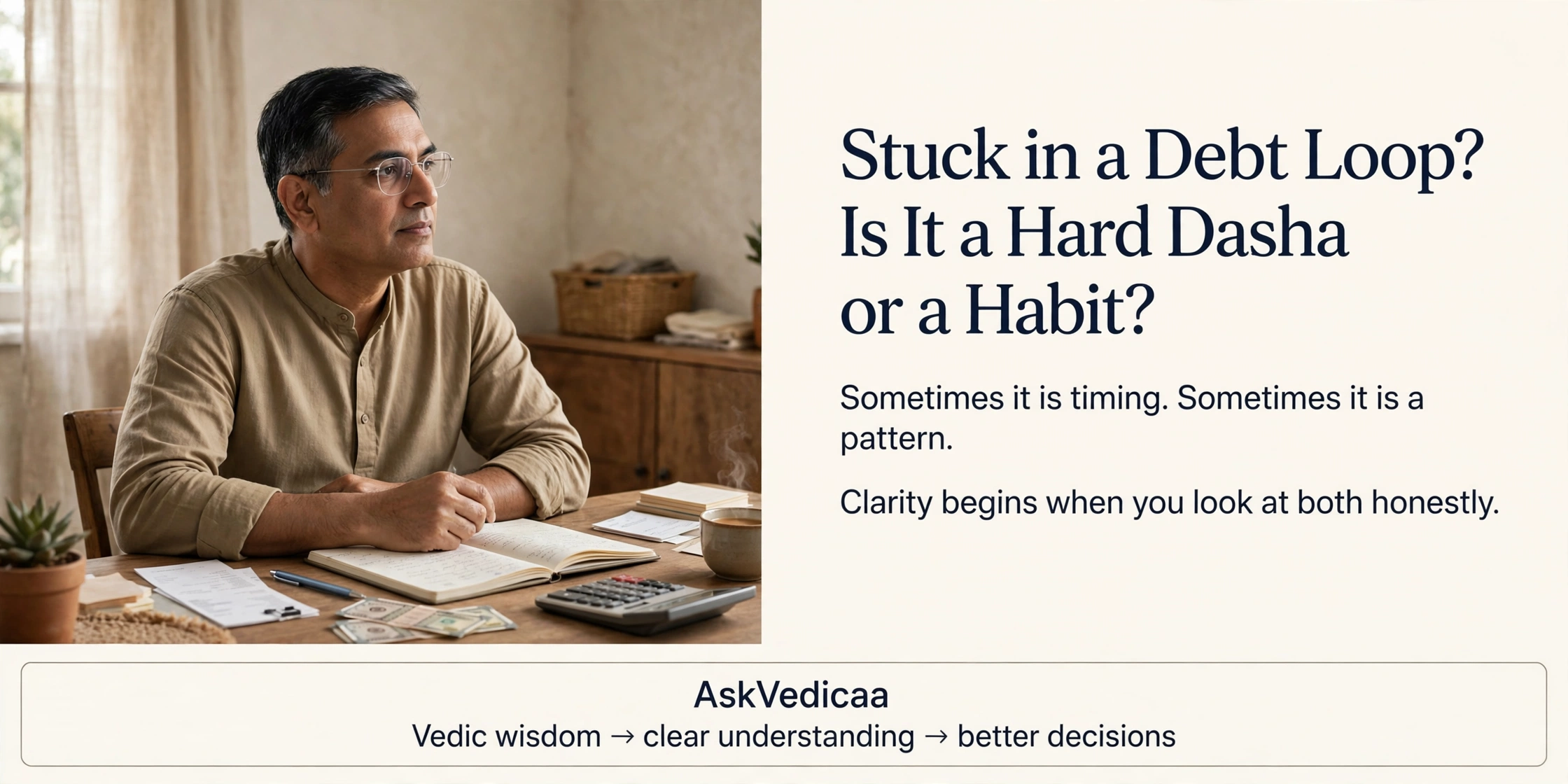
You repay one loan, but another expense arrives. You clear a credit card, then use it again. Your salary comes in, but a large part of it already belongs to someone else.
After a while, debt stops feeling like a financial problem. It begins to feel like your destiny.
You may even look at your birth chart and wonder whether a difficult Mahadasha, Saturn or Rahu is responsible. But before you conclude that the planets have trapped you, there is another question worth asking:
What is keeping the debt cycle alive—and what can you change?
Summary
Repeated borrowing can make you feel that you have lost control of your financial life. Vedic astrology traditionally examines the sixth house, its lord, the second and eleventh houses, the twelfth house and relevant planetary periods when assessing debt-related themes. However, no single planet or Dasha can establish why you are in debt or determine whether you will escape it. Your borrowing pattern, interest costs, income, expenses and repayment structure matter just as much. The practical starting point is to list every liability, stop avoidable new borrowing, protect essential expenses and create a realistic repayment sequence. Astrology may provide a traditional perspective on timing and recurring patterns, but recovery requires a financial system and consistent action.
Why does debt become a repeating pattern?
Debt rarely grows through one decision alone. It often develops through a series of decisions that seem reasonable at the time.
-
You borrow to manage an emergency but have no reserve for the next one.
-
You use a credit card to manage monthly expenses, then struggle with the interest.
-
You take a personal loan to close existing balances, but continue the spending habits that created them.
-
You increase your lifestyle commitments after a salary hike.
-
You borrow again because the previous EMIs leave too little money for everyday expenses.
This is how a temporary financial difficulty can become a recurring cycle.
The emotional burden makes it harder. Shame can prevent you from discussing the problem with family or seeking help. You may avoid checking balances because you already know the numbers will be uncomfortable.
But avoiding the numbers does not reduce the debt.
What does Vedic astrology examine when debt keeps recurring?
In Vedic astrology, debt is not judged by simply finding Saturn or Rahu in a particular house. A meaningful interpretation considers the relationship between financial houses, their lords, planetary influences and the running Dasha.
| Chart factor | Traditional area of interpretation |
|---|---|
| Sixth house and its lord | Debts, obligations, disputes, competition and the effort involved in resolving difficulties |
| Second house and its lord | Savings, accumulated resources and the ability to retain wealth |
| Eleventh house and its lord | Income, gains and financial fulfilment |
| Twelfth house and its lord | Expenditure, outflows, losses and commitments |
| Eighth house and its lord | Sudden disruptions, shared liabilities and financial uncertainties |
| Tenth house and its lord | Profession, work and earning capacity |
The connections between these factors can matter more than an isolated placement.
For example, an astrologer may examine whether the sixth house or its lord has significant connections with the second or eleventh house, whether financial houses are under pressure, and how the relevant planets operate during the Mahadasha and Antardasha.
Saturn is traditionally associated with responsibility, restriction, discipline and prolonged effort. Rahu may be interpreted in connection with amplified desires, unconventional choices or excessive appetite, depending on the chart.
But neither planet automatically causes debt.
A difficult planetary period does not mean that borrowing is inevitable, and a favourable period does not mean that outstanding loans will disappear.
What does a difficult Dasha mean for someone in debt?
A period-aware approach does not mean waiting passively for a planetary period to end.
It means being careful about the decisions you make during financially demanding circumstances.
If your income is unstable, existing EMIs are high or you are already struggling with repayments, consider postponing discretionary borrowing, speculative investments and major financial commitments until you have assessed the risks.
That does not mean avoiding every opportunity. It means distinguishing between a necessary decision and an avoidable financial gamble.
A personalised Vedic assessment may help explore traditional timing indicators. It cannot establish that a particular loan will be approved, that a business will succeed or that a debt will be cleared by a certain date.
The debt inventory: face the numbers before they grow
Before trying to repay everything, understand exactly what you owe.
Create one list covering every outstanding liability.
| What to record | Why it matters |
|---|---|
| Lender or creditor | Know exactly who you owe |
| Outstanding balance | Establish the total amount |
| Interest rate | Identify expensive borrowing |
| Monthly EMI or minimum payment | Understand the repayment burden |
| Due date and overdue amount | Identify immediate repayment risks |
| Secured or unsecured | Understand what assets or guarantees may be involved |
Include credit cards, personal loans, vehicle loans, buy-now-pay-later balances, informal borrowing and money owed to family or friends.
Then calculate:
Monthly take-home income − essential expenses − minimum debt payments = available repayment capacity.
If the result is negative, you do not have a simple budgeting problem. You may need to restructure your obligations, increase income, reduce commitments or seek professional assistance.
A realistic example: when one loan creates another
Imagine a hypothetical 38-year-old professional earning ₹1.2 lakh a month.
A personal loan was taken for a family emergency. Later, credit card balances accumulated because monthly expenses exceeded available cash. A second loan was taken to consolidate the first two obligations.
But the underlying spending pattern did not change.
Now, the person has multiple EMIs, limited savings and a growing fear of the next unexpected expense.
Would it be useful to blame Rahu or Saturn?
A traditional chart assessment might explore the sixth house, its connections with the second and twelfth houses, and the current planetary periods. But the immediate financial problem is visible without astrology: borrowing has become a substitute for available cash.
The first task is to stop the cycle from expanding.
A realistic sequence for getting out of debt
1. Stop avoidable new borrowing.
Avoid using fresh credit to fund discretionary purchases or maintain a lifestyle that your income cannot support. Do not take another loan simply because the new EMI appears smaller.
2. Protect essential expenses.
Prioritise food, housing, utilities, necessary transport, healthcare and other essential responsibilities. A repayment plan that leaves you unable to meet basic needs is unlikely to remain sustainable.
3. Pay attention to minimum obligations and overdue accounts.
Understand the consequences of missed payments and contact lenders early if you cannot meet an instalment. Ask about available repayment or restructuring options and obtain the terms in writing.
4. Choose a repayment strategy.
After meeting required payments, you can consider two common approaches:
-
Highest-interest-first: Direct additional money towards the most expensive debt. This can reduce total interest.
-
Smallest-balance-first: Clear smaller balances first to create visible progress and motivation.
The best approach depends on your circumstances, interest rates and ability to remain consistent.
5. Review behavioural leaks.
Look at recurring subscriptions, impulse purchases, frequent online shopping, lifestyle upgrades and spending triggered by stress or social pressure. The purpose is not to shame yourself. It is to identify where money repeatedly disappears.
6. Build a small financial buffer as repayment progresses.
Without any reserve, the next emergency may push you back into borrowing. The appropriate amount depends on your income, responsibilities and risk exposure.
If your debt is already unmanageable, seek qualified financial or debt-counselling assistance rather than relying on a generic repayment formula.
Why this matters in India
Household borrowing is an important part of India's financial landscape. The RBI's June 2026 Financial Stability Report reported household debt at 45.5% of GDP by September 2025. It also reported that non-housing retail loans accounted for 58.4% of household borrowings by March 2026.
These figures describe aggregate household borrowing, not the financial condition of every Indian family. Still, they highlight why borrowers should understand the difference between productive borrowing, manageable credit and borrowing that becomes difficult to service.
Source: Reserve Bank of India, Financial Stability Report, June 2026.
A lesson from the Bhagavad Gita
In Chapter 16, Verse 21, the Bhagavad Gita identifies desire, anger and greed as three gates leading towards self-destructive conduct.
The verse is not a discussion of modern debt or credit cards. But it offers a useful ethical lens for examining impulsive decisions.
When the desire to possess, impress or immediately satisfy an urge repeatedly overrides judgement, financial decisions can become harmful.
The lesson is not that every person in debt lacks discipline. Job loss, medical emergencies, family responsibilities and inadequate income can all create genuine financial hardship.
It is to recognise where choices are within your control—and where you need support.
Before you blame your Dasha, ask yourself these five questions
-
Do I know the exact amount I owe across all lenders?
-
Am I borrowing for essential needs or to maintain spending habits?
-
Have I taken a new loan to repay an older loan without changing the underlying problem?
-
Do my monthly repayments leave enough for essential expenses?
-
Have I contacted my lenders or sought professional help if repayment is becoming difficult?
Your answers will tell you more about the immediate debt problem than a fear-driven interpretation of one planetary placement.
Can AskVedicaa help you understand recurring debt patterns?
When debt keeps returning, the question is not merely whether a difficult planetary period is operating. You may want to understand why financial pressure appears repeatedly, whether your chart shows traditional indicators involving obligations, savings, income and expenditure, and how the current Mahadasha and Antardasha are interpreted in that context.
AskVedicaa can help you explore these questions through a personalised Vedic chart assessment.
It should not promise debt clearance, prescribe borrowing decisions or replace professional financial advice.
Frequently asked questions
Does Saturn cause debt in Vedic astrology?
Saturn is traditionally associated with responsibility, restriction, discipline and sustained effort. Its role in debt-related interpretation depends on the full birth chart, house ownership, placement, aspects and planetary periods. Saturn alone cannot establish that a person will fall into debt.
Does Rahu indicate loans or financial problems?
Rahu may be interpreted in relation to amplified desires, unconventional decisions or excessive tendencies in some traditional readings. However, it does not automatically indicate debt. The sixth, second, eleventh and twelfth houses and their connections need to be considered.
Which house represents debt in Vedic astrology?
The sixth house is traditionally associated with debts, obligations, disputes and competition. A complete financial assessment also considers the second house of accumulated resources, the eleventh house of gains and the twelfth house of expenditure.
Should I avoid taking a loan during a difficult Mahadasha?
Not automatically. A difficult Dasha is not sufficient reason to reject a necessary loan. Consider affordability, interest rate, purpose, repayment capacity and alternatives first. Astrology may offer timing context, but it cannot replace financial assessment.
Can Vedic astrology predict when my debts will be cleared?
A traditional astrologer may examine financial houses, their lords and relevant planetary periods to interpret possible changes in financial circumstances. This cannot guarantee a debt-free date or replace a realistic repayment plan.
Should I take another loan to clear my credit card debt?
Not without carefully comparing the interest rate, fees, tenure, total repayment amount and the risk of accumulating new credit card balances afterwards. If you are struggling, seek qualified financial guidance before committing to another loan.
Explore more