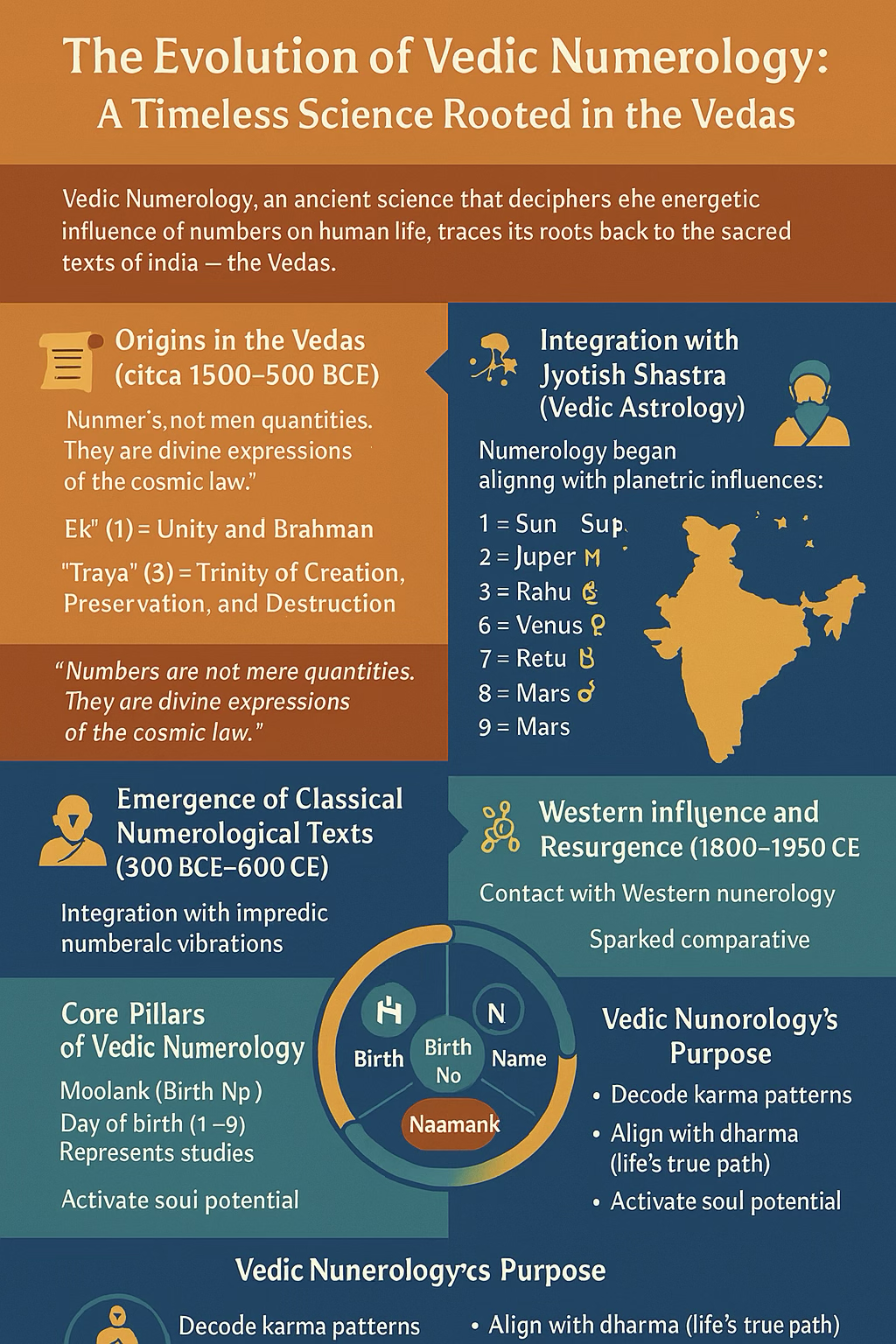
Vedic Numerology, an ancient science that deciphers the energetic influence of numbers on human life, traces its roots back to the sacred texts of India — the Vedas. This powerful system evolved over millennia, blending spiritual insight with mathematical precision to guide personal destiny, relationships, and success.
1. Origins in the Vedas (circa 1500–500 BCE)
Concepts: Numbers were seen as cosmic vibrations.
Belief: Every number carried a spiritual frequency affecting life and karma.
Examples:
“Ek” (1) = Unity and Brahman.
“Traya” (3) = Trinity of Creation, Preservation, and Destruction.
“Numbers are not mere quantities. They are divine expressions of the cosmic law.”
2. Integration with Jyotish Shastra (Vedic Astrology)
Numbers 1 to 9 were mapped to planets:
1 = Sun
2 = Moon
3 = Jupiter
4 = Rahu
5 = Mercury
6 = Venus
7 = Ketu
8 = Saturn
9 = Mars
This added astrological depth to number interpretations.
3. Emergence of Classical Numerological Texts (300 BCE – 600 CE)
Concept of “Bhagyank” (Destiny Number) and “Moolank” (Birth Number) evolved.
Numbers were linked to life paths, karma, and dharma.
Naming practices started incorporating numerical vibrations.
4. Development of Name Numerology (700–1200 CE)
Emergence of Akshara Shastra: analysis of name vibrations.
Kings, dynasties, and sages used name numerology for:
- Naming babies.
- Establishing kingdoms.
- Fixing auspicious timings (muhurta).
5. Codification and Regional Adaptations (1200–1800 CE)
Systems evolved regionally — South Indian and North Indian methods diverged slightly.
Combined with Tantra, Yoga, and Ayurveda for holistic diagnosis.
6. Western Influence and Resurgence (1800–1950 CE)
Comparative studies.
Revivalist interest in ancient Indian methods.
- Scholars like Cheiro referenced Vedic insights indirectly.
7. Modern Rebirth & Digital Transformation (1950–Present)
Numerology apps and tools now widely used for:
- Personal branding.
- Business names.
- Marriage compatibility.
Emergence of systems like:
- Birth-Destiny-Name Matrix.
- Vibe Analysis using Vedic algorithms.
|
Element |
Description |
|---|---|
|
Moolank (Birth No.) |
Day of birth (1–9) – Represents personality |
|
Bhagyank (Destiny No.) |
Full DOB (dd+mm+yyyy) – Life path & fate |
|
Naamank (Name No.) |
Alphabet value sum – Vibration & external identity |
|
Compatibility Matrix |
Determines harmony across name, birth, and destiny numbers |
|
Planetary Rulers |
Links numbers with planetary energies for deeper guidance |