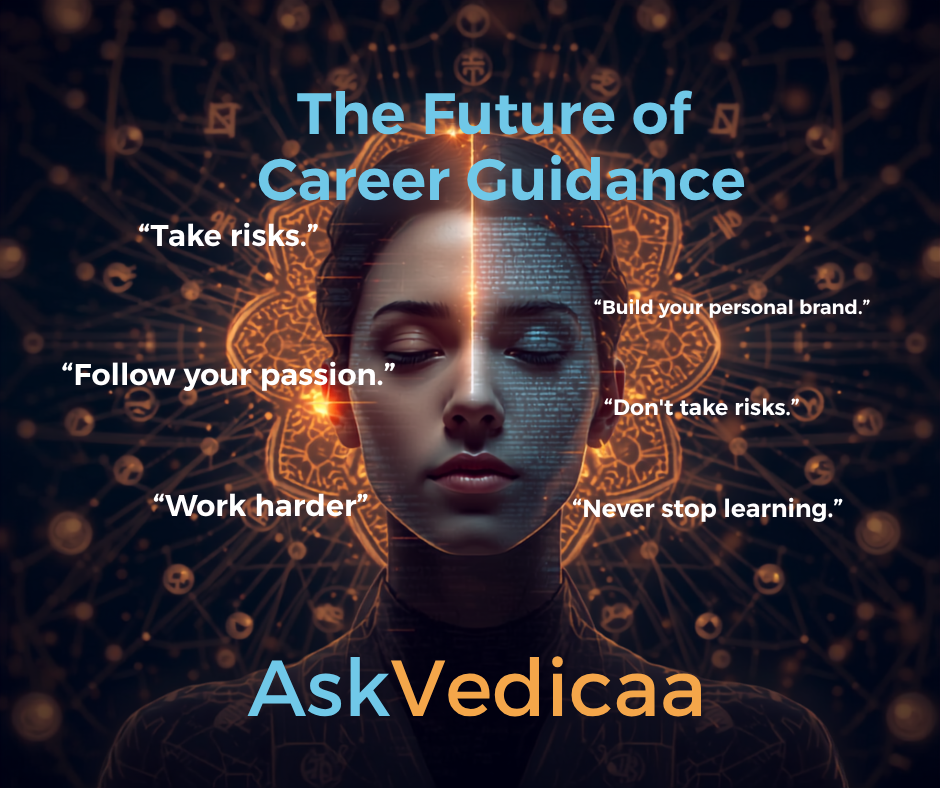
Neha had read enough career advice to fill a small library.
“Follow your passion.” “Work harder.” “Build your personal brand.” “Network.” “Never stop learning.” “Take risks.” “Don't take risks.”
Every piece of advice sounded reasonable.
Some of it was even useful.
But none of it answered the question that kept her awake at night.
“What should I do in my situation?”
Neha was not a college graduate trying to choose her first job.
She was not unhappy because she lacked motivation.
She was a mid-career professional with fifteen years of experience, financial responsibilities, a family, and a career that had reached an uncomfortable point.
She could continue.
She could try for leadership.
She could change companies.
She could move into consulting.
She could learn something new.
She could even start something of her own.
The problem was not a lack of advice.
The problem was too much advice without enough context.
That may be the biggest change coming to career guidance.
The future will not belong to platforms that simply provide more information.
It will belong to systems that help people understand information in the context of their actual questions.
AskVedicaa is built around this broader idea:
Start with the person's real question, understand the context, explore relevant Vedic perspectives and help the user think more clearly about possible actions.
The purpose is not to replace professional career counselling, financial advice or personal judgment.
It is to make guidance more personal, accessible and conversational.
We Have an Information Problem, Not an Information Shortage
For most of human history, finding information was difficult.
Today, the opposite is true.
Search for:
“Should I change my job?”
and you can find thousands of articles.
Search:
“How to get promoted?”
and you will find endless lists.
Search:
“How to deal with a bad manager?”
and there will be videos, podcasts, LinkedIn posts and AI-generated answers.
The problem is no longer access.
The problem is relevance.
A 25-year-old employee deciding whether to leave their first job has a very different situation from a 45-year-old professional considering a major career transition.
Yet both may receive the same advice:
“Take risks and follow your passion.”
That may be inspiring.
It may also be completely impractical.
Good guidance requires context.
The Same Career Question Can Mean Completely Different Things
Consider the question:
“Should I change my job?”
For one person, it may mean:
“My manager is making my life miserable.”
For another:
“I haven't learned anything new in three years.”
For another:
“I am exhausted and cannot continue like this.”
For another:
“I want to earn more.”
And for someone else:
“I no longer know why I am doing this.”
The visible question is the same.
The underlying problem is different.
This is why the future of guidance must move beyond keyword-based answers.
The next generation of guidance should help identify:
What the person is actually asking.
What factors are influencing the decision.
What information is relevant.
What questions they may not have considered.
What practical options exist.
From Static Reports to Conversations
Traditional reports generally work in one direction.
The system analyses information.
The system produces an answer.
The user reads it.
The conversation ends.
But life doesn't work that way.
A person may read an answer and immediately think:
“But what about my current job?”
or:
“Does that change if I have another offer?”
or:
“What should I do first?”
This is where conversational AI changes the experience.
A conversation allows a person to move from:
Question
to:
Clarification
to:
Context
to:
Follow-up
to:
Reflection
to:
Possible action.
That is a fundamentally different model from receiving a one-time report.
Why Context Matters in Vedic Guidance
Vedic Astrology is often presented online through simplified statements.
“Saturn is delaying your success.”
“This year will bring career growth.”
“You will change jobs soon.”
Such statements can sound specific.
But without context, they can also become misleading.
Traditional Vedic analysis is more complex.
Depending on the question, an analysis may consider factors such as:
Relevant houses and house lords.
Planetary placements.
Planetary relationships and strengths.
Dasha periods.
Transits.
The broader chart.
The person's actual question.
A responsible interpretation does not reduce an entire career to one planet or one transit.
The question matters.
The timing matters.
The broader context matters.
AskVedicaa can Make Personalised Exploration More Accessible
Traditionally, personalised guidance required direct interaction with an expert.
That remains valuable.
But it is not always available.
People may not have access.
They may not know whom to ask.
They may not be comfortable discussing personal concerns.
They may simply want to explore a question privately before speaking to someone.
AI can help create an accessible first layer of exploration.
A person can ask:
“Why do I feel stuck in my career?”
Then follow up:
“Could burnout be affecting how I see my future?”
Then:
“What does my current Vedic timing traditionally indicate?”
Then:
“What practical steps should I consider?”
The conversation can become progressively more relevant.
That is where AI has genuine potential.
Not because AI should tell people how to live.
But because AI can help people think through questions interactively.
AskVedicaa and the Idea of Conversational Guidance
AskVedicaa is based on the idea that people should not have to translate their life problems into technical astrological language.
Most people don't wake up thinking:
“What is the condition of my tenth house lord?”
They wake up thinking:
“Why am I working so hard and still not moving forward?”
Or:
“Should I accept this job offer?”
Or:
“Why is my relationship becoming difficult?”
AskVedicaa begins with the human question.
The user can ask naturally.
The system can then explore relevant Vedic perspectives, depending on the information and context available.
This makes traditional concepts more accessible without requiring every user to become an astrology student.
Guidance Should Not Create Dependency
This is an important principle for the future of AI and spiritual guidance.
A good guidance system should not encourage people to become dependent on predictions for every decision.
It should not make users feel:
“I cannot make a decision unless the system tells me what to do.”
That is not empowerment.
A better goal is:
Help the user understand the situation well enough to make a more informed decision.
This means acknowledging uncertainty.
It means explaining that multiple factors affect outcomes.
It means avoiding unrealistic guarantees.
And it means encouraging practical judgment.
The future of responsible guidance should increase clarity—not dependency.
Where Vedic Wisdom and Practical Action Meet
Vedic frameworks can provide useful lenses for reflection.
But reflection without action has limited value.
Consider someone asking about a promotion.
The Vedic discussion may explore timing, responsibility, career patterns or relevant chart indicators.
But practical action may still involve:
Documenting achievements.
Building leadership skills.
Discussing career progression.
Improving visibility.
Understanding organisational requirements.
Developing new capabilities.
Similarly, someone considering a job change may explore timing through traditional Vedic frameworks while also:
Researching the market.
Updating their CV.
Building financial preparation.
Speaking with trusted professionals.
Evaluating the actual opportunity.
The strongest guidance connects reflection with reality.
Why Personalisation Is More Important Than Prediction
People often ask for predictions because uncertainty is uncomfortable.
They want to know:
“Will this work?”
“When will it happen?”
“Should I do it?”
But life decisions are rarely solved by a single prediction.
A more useful question can be:
“What should I understand before I decide?”
This is where personalised guidance becomes valuable.
Instead of offering only an answer, it can help the user understand:
The situation.
The possible patterns.
The timing context.
The risks.
The opportunities.
The questions that need more thought.
That is a more mature relationship with guidance.
The Future Is Human Questions + Intelligent Conversation
The most useful technology may not be the technology that provides the most answers.
It may be the technology that helps people ask better questions.
A future guidance system should understand that:
A question about career may also involve money.
A question about promotion may involve confidence.
A question about burnout may involve purpose.
A question about changing jobs may involve family responsibilities.
Human life does not exist in isolated categories.
And guidance shouldn't either.
Frequently Asked Questions
Is AI replacing professional career counsellors or Vedic astrologers?
No. AI can make information and guided exploration more accessible, but experienced professionals can provide human judgment, domain expertise and deeper interaction that an AI system does not replace.
What makes personalized guidance different from generic advice?
Personalized guidance focuses on the user's actual question and circumstances. Generic advice is designed to apply broadly and may not address the specific factors influencing an individual's decision.
Can AI provide Vedic guidance?
AI can help present and explore Vedic concepts based on the information and systems it has been designed to use. The quality and usefulness of guidance depend on the underlying methodology, data, context and implementation.
Does AskVedicaa predict the future?
AskVedicaa is designed to provide conversational guidance using traditional Vedic perspectives. It should not be treated as a system that guarantees specific future outcomes.
Why does Dasha matter in Vedic career guidance?
Dasha is traditionally used in Vedic Astrology to examine planetary periods and their themes. It can add a timing perspective when exploring career phases and transitions.
Should I make important life decisions based only on astrology or AI?
No. Important decisions should consider practical circumstances, reliable information, professional advice where appropriate and your own judgment. Vedic or AI-based guidance can be one perspective within a broader decision-making process.