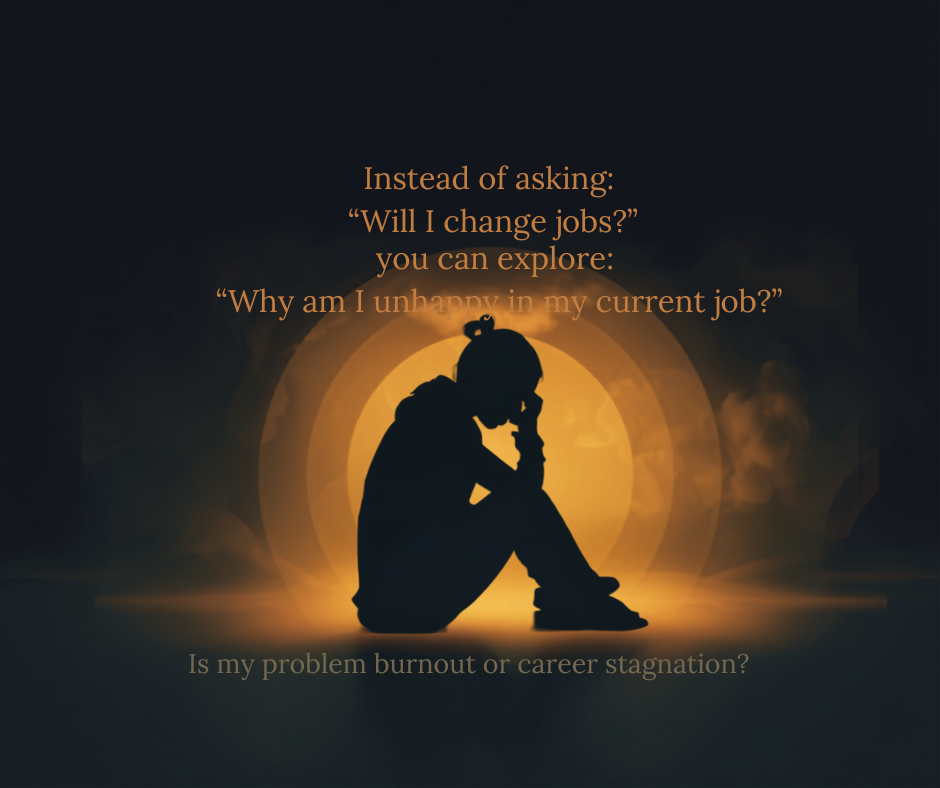
The Resignation Letter Sitting in the Draft Folder
For three months, Arjun had been writing the same email.
Not sending it.
Just writing it.
Subject: Resignation
He would type the first paragraph.
Then delete it.
The next morning, he would think:
"Maybe things will improve."
Then another difficult meeting would happen.
Another weekend would disappear into work.
Another colleague would leave.
Another promise about his career would go nowhere.
That evening, he would open the draft again.
He wasn't sure whether he wanted to leave.
He was sure he didn't want to continue exactly as he was.
And those are two very different things.
The Real Question Behind "Should I Quit?"
Most people ask:
"Should I change my job?"
But that question is too broad.
Try breaking it down.
Ask:
Am I still learning?
Am I being treated fairly?
Is my compensation aligned with my contribution?
Do I have a realistic path to promotion?
Is my manager helping or blocking my growth?
Is my health or wellbeing being affected?
Does the organisation still fit my values?
Am I burned out—or genuinely ready for change?
Would another role solve the problem?
These questions turn an emotional decision into a career decision.
Sign 1: You Have Stopped Learning
Arjun realised he had become an expert at yesterday's problems.
Every Monday looked familiar.
Every client issue followed a predictable pattern.
Every project required skills he had mastered years earlier.
He was productive.
But he wasn't developing.
This is one of the clearest signs of career stagnation.
A good career should ideally increase both:
Depth of expertise
and
Breadth of capability.
If you have spent years doing the same work without meaningful development, ask:
"What will I be able to do two years from now that I cannot do today?"
If the answer is difficult to find, your career may need a change.
Sign 2: There Is No Real Path Forward
Your manager says:
"Your time will come."
Then another year passes.
You hear:
"Let's discuss this next quarter."
Another quarter passes.
You ask about leadership.
You are told:
"Keep doing good work."
But nobody explains what "good enough" actually means.
This isn't a career plan.
A genuine growth path should provide some clarity about:
What capability you need.
What responsibility you need.
What results you need.
Who makes the decision.
What the likely timeline is.
No organisation can guarantee a promotion.
But a good organisation should usually be able to explain what readiness looks like.
Sign 3: Your Salary and Responsibility Have Become Disconnected
Money isn't everything.
But it isn't nothing either.
Suppose your responsibilities have increased significantly.
You are handling larger clients.
Managing people.
Making important decisions.
Solving difficult problems.
But your compensation has barely changed.
That doesn't automatically mean you should resign.
First understand:
Market compensation.
Internal salary structure.
Your actual impact.
Promotion criteria.
Timing of salary reviews.
Then have a direct conversation.
If the organisation cannot reasonably address the gap, external opportunities may become worth exploring.
Sign 4: Your Manager Is Consistently Damaging Your Growth
One difficult manager does not necessarily mean you should leave.
But patterns matter.
Consider a manager who:
Takes credit for your work.
Withholds important opportunities.
Gives unclear expectations.
Micromanages everything.
Publicly undermines you.
Provides no useful feedback.
Repeatedly blocks your development.
If you've tried to address the issue and nothing changes, the problem may no longer be an individual disagreement.
It may be an environment problem.
Ask Yourself
"If I had a different manager, would I still want to leave this company?"
That answer can tell you a lot.
Sign 5: You're Burned Out—and Nothing Changes
Arjun initially thought his problem was ambition.
Then he realised he was exhausted.
He didn't want another promotion.
He didn't want another project.
He didn't even want to open his laptop.
This is where burnout needs to be distinguished from career dissatisfaction.
If work-related stress has become persistent and is affecting your functioning, relationships, sleep, mood, or wellbeing, don't simply treat it as a career strategy problem.
Rest and appropriate professional support may be necessary.
A job change can sometimes help if the environment is the source of the problem.
But burnout can also follow you into a new organisation if the underlying patterns remain.
Sign 6: Your Values Have Changed
This is one of the most overlooked reasons people change careers.
The job may not have changed.
You did.
At 28, you may have wanted:
Rapid growth.
Money.
Status.
Long hours.
International exposure.
At 42, you may want:
Stability.
Meaning.
Family time.
Leadership.
Flexibility.
Less travel.
Neither version of you is wrong.
Your career simply needs to evolve with your life.
This is where purpose becomes important.
The question is no longer:
"Is this a good job?"
It becomes:
"Is this a good job for the life I want now?"
Sign 7: You Are Staying Only Because You're Afraid
This is perhaps the most difficult sign.
You tell yourself:
"It's not that bad."
But underneath that sentence is:
"What if I can't find anything better?"
Fear can make a bad situation feel safer than an unknown one.
Before leaving, reduce the uncertainty.
Update your CV.
Speak to people in your network.
Research the market.
Apply selectively.
Understand your financial runway.
Build skills.
Explore internal options.
You don't have to resign to begin preparing.
Sign 8: You Have Started Imagining a Different Life
Sometimes the strongest signal is not dissatisfaction.
It's curiosity.
You keep thinking about:
Another industry.
Another city.
Starting something yourself.
Teaching.
Consulting.
A leadership role.
A completely different profession.
Don't immediately act on the fantasy.
Study it.
What attracts you?
Money?
Freedom?
Recognition?
Creativity?
Meaning?
Status?
Flexibility?
The fantasy may not be the answer.
But it may reveal the question.
Sign 9: You Have Tried to Fix It
This is perhaps the most important test.
Before changing jobs, ask:
Have I actually tried to improve my current situation?
Have you:
Spoken to your manager?
Asked for greater responsibility?
Requested a development plan?
Explored internal roles?
Built new skills?
Improved your visibility?
Set boundaries?
Taken leave?
Asked for compensation review?
If you haven't tried anything, you may be escaping before understanding the problem.
But if you have tried repeatedly and nothing meaningful changes, the evidence becomes stronger.
When You Should NOT Change Your Job
There are moments when resignation feels attractive but may not be the best decision.
After One Bad Week
Every job has difficult periods.
Immediately After a Conflict
Don't make a permanent decision during temporary anger.
Because Someone Else Got Promoted
Their career isn't your career.
Because You're Bored
First determine whether a new challenge could solve the problem.
Because Someone Promised a Better Job
Verify the opportunity before making a move.
Without Financial Preparation
Unless circumstances require immediate departure, understand your financial situation before resigning.
A career change should ideally be a move toward something, not simply an escape from something.
What Does Vedic Astrology Add to Career Change?
Traditional Vedic Astrology has long been used to explore career, life direction, responsibility, and periods of change.
A career-focused reading may consider factors such as:
The 10th house and its lord.
Relevant career-related houses.
Planetary placements and strengths.
Dasha.
Planetary transits.
Broader chart patterns.
The important principle is context.
There isn't a responsible universal rule such as:
"Saturn means don't change jobs."
or:
"This Dasha guarantees a career change."
Traditional interpretation is more nuanced.
The question becomes:
"What themes are traditionally associated with this period, and how do they relate to the real circumstances of my career?"
Saturn and Career Change
Saturn is often feared when career decisions are discussed.
But traditional Vedic symbolism around Saturn is broader than delay.
It includes:
Discipline.
Responsibility.
Structure.
Patience.
Persistence.
Long-term results.
Sometimes Saturn-like lessons involve staying and building.
Sometimes they involve accepting responsibility.
Sometimes they involve recognising that an old structure no longer works.
So instead of asking:
"Is Saturn stopping my career?"
ask:
"What structure needs to become stronger?"
That might be your skills.
Your finances.
Your confidence.
Your leadership ability.
Or your career plan.
Dasha and Career Timing
Dasha is traditionally used to understand planetary periods and their associated themes.
When exploring a possible job change, someone may consider whether the current period is traditionally associated with:
Change.
Expansion.
Responsibility.
Learning.
Leadership.
Consolidation.
Transition.
But timing should never replace practical judgment.
If your workplace is unhealthy, don't stay simply because someone tells you to wait for a better planetary period.
If a great opportunity appears, don't reject it simply because your horoscope isn't being interpreted as "perfect."
Use Vedic timing as one perspective among several.
The final decision should consider reality.
AskVedicaa: Don't Ask Only "When Should I Quit?"
This is where a conversational tool can be more useful than a simple prediction.
Instead of asking:
"Will I change jobs?"
you can explore:
"Why am I unhappy in my current job?"
"Is my problem burnout or career stagnation?"
"What should I focus on before changing jobs?"
"What does my current Dasha traditionally indicate about career transition?"
"What career strengths should I build?"
"How should I think about career timing?"
AskVedicaa can combine conversational AI with traditional Vedic Astrology, Numerology, Vastu, Panchang, and related Vedic guidance to help you examine the question from multiple perspectives.
It doesn't make the decision for you.
It helps you ask a better question before making one.
The visible question might be:
"Should I quit?"
The deeper question may be:
"What kind of career should I build next?"
Frequently Asked Questions
How do I know when it's time to change jobs?
Consider a change when problems such as lack of growth, poor management, inadequate compensation, burnout, or value misalignment persist despite reasonable attempts to improve the situation.
Should I quit if I hate my job?
Not necessarily. First understand why you hate it. If the problem is fixable, try to fix it. If it is persistent and fundamental, prepare a thoughtful transition.
Is changing jobs good for career growth?
It can be. A new role may provide better learning, compensation, leadership opportunities, or exposure. But frequent moves without a clear development strategy can also create problems.
Can Vedic Astrology tell me when to change jobs?
Vedic Astrology can traditionally be used to explore periods and themes associated with career transitions. It should be treated as guidance rather than a guaranteed prediction.
What is the role of Dasha in career timing?
Dasha represents planetary periods traditionally used to interpret different phases of life. In career analysis, it may provide context around periods of responsibility, change, growth, or consolidation.
Does Saturn delay career changes?
Saturn is traditionally associated with patience, discipline, responsibility, and gradual development. It is too simplistic to say that Saturn automatically delays a career change.
Should I change jobs because I am bored?
Not automatically. First determine whether a new project, responsibility, skill, or internal role could restore growth.
Should I wait for the perfect time to resign?
There may never be a perfect time. Aim for an informed time when you understand the opportunity, risks, finances, and practical consequences.
Arjun eventually deleted the resignation letter.
Not because he decided to stay forever.
He deleted it because he realised he had been using the letter as an emotional escape hatch.