
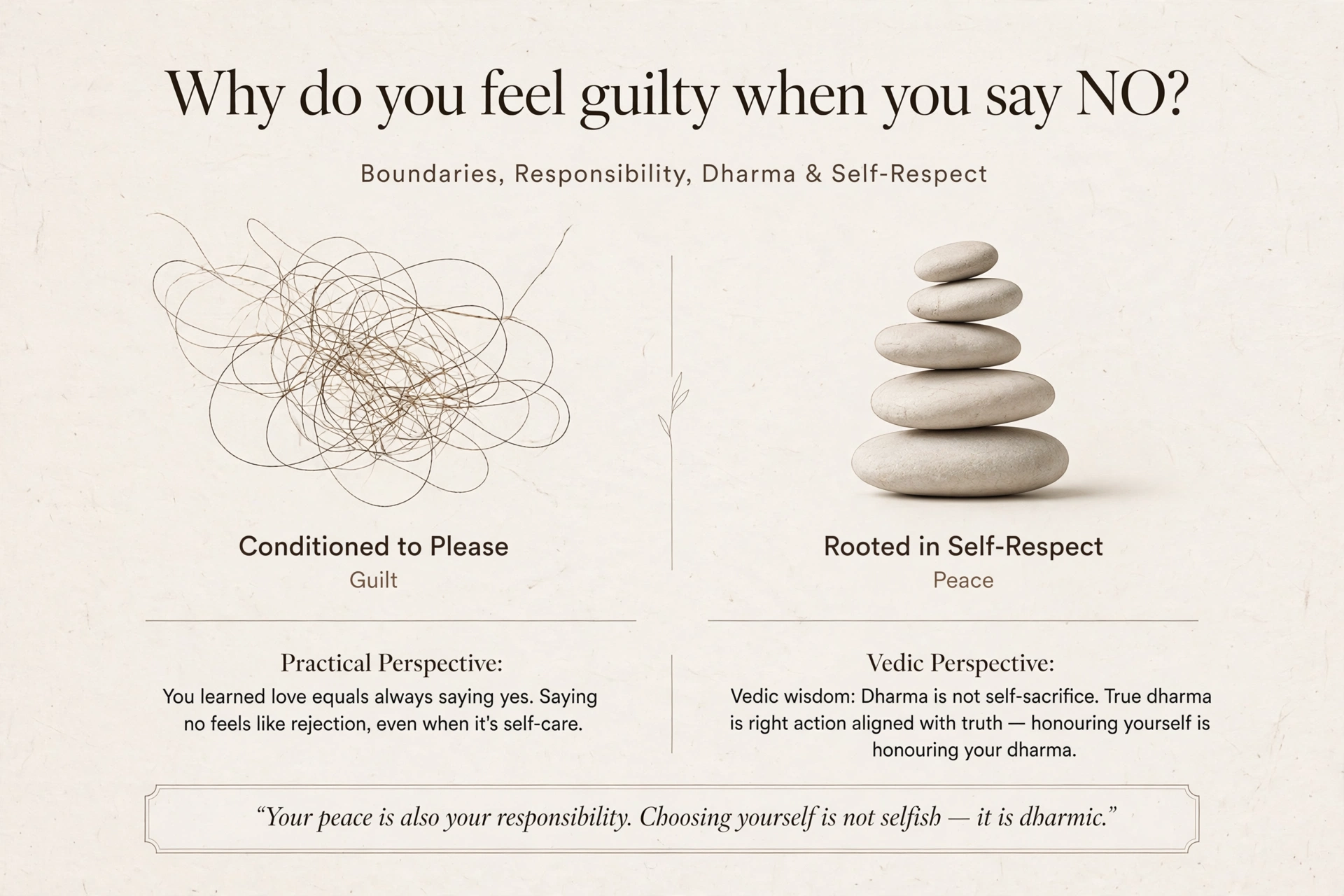
You finally say no.
No, you cannot take on another responsibility.
No, you cannot attend the event.
No, you cannot lend the money.
No, you cannot keep solving the same problem for someone else.
For a few minutes, you feel relieved.
Then the guilt begins.
“Was I selfish?”
You replay the conversation.
Maybe you should have explained yourself better.
Maybe you should have said yes.
Maybe the other person sounded disappointed because you did something wrong.
So you send another message.
You soften your decision.
Sometimes, you even take back the boundary you had just tried to create.
This pattern is especially common among people who are used to being responsible, helpful and dependable.
Family comes to them.
Colleagues rely on them.
Friends call when something goes wrong.
Over time, being needed can become part of their identity.
So when they finally consider their own needs, even briefly, it can feel uncomfortable.
Not necessarily because the choice was wrong.
But because they are not used to giving themselves the same consideration they give everyone else
Why Does Saying “No” Feel So Difficult?
For some people, saying no feels almost like rejection.
They worry:
- Will they be upset with me?
- Will they think I don't care?
- What if they need me?
- What if I disappoint them?
- What if they stop respecting me?
- What if I'm being selfish?
The problem is that these questions can turn every boundary into a moral test.
Instead of asking “Can I reasonably do this?”
you start asking: “Am I a good person if I don't?”
That's a much heavier question.
And when every request becomes a test of your goodness, it becomes difficult to distinguish responsibility from over-responsibility.
Caring for Others Is Not the Same as Carrying Everyone
There is an important difference between being responsible and taking responsibility for everything.
You can care about your parents without solving every problem for them.
You can love your children without controlling every outcome.
You can support a friend without becoming responsible for their emotions.
You can be a good employee without being available every hour.
You can love your partner without abandoning your own needs.
Healthy relationships contain responsibility.
They also contain boundaries.
When boundaries disappear, care can quietly turn into exhaustion.
Why Responsible People Often Struggle With Boundaries
Sometimes this pattern starts early.
You may have learned that being “good” meant being helpful.
Perhaps you received appreciation when you performed well, helped at home, stayed quiet or avoided creating problems.
Eventually, an internal rule can develop: “Other people's needs should come before mine.”
That rule can be useful in some circumstances.
Parents have responsibilities.
Children have responsibilities.
Partners have responsibilities.
Professionals have responsibilities.
But when that rule becomes permanent, you may start ignoring your own needs until they become impossible to ignore.
Then resentment appears: “Why does nobody understand how much I do?”
Sometimes the people around you aren't deliberately taking advantage of you.
They may simply have become accustomed to the version of you that always says yes.
Choosing Yourself Doesn't Automatically Mean Choosing Against Others
This distinction matters.
Choosing yourself could mean:
- taking an afternoon off
- going to the doctor instead of postponing the appointment
- protecting your sleep
- spending time on something you enjoy
- refusing unreasonable work
- saying no to a financial request you cannot comfortably meet
- taking time to think before agreeing
- pursuing an interest unrelated to your responsibilities
None of these automatically makes you selfish.
Self-respect is not the same as self-centredness.
The real question is whether you can recognise your own legitimate needs without denying the legitimate needs of others.
Dharma Is Not Simply “Do Everything for Everyone”
This is where the traditional Vedic idea of dharma becomes particularly interesting.
Dharma is often translated as duty, but it is broader than fulfilling every demand placed upon you.
Traditional Vedic thought considers responsibility in relation to:
- your role
- circumstances
- values
- conduct
- responsibilities
That means duty is contextual.
A parent's responsibilities differ from those of a child.
Your responsibilities toward family may differ from your responsibilities toward an employer.
And your responsibilities to others exist alongside responsibilities toward yourself.
This is an important distinction: Self-neglect should not automatically be confused with dharma.
There are situations where sacrifice is appropriate.
There are also situations where refusing an unreasonable demand is the more responsible choice.
The challenge is learning to distinguish between them.
What Can Vedic Astrology Add to the Question?
If someone repeatedly struggles with guilt, over-responsibility or boundaries, Vedic astrology can be used as a reflective framework, not as a diagnosis.
Depending on the question, a traditional interpretation may consider:
1st House
Identity, self-expression and how you approach life.
4th House
Home, emotional foundations, inner security and private environment. It may become relevant when family expectations and emotional security are closely connected.
6th House
Service, work, responsibilities, challenges and daily obligations. This can be relevant when life feels dominated by duties.
7th House
Partnerships and significant one-to-one relationships.
10th House
Professional responsibility, career and public role.
Moon
Emotional responses, attachment and the subjective experience of security.
Mahadasha and Antardasha
Planetary periods can provide context for whether themes around family, relationships, work, responsibility or personal priorities are becoming more prominent during a particular phase.
The point isn't: “Your chart makes you unable to say no.”
That would be far too simplistic.
The more useful question is: “What patterns might be worth examining, and how do they relate to what is actually happening in my life?”
Guilt Does Not Always Mean You Did Something Wrong
Guilt can sometimes be useful.
If you genuinely hurt someone or failed an important responsibility, guilt may encourage you to repair the situation.
But guilt can also become automatic.
You say no.
You feel guilty.
Therefore:
“I must have done something wrong.”
That logic isn't reliable.
Try asking three questions instead.
Did I break a genuine responsibility?
If yes, take responsibility.
Did I deliberately harm someone?
If yes, examine what needs repair.
Or did I simply disappoint someone by protecting a legitimate need?
If it's the third, guilt may not mean you did anything wrong.
Someone being disappointed does not automatically mean you behaved badly.
A Simple Boundary Test
Before agreeing to something, pause.
Ask yourself:
Do I want to do this?
Can I realistically do this?
Am I doing it because I genuinely choose to—or because I am afraid of saying no?
That third question can be revealing.
If the answer is fear, don't automatically commit.
You don't have to reject the request.
You can simply say: “Let me think about it and get back to you.”
That creates space between the request and your automatic response.
Sometimes that small space is enough to hear your own opinion.
What Happens When You Start Setting Boundaries?
Not everyone will immediately like it.
That's normal.
People who are accustomed to your availability may notice the change.
Someone might say: “You've changed.”
Sometimes that's true.
You have changed.
You've started considering your own limits.
That doesn't automatically mean you've become less caring.
In fact, healthier relationships can emerge when people know what you can genuinely give instead of receiving endless yeses followed by exhaustion and resentment.
You also don't need a long explanation every time.
Sometimes: “I can't take that on right now.”
is enough.
What If Your Family Expects You to Always Be Available?
This can be particularly complicated when family responsibility is deeply valued.
You may genuinely be supporting parents, children, siblings or extended family.
There may be responsibilities that cannot simply be dismissed in the name of “self-care.”
The answer isn't to abandon responsibility.
It is to make responsibility sustainable.
Ask:
- What am I genuinely responsible for?
- What am I doing because nobody else will—or because I assume nobody else can?
- What can be shared?
- What can wait?
- What can I afford financially and emotionally?
- What support do I need?
- Which responsibilities are temporary?
- Which are long-term?
These questions turn an emotional problem into a practical one.
You Can Be a Good Person Without Being Available to Everyone
Perhaps this is the sentence someone with chronic guilt needs to hear:
You do not have to exhaust yourself to prove that you care.
You can be generous without being constantly available.
You can be responsible without controlling everything.
You can love someone without solving every problem for them.
You can say no without becoming a bad person.
And you can make space for your own life without abandoning the people who matter to you.
The goal isn't to become less caring.
It is to make your care sustainable.
AskVedicaa: When “Doing the Right Thing” Has Become Exhausting
If you constantly find yourself caught between what you want and what everyone else expects, the deeper question may not be: “Should I choose myself?”
It may be: “Why do I feel guilty whenever I do?”
That is a much more useful question.
With AskVedicaa, you can explore questions such as:
- “Why do I struggle to set boundaries with my family?”
- “Why do I feel guilty when I prioritise myself?”
- “What does my chart suggest about responsibility and relationships?”
- “Am I taking on responsibilities that are not really mine?”
- “How can I understand this phase of my life through dharma?”
- “Why do I keep putting other people's needs before my own?”
- “What Vedic factors may be relevant to my current family responsibilities?”
- “How should I think about my responsibilities without completely neglecting myself?”
AskVedicaa can bring your birth chart, planetary periods, numerology and personal context into the conversation rather than reducing the issue to a generic personality statement.
You can explain the situation.
Ask a follow-up.
Challenge the interpretation.
Add what actually happened in your life.
The goal isn't to tell you:
“Choose yourself.”
That would be another simplistic answer.
The more useful conversation is about understanding where your sense of responsibility comes from, what your current phase may be highlighting, and where healthy boundaries might deserve attention.
Because sometimes the hardest thing to learn isn't how to care for other people.
It is learning that: You are also one of the people you are responsible for.
Your question. Your birth chart. Your context. A Vedic conversation about the responsibility you carry.
If saying no makes you feel like a bad person, don't immediately obey the guilt.
Ask where it comes from. AskVedicaa.