You sit down for dinner, but your mind is already thinking about tomorrow.
You are talking to someone you care about, but part of you is checking your phone.
You finally get a quiet evening, yet instead of enjoying it, you start thinking about what needs to happen next.
Sometimes you are not worried about anything in particular. Your life may actually be going reasonably well.
Still, your mind does not seem to stay where your body is.
If you have ever thought, “Why can’t I just be present?”, you are not alone.
Modern life constantly pulls attention in different directions. Notifications, work, family responsibilities, social media, unfinished tasks and future plans all compete for the same limited resource: your attention.
But there can be another layer to this experience.
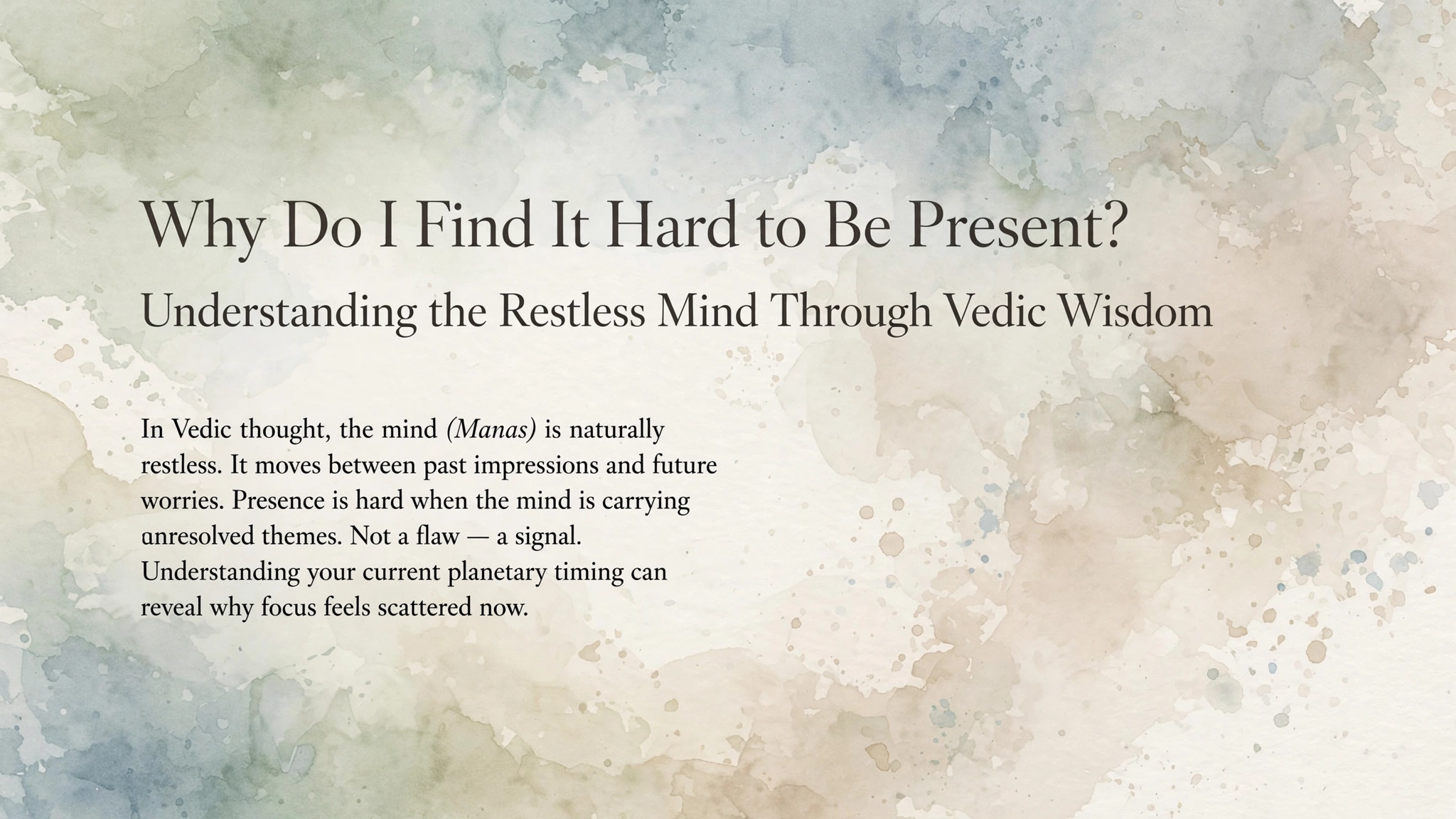
In Vedic thought, the quality of attention is not simply a productivity issue. It is connected to the state of the chitta — the field of the mind — and to the balance of sattva, rajas and tamas.
Understanding that distinction can change the way you approach your restless mind.
What does it mean to be present?
Being present does not mean that your mind must become completely empty.
It means that your attention is available for the experience happening now.
When you are eating, you are actually eating.
When someone is speaking, you are actually listening.
When you are walking, you notice that you are walking.
When you are resting, you do not constantly feel compelled to mentally work.
Presence is therefore less about having no thoughts and more about not being constantly pulled away from the moment.
That is an important distinction.
A person can have many thoughts and still be present.
Another person can sit quietly for an hour while mentally living through tomorrow, next month or ten years from now.
The problem is not necessarily the number of thoughts.
It is where your attention keeps going.
Why is it so difficult to stay in the present?
There are several everyday reasons.
Your brain is trained to anticipate
Modern life rewards planning.
You think about deadlines before they arrive. You prepare for meetings. You plan finances. You think about your children's future. You anticipate problems so you can prevent them.
Planning is useful.
But when anticipation becomes your default mental state, the present moment can start feeling like a waiting room.
You are physically here, but mentally somewhere else.
Your attention is constantly interrupted
A notification arrives.
You check a message.
You remember an email.
You open one application and see something else.
Five minutes later, your original thought has disappeared.
Over time, this trains the mind to expect stimulation.
Silence begins to feel uncomfortable.
Doing one thing begins to feel insufficient.
You may have become uncomfortable with stillness
This is something many people discover only when they deliberately slow down.
The moment there is nothing demanding your attention, the mind starts producing something.
A memory.
A plan.
A worry.
A conversation from yesterday.
A question about tomorrow.
Sometimes we keep ourselves busy not because everything needs to be done, but because stillness makes us aware of what is happening inside.
The Vedic perspective: the restless mind
Vedic philosophy does not treat the mind as something that should simply be switched off.
Instead, it pays close attention to the movement of the mind.
The Bhagavad Gita repeatedly addresses the difficulty of controlling and directing the mind. The challenge is not presented as unusual. The restless mind is part of the human experience.
One useful way to understand this through the three gunas is:
-
Sattva brings clarity, steadiness and awareness.
-
Rajas brings movement, stimulation, desire and activity.
-
Tamas brings heaviness, inertia and dullness.
When rajas becomes dominant, the mind can keep moving even when there is no immediate reason for it to do so.
You finish one task and immediately think about the next.
You achieve one thing and start planning another.
You sit down to rest and reach for stimulation.
You move from thought to thought without fully experiencing any of them.
This does not mean rajas is bad.
Rajas is necessary for action.
The difficulty arises when movement continues after movement is no longer needed.
Presence is not the same as doing nothing
This is where the idea of presence is often misunderstood.
You do not need to abandon ambition.
You do not need to stop planning.
You do not need to become detached from your responsibilities.
The goal is not to eliminate activity.
The goal is to develop the ability to move between activity and stillness consciously.
Think about a car.
The accelerator allows movement.
The brakes allow you to stop.
A healthy life needs both.
If you can work but cannot rest, something is out of balance.
If you can plan but cannot experience the present, something is out of balance.
If you can constantly consume information but struggle to sit quietly for ten minutes, your attention may need training.
What role does the Moon play in Vedic astrology?
In Vedic astrology, the Moon has an important relationship with the mind, emotional responses, perception and mental habits.
This does not mean that your Moon placement determines whether you can be present.
Rather, a birth chart can offer a framework for understanding how your mind tends to process experience.
For example, a Vedic astrologer may examine:
-
The condition and placement of the Moon
-
The relationship of the Moon with other planets
-
Mercury's influence on mental processing
-
The 5th house associated with attention, intelligence and mental focus
-
The 12th house associated with withdrawal, sleep, solitude and the inward mind
-
The 3rd house associated with activity, communication and mental engagement
-
The influence of Rahu, particularly where stimulation, craving or mental amplification becomes relevant
The purpose is not to label someone as “restless” because of one planetary position.
A serious interpretation looks at the chart as a whole.
Your current planetary period may matter too
There is another reason a person's experience can change over time.
Your basic birth-chart tendencies do not operate in exactly the same way throughout life.
Vedic astrology uses Mahadasha and Antardasha to examine changing planetary periods.
A particular period may coincide with greater activity, responsibility, mental stimulation, withdrawal, reflection or internal focus.
This can help explain why you may have felt relatively calm during one period of life and unusually mentally active during another.
That distinction matters.
Instead of asking only:
“Why am I like this?”
you can ask:
“Why does my mind feel this way during this particular phase of my life?”
That is a much more useful question.
How do you know whether you need more presence?
Look at your daily experience rather than judging yourself.
You may need to strengthen your ability to stay present if:
-
You frequently reach for your phone without consciously deciding to.
-
You struggle to enjoy activities without documenting or sharing them.
-
You constantly think about the next task.
-
Conversations are often interrupted by your internal thoughts.
-
You find silence uncomfortable.
-
You eat while watching something and barely notice the food.
-
You struggle to rest without feeling that you should be productive.
-
You often realise that you have spent an hour consuming information without remembering much of it.
-
You frequently move between several activities without completing any one experience properly.
None of these automatically indicates a serious problem.
They are simply signals worth noticing.
The first step is not meditation
Meditation can help.
But telling a constantly stimulated person to “meditate for 30 minutes every morning” is often not the best starting point.
Start much smaller.
Choose one ordinary activity every day and give it your complete attention.
It could be:
-
Drinking your morning tea.
-
Taking a shower.
-
Walking for ten minutes.
-
Eating lunch.
-
Talking to your partner.
-
Sitting with your child.
-
Driving without constantly checking your phone.
For those few minutes, do only that.
When your mind moves away, notice it.
Do not become irritated.
Bring it back.
That is the practice.
Try the “one thing fully” exercise
For the next seven days, choose one activity each day.
Before beginning, say to yourself:
“For the next ten minutes, this is the only thing I am doing.”
Then notice three things:
What am I seeing?
What am I hearing?
What am I physically experiencing?
If your mind moves elsewhere, gently return.
You are not trying to achieve a special spiritual state.
You are teaching your attention that it does not have to chase every thought.
Reduce unnecessary mental switching
One of the simplest ways to create more presence is to reduce the number of times you switch attention.
Instead of checking messages while eating, eat.
Instead of listening to a podcast while walking every single time, occasionally walk without one.
Instead of opening five browser tabs while working, finish one small task first.
Instead of answering a message while someone is talking to you, listen.
These sound like tiny changes.
They are.
But presence is built through repeated tiny choices.
Give your mind somewhere to go
A restless mind often becomes more restless when you keep telling it:
“Stop thinking.”
That rarely works.
Instead, give it an anchor.
In Vedic practices, this can take different forms — breath awareness, mantra, prayer, meditation or focused attention.
The principle is simple:
Attention needs an object.
When the mind wanders, return to the chosen object.
Breath.
Mantra.
Prayer.
A sound.
A physical sensation.
The practice is not in never wandering.
The practice is in returning.
Presence can change the quality of ordinary life
There is something easy to miss here.
Being present is not only about reducing stress.
It changes how you experience ordinary moments.
A meal becomes a meal instead of something consumed while working.
A conversation becomes a conversation instead of background noise.
A walk becomes an experience instead of transportation.
Time with family becomes something you actually remember.
Even work can improve because attention becomes less fragmented.
You may discover that you do not necessarily need more experiences.
You may need to experience the ones you already have more completely.
Ask yourself a different question
When your mind constantly moves toward the future, you may instinctively ask:
“What should I do next?”
Try asking:
“What is happening right now?”
Not philosophically.
Literally.
What are you doing?
Who is with you?
What are you feeling?
What deserves your attention?
What are you missing because your mind is already somewhere else?
That question can bring you back surprisingly quickly.
When the inability to be present feels overwhelming
Sometimes difficulty staying present is more than a lifestyle habit.
Persistent anxiety, severe sleep problems, depression, trauma-related symptoms, attention difficulties or other mental-health concerns can affect concentration and presence.
Vedic wisdom can be used as a reflective framework, but it should not replace appropriate professional support.
If your difficulty concentrating or staying present is significantly affecting your daily life, relationships, sleep or ability to function, consider speaking with a qualified mental-health or healthcare professional.
The goal is not to explain every difficulty through astrology.
The goal is to understand yourself more clearly and use the right support when you need it.
What Vedic astrology can help you explore
A personalised Vedic reading can go beyond saying that your mind is “restless.”
It can explore questions such as:
-
What does my birth chart suggest about my natural mental rhythm?
-
Is my current Mahadasha or Antardasha increasing activity or inwardness?
-
What role does my Moon play in how I process experiences?
-
Which areas of life are currently demanding most of my mental attention?
-
Is this a temporary phase or a recurring tendency?
-
What practices may be more suitable for my current phase?
-
How can I create more balance between action and stillness?
The value comes from connecting the chart to your actual life rather than giving you a generic planetary description.
Your mind does not have to be empty to be present
Perhaps the most important thing to remember is this:
Presence does not mean having no thoughts.
Your mind will think.
It will remember.
It will plan.
It will imagine.
It will wander.
That is normal.
The practice is learning that you can notice the movement and consciously return to where you are.
Over time, the question changes from:
“How do I stop my mind from wandering?”
to:
“Can I notice when it wanders and choose where to bring it back?”
That is a much more achievable form of inner discipline.
And perhaps that is what being present really means.
Not controlling every thought.
Not escaping the future.
Not erasing the past.
Simply learning to be fully available for the life that is happening now.
AskVedicaa: Ask About Your Mind, Not Just Your Horoscope
Sometimes the question is not:
“What does my horoscope say?”
The real question is:
“Why am I experiencing this right now?”
That is where a personalised Vedic conversation becomes more useful.
With AskVedicaa, you can start with your actual situation: “I have a good life, but I cannot seem to slow my mind down. Is this a temporary phase?”
Then continue:
“What does my current Mahadasha and Antardasha suggest?”
“Why has this become stronger recently?”
“What should I pay attention to during this period?”
Your question.
Your birth chart.
Your context.
Instead of giving you a generic prediction, AskVedicaa helps connect Vedic principles with the question you are actually trying to understand.
It does not tell you to stop thinking for yourself.
It helps you think more deeply.
Education before prediction. Guidance before certainty.
Before life’s biggest decisions, ask Vedicaa.
Chart-backed guidance rooted in authentic Vedic wisdom—and translated into your next practical step.