Why Do I Keep Arguing With My Child
How Can I Stop Arguing With My Child? Understanding What Is Really Behind the Conflict
“Did you finish your homework?”
“Yes.”
“Then why are you still on your phone?”
“I’m taking a break.”
“You’ve been taking a break for an hour.”
“I said I’ll do it!”
And suddenly, a simple conversation has become an argument.
The parent raises their voice.
The child shuts the door.
Everyone walks away angry.
A few minutes later, the guilt begins.
The parent thinks:
“Why can’t my child understand that I’m only trying to help?”
The child may be thinking:
“Why does my parent never understand me?”
Both may love each other deeply.
Both may genuinely believe they are right.
And yet both can walk away feeling unheard.
This is one of the most difficult parts of parenting:
You can love your child deeply and still struggle to understand each other.
If arguments are becoming frequent, the real problem may not be the homework, phone, friends, school or career decision that started the conversation.
The argument may be a symptom of something deeper.
It may be about trust, independence, fear, expectations, communication or control.
And understanding that difference can change the way you approach the relationship.
Why Do Parents and Children Keep Arguing?
Most parent-child arguments are not really about the immediate subject.
The visible argument may be about:
- Homework
- Phone usage
- Friends
- Clothes
- School
- Money
- Career choices
- Going out
- Screen time
- Rules
But underneath the argument, each person may be communicating something completely different.
The parent may actually be saying:
“I am worried about your future.”
But the child hears:
“You don't trust me.”
The child may actually be saying:
“I need some independence.”
But the parent hears:
“You don't respect me.”
This creates a communication gap.
And when two people are arguing about different things, solving the visible problem rarely solves the real one.
For example, taking the phone away may end tonight's argument.
It may not solve the underlying question:
Does my child feel trusted?
Likewise, allowing the child to stay on the phone may avoid an argument tonight.
It may not solve the parent's concern about responsibility.
The first step is therefore not:
“How do I stop my child from arguing?”
It is:
“What is this argument really about?”
Is My Child Really Being Disobedient—or Is Something Else Happening?
This is particularly important as children grow older.
When a child is young, parents naturally make most decisions.
Parents decide:
- What they eat
- When they sleep
- Where they go
- What they wear
- What they study
- Who they spend time with
But growing up changes that relationship.
A child gradually develops:
- Their own opinions
- Their own identity
- Their own friendships
- Their own ambitions
- Their own preferences
- Their need for privacy
- Their desire to make decisions
This creates a difficult transition.
The parent may think:
“I have more experience. I know what is best.”
The child may think:
“I need to learn how to make my own decisions.”
Both perspectives can contain some truth.
The challenge is finding the balance between parental guidance and healthy independence.
This is why some behaviour that looks like disobedience may actually be a child's attempt to establish autonomy.
That doesn't mean every act of resistance should be accepted.
Children need boundaries.
But the question becomes:
Is the boundary teaching responsibility—or simply demanding obedience?
That distinction matters.
Guidance and Control Are Not the Same Thing
Consider two conversations.
Conversation A
“How many times do I have to tell you? Put your phone away and study.”
Now compare it with:
Conversation B
“You have an exam coming up. How are you feeling about your preparation? Do you think your phone is making it harder to concentrate?”
The practical concern is similar.
The emotional experience is not.
The first conversation communicates:
Control.
The second communicates:
Trust + responsibility.
This doesn't mean parents should stop setting rules.
A child still needs boundaries, structure and accountability.
But how a boundary is communicated can determine whether the child experiences it as guidance or domination.
A useful parenting question is therefore:
“Am I trying to teach my child how to make a better decision, or am I simply trying to make the decision for them?”
Why Do Arguments Become Worse During the Teenage Years?
Adolescence creates a particularly difficult transition.
The teenager is developing a stronger sense of:
- Identity
- Independence
- Privacy
- Social relationships
- Opinions
- Ambitions
- Personal values
At exactly the same time, parents may become more concerned about:
- Academic performance
- Friends
- Online behaviour
- Career choices
- Relationships
- Safety
- The child's future
So both sides can become more intense at the same time.
The parent says:
“I am trying to protect you.”
The teenager says:
“I am trying to become myself.”
That tension can sit underneath many apparently unrelated arguments.
Understanding this does not mean giving teenagers unlimited freedom.
It means recognising that the relationship itself is changing.
The child is no longer simply looking for instructions.
They are beginning to look for respect, trust and participation.
Why Comparing Your Child With Others Often Makes Things Worse
Few sentences create distance faster than:
“Look at your cousin.”
“When I was your age…”
“Your friend is doing much better.”
Parents often compare because they believe comparison will motivate their child.
But the child may hear something very different:
“I am not good enough.”
Repeated comparison can gradually make children less willing to share their thoughts.
They may stop talking about:
- Their worries
- Their failures
- Their friendships
- Their ambitions
- Their mistakes
- Their uncertainties
And that creates another problem.
The less the child communicates, the more anxious the parent becomes.
The more anxious the parent becomes, the more they question.
The more they question, the more the child resists.
And the cycle continues.
Questioning → resistance → anxiety → more questioning → more resistance.
Breaking that cycle requires something more powerful than another lecture.
It requires listening.
Could Listening Be the Most Important Parenting Skill?
Listening sounds simple.
It isn't.
Real listening means resisting the immediate urge to:
- Correct
- Lecture
- Compare
- Give advice
- Explain
- Defend yourself
- Prove that you are right
Sometimes a child does not need a solution.
They need to know:
“My parent understands what I am feeling.”
Instead of:
“You shouldn't feel like that.”
Try:
“Tell me why you feel that way.”
Instead of:
“That's a stupid decision.”
Try:
“Help me understand why this feels like the right decision to you.”
You are not necessarily agreeing.
You are creating space for a real conversation.
And conversation is where guidance becomes possible.
What Does Vedic Astrology Say About Parent-Child Relationships?
Vedic astrology provides a traditional framework for exploring family dynamics through the birth charts of the people involved.
For parent-child relationships, relevant factors can include:
- The 4th house and its lord
- The 5th house and its lord
- The Moon
- The Sun
- The Ascendant and its lord
- Planetary strengths and influences
- Relevant divisional charts
- Planetary periods
The exact factors considered should depend on the question being asked and the charts being examined, rather than applying one generic formula to every family.
This is an important distinction.
Consider these three questions:
“Why do my child and I keep arguing?”
“Why has my child become emotionally distant?”
“How can I support my child during an important education phase?”
They may involve the same parent and the same child.
But they are not the same question.
Therefore, they should not necessarily lead to the same analysis.
This is one reason a question-led approach to Vedic guidance can be more meaningful than a generic parent-child compatibility reading.
Can Astrology Explain Why My Child Is Difficult?
This is where responsible interpretation becomes extremely important.
A birth chart should not be used to permanently label a child.
For example:
“My child's Mars is difficult, so he is aggressive.”
Or:
“My daughter has this combination, so she will always be stubborn.”
These conclusions are too simplistic.
They turn an interpretive framework into a personality label.
A better approach is to use astrology to explore patterns and possibilities, and then ask better questions.
For example:
- What may trigger conflict between us?
- Where might our communication styles differ?
- How might my child respond to authority?
- What may my child need from me during this phase?
- Where should I provide structure?
- Where might giving more space be helpful?
- How can I communicate more effectively?
The purpose is not to label the child.
The purpose is to understand the relationship better.
Your Child's Birth Chart Is Not a Substitute for Knowing Your Child
This point deserves emphasis.
If your child tells you they are struggling, listen.
If their behaviour changes significantly, pay attention.
If you have concerns involving mental health, safety, education, development or serious behavioural changes, seek appropriate professional support.
Astrology can provide an additional reflective perspective.
It should never replace:
- Parenting
- Observation
- Direct communication
- Education
- Professional support when needed
The most important source of understanding in a family may still be the conversation happening at the dinner table.
What Can I Do When Every Conversation With My Child Becomes an Argument?
Start with five changes.
1. Choose the Right Moment
Don't begin a serious conversation when everyone is already angry.
A difficult conversation rarely becomes easier when emotions are at their highest.
Sometimes the best thing you can do is pause.
2. Change the Opening Sentence
Instead of:
“You never listen.”
Try:
“I want to understand what is happening from your side.”
The second sentence opens a conversation.
The first usually starts a defence.
3. Ask Before Advising
Before giving your solution, find out what your child actually thinks.
Ask:
“What do you think we should do?”
You may be surprised by the answer.
And even when you disagree, you now have something real to respond to.
4. Separate Behaviour From Identity
Say:
“I'm concerned about what happened.”
Not:
“You are irresponsible.”
The first addresses behaviour.
The second attacks identity.
That distinction can have a significant impact on how a child receives feedback.
5. Give Appropriate Ownership
Not every decision requires parental control.
Children need opportunities to experience:
- Responsibility
- Consequences
- Problem-solving
- Failure
- Recovery
- Decision-making
Sometimes the best lesson is not another lecture.
It is allowing experience to teach.
What If My Child Has Already Become Distant?
This is where many parents panic.
They think:
“I have lost my child.”
But distance does not automatically mean that the relationship is broken.
Sometimes a child is asking for a different kind of relationship.
Less control.
More privacy.
More trust.
More listening.
More respect.
More opportunity to make their own decisions.
Rebuilding connection rarely happens through one dramatic conversation.
It often happens through small moments.
A meal without interrogation.
A drive without advice.
A conversation where you listen without immediately correcting.
A simple message:
“I may not always understand what you're going through, but I want you to know you can talk to me.”
Trust is often rebuilt quietly.
How Can AskVedicaa Help Me Understand My Relationship With My Child?
This is where question-led Vedic guidance becomes particularly relevant.
Instead of asking:
“Why is my son so stubborn?”
try asking:
“What does his birth chart suggest about his communication style and need for independence, and how can I communicate with him more effectively?”
Instead of:
“Why does my daughter keep fighting with me?”
ask:
“What patterns in our charts may help explain differences in our emotional or communication styles, and what practical steps could improve our relationship?”
Instead of:
“Will my child listen to me?”
ask:
“What kind of parental support may work better for my child during the current planetary period?”
Notice the difference.
The first set of questions looks for a verdict.
The second looks for understanding.
And that changes the nature of the conversation.
The objective isn't to discover who is wrong.
It is to understand:
What is happening?
Why might it be happening?
What can I do differently?
What should I observe?
Where should I guide?
Where should I give space?
That is much closer to useful guidance.
The Same Child Can Need Different Guidance at Different Times
A parent-child relationship isn't static.
The question you ask at age 10 may not be the question you ask at 15.
At 12:
“How can I help my child become more confident?”
At 15:
“Why is my child becoming increasingly independent?”
At 17:
“How can I support my child through an important education decision?”
At 20:“Why has our communication changed since my child went to university?”
The child is the same person.
But the life phase and question have changed.
That is why meaningful Vedic analysis should respond to the question being asked rather than forcing every situation into a fixed compatibility formula.
A Simple Exercise: Look at Your Last Three Arguments
Tonight, think about the last three arguments you had with your child.
For each one, ask yourself:
- What did I say?
- What did my child say?
- What was I actually worried about?
- What might my child have been worried about?
- Was I trying to guide—or control?
- Was my child asking for freedom—or simply trying to be heard?
You may discover something interesting.
The argument may have been about the phone.
But the real issue may have been trust.
It may have been about studies.
But the real issue may have been fear of failure.
It may have been about going out.
But the real issue may have been independence.
Once you identify the real issue, you can begin changing the conversation.
Quick Answer: Why Do I Keep Arguing With My Child?
Repeated parent-child arguments are often about more than the immediate issue. They can reflect differences in communication style, independence, expectations, trust, fear, boundaries and changing family roles.
The solution is not simply to make the child obey.
It is to understand what is happening underneath the conflict while maintaining appropriate boundaries.
Vedic astrology can provide an additional framework for exploring traditional indicators related to family relationships, communication patterns and periods of change.
But it should complement—not replace—direct communication, responsible parenting and professional support when appropriate.
The goal isn't to eliminate disagreement.
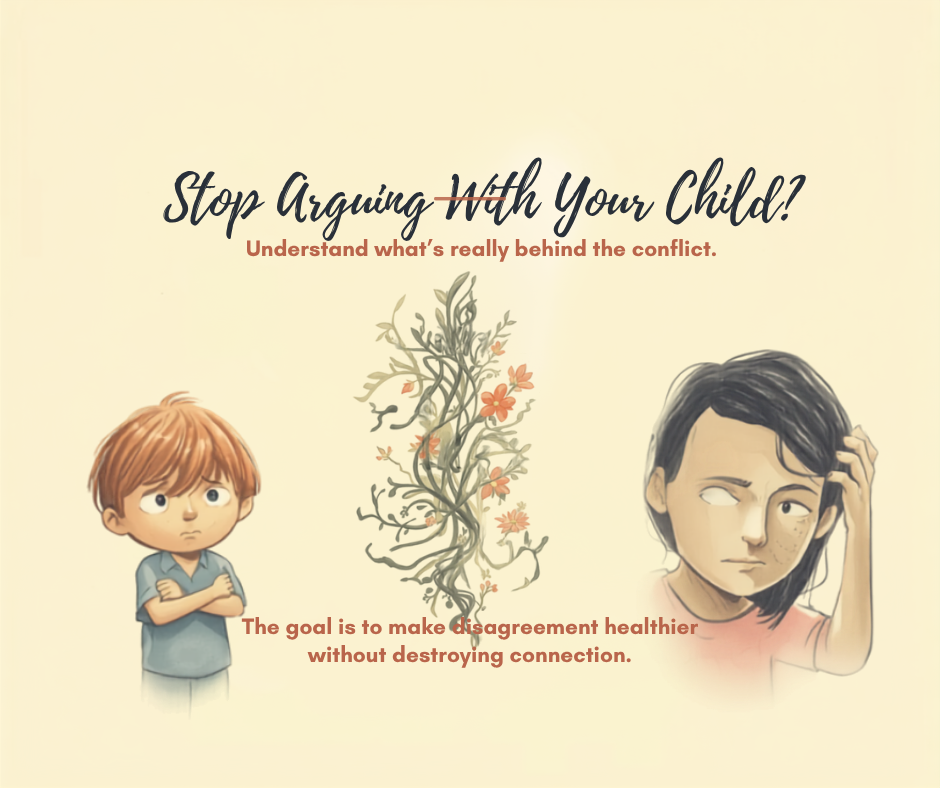
The goal is to make disagreement healthier without destroying connection.
Frequently Asked Questions
Why does my child argue with me about everything?
Repeated arguments can arise from changing independence, communication patterns, boundaries, expectations or unresolved concerns. Look for recurring patterns rather than focusing only on individual arguments.
Why doesn't my child listen to me?
Resistance can have many causes. Your child may want greater autonomy, disagree with a rule, feel unheard or react to how an instruction is communicated. Understanding the reason behind resistance can be more productive than simply increasing pressure.
How can I stop arguing with my child?
Choose calmer moments, listen before advising, avoid personal criticism and involve your child in age-appropriate decisions. The objective is not to eliminate disagreement but to create healthier disagreement.
Why has my child become distant from me?
Growing independence is one possibility, but distance can have many causes. Avoid immediately assuming the reason. Create opportunities for non-judgmental conversation and pay attention to broader changes in behaviour.
Can Vedic astrology explain parent-child conflict?
Vedic astrology can provide a traditional framework for exploring family relationships, emotional patterns and communication tendencies. It should be treated as a perspective for reflection, not a definitive explanation.
Can AskVedicaa analyse a parent-child relationship?
AskVedicaa can help explore a specific parent-child question through relevant Vedic astrology factors when the required birth details are available. A focused question can provide more useful guidance than a generic compatibility verdict.
Should I use astrology to make decisions for my child?
No single system should replace the child's voice, education, real-world experience or appropriate professional advice. Astrology is better used as one perspective that helps parents reflect on patterns, options and choices.
What should I do if my child refuses to talk to me?
Avoid turning every interaction into an interrogation. Create low-pressure opportunities for connection, listen without immediately correcting and communicate that your child can approach you without automatically receiving criticism or a lecture.
Your Child Doesn't Need a Perfect Parent
They need a parent who is willing to understand.
There will still be arguments.
There will still be rules.
There will still be moments when you say no.
There will be times when your child thinks you are completely wrong.
That is part of growing up.
The goal is not to create a relationship where nobody disagrees.
It is to create one where: Disagreement does not destroy connection.
Years from now, your child may not remember every argument about homework, screen time or bedtime.
They may remember something much more important:
Did I feel heard?
Did I feel trusted?
Did I feel respected?
Did I feel that I could come home and talk?
Perhaps that is the real purpose of understanding family relationships.
Not to find out who is right.
But to understand each other well enough to stay connected.
Vedic guidance can play a meaningful role in that process—not by replacing the relationship, but by helping you ask better questions about it.
Education before prediction.
Guidance before certainty.