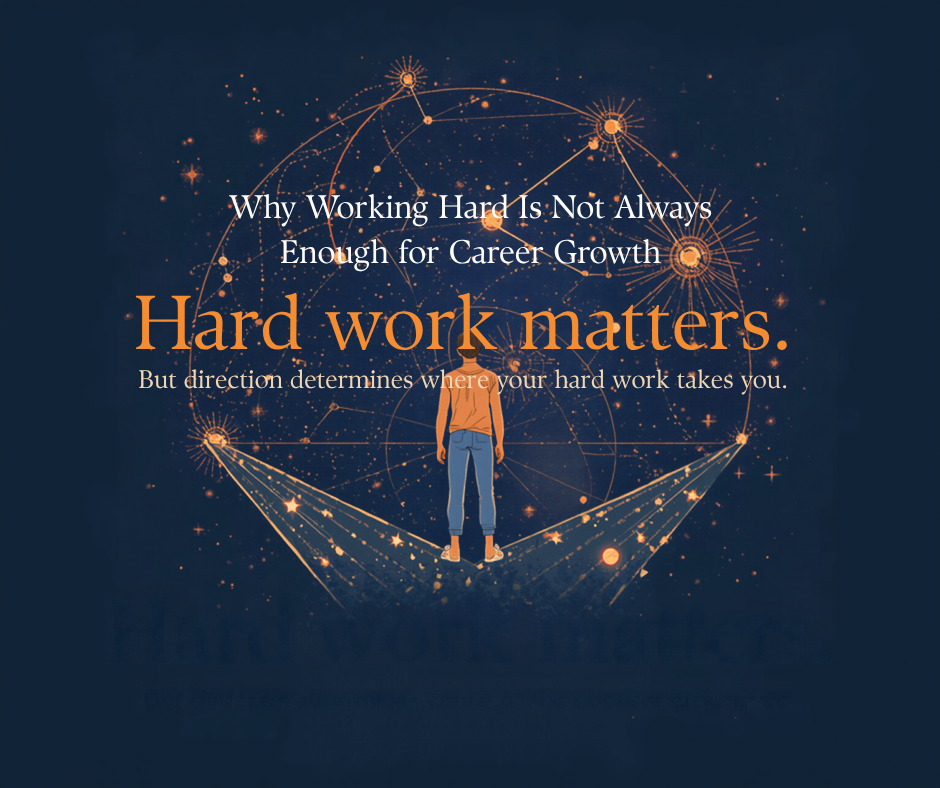
He Stopped Working Harder Because He Finally Understood the Problem
Arjun had become the person everyone depended on.
If a project was delayed, Arjun fixed it.
If a client was unhappy, Arjun handled it.
If a colleague needed help, Arjun stayed late.
He was reliable.
Responsible.
Available.
And tired.
For years, he believed this was how careers worked.
You work harder.
People notice.
You grow.
So when promotion season arrived, Arjun expected his name to come up.
It didn't.
Another colleague was promoted.
Then another.
Arjun congratulated them.
He smiled.
And then went home wondering what he was doing wrong.
The obvious answer seemed to be:
"I need to work harder."
So he did.
He arrived earlier.
Stayed later.
Accepted more responsibility.
Said yes to more requests.
Six months later, he was more exhausted.
But not more successful.
That was when Arjun finally asked a different question.
"What if working harder is not the problem?"
It was an uncomfortable thought.
Because if effort was not enough, he had to learn something his education and experience had not taught him.
Career growth requires more than effort. It requires direction.
The Dangerous Belief That Hard Work Automatically Gets Recognised
Most of us grow up with a simple formula.
Study hard.
Work hard.
Be honest.
Do good work.
Success will follow.
There is truth in this.
Hard work matters.
Competence matters.
Reliability matters.
But workplaces are complex systems.
Opportunities are influenced by:
- Business priorities.
- Leadership needs.
- Organisational structure.
- Visibility.
- Relationships.
- Communication.
- Timing.
- Available roles.
- Economic conditions.
This means two equally hardworking people can experience very different career outcomes.
That is not always fair.
But understanding it helps you stop using more effort as the answer to every career problem.
Hard Work Can Make You Valuable Without Making You Visible
This is one of the most common professional traps.
You become extremely valuable to your team.
But only a small group of people knows it.
Your manager may know how much you contribute.
Your immediate colleagues may depend on you.
But the people making promotion decisions may see only the final result.
Not the person who made it possible.
This does not mean you should constantly promote yourself.
It means you need to learn how to communicate your impact.
Ask yourself:
- Do senior decision-makers know what I contribute?
- Can I clearly explain the results I create?
- Do I take credit for my work appropriately?
- Are my achievements documented?
- Am I visible beyond my immediate manager?
Visibility is not arrogance.
It is making your contribution understandable.
Promotion Is Not Always a Reward for Effort
Arjun believed promotion was a reward.
Work hard.
Earn promotion.
But organisations often promote people based on what the next role requires.
A senior role may require:
- Decision-making.
- Strategic thinking.
- Communication.
- Stakeholder management.
- Team leadership.
- Business understanding.
- Influence.
You may be the best individual contributor in the room.
But leadership may require a different set of skills.
This creates an important question:
"Am I demonstrating the capabilities required for the career level I want?"
Working harder at your current role may not prepare you for your next one.
Sometimes career growth requires working differently.
The Difference Between Being Busy and Building a Career
Being busy can feel productive.
Your calendar is full.
Your inbox is overflowing.
People constantly need you.
But activity and progress are not always the same.
At the end of a difficult month, ask yourself:
What did I complete?
What did I learn?
What became easier because of my work?
What relationships did I build?
What skill did I strengthen?
What opportunity did I create for myself?
If you cannot answer these questions, you may be spending energy without building professional momentum.
This is where career stagnation often begins.
Not because the person is lazy.
But because their effort is disconnected from a longer-term direction.
Confidence Can Quietly Influence Career Growth
Confidence does not always look like speaking loudly.
Sometimes confidence means:
- Asking for responsibility.
- Sharing an idea.
- Applying for a role.
- Negotiating compensation.
- Saying no.
- Leaving an unhealthy environment.
- Admitting you need to learn something.
A lack of confidence can keep talented people invisible.
They wait until they feel completely ready.
They assume others are more qualified.
They avoid leadership opportunities.
Then they watch less experienced people move ahead.
Confidence does not replace competence.
But competence that is never expressed can remain unnoticed.
The Promotion Question Arjun Had Never Asked
After another disappointing year, Arjun finally spoke openly with his manager.
He asked:
"What would I need to demonstrate to move into the next level?"
The answer surprised him.
Nobody questioned his effort.
Nobody questioned his reliability.
His manager's concern was different.
Arjun was excellent at solving problems himself.
But senior roles required developing others.
He was known for execution.
But he needed more strategic visibility.
He completed work.
But rarely explained the broader business impact.
For the first time, Arjun understood something important.
He was not necessarily being held back because he lacked ability.
He was being evaluated against criteria he had never clearly understood.
Career Growth Requires Feedback You May Not Want to Hear
One of the fastest ways to remain stuck is to ask only:
"Am I doing a good job?"
Most managers will say yes.
A better question is:
"What would prevent me from succeeding at the next level?"
That question can produce uncomfortable answers.
Maybe you need stronger communication.
Maybe your technical skills are excellent but your leadership skills are weak.
Maybe you need more visibility.
Maybe you are not ready yet.
Maybe the organisation has no real path for growth.
All of these answers are useful.
Clarity can be uncomfortable.
But confusion is more expensive over time.
Career Growth Also Depends on the Environment
Sometimes the problem is not you.
This needs to be said clearly.
You can be talented.
Hardworking.
Experienced.
And still remain stuck because:
- The organisation has limited growth opportunities.
- Your manager does not support development.
- Promotions are based on politics.
- The company is shrinking.
- Your role has limited visibility.
- There is no next-level position.
In such situations, working harder may not change the outcome.
You may need to ask:
"Am I trying to grow in an environment that cannot support my growth?"
That is a very different problem from lacking skills.
And it requires a different solution.
What Vedic Astrology Can Add to Career Reflection
When people experience repeated delays, they often turn to Vedic Astrology with questions such as:
"Why is my career not progressing?"
Traditional Vedic analysis may examine several factors relevant to professional life, depending on the person's chart and question.
These may include:
- Career-related houses.
- Relevant planetary placements.
- Planetary relationships.
- Dasha.
- Broader timing considerations.
Saturn is also frequently discussed in relation to professional life because of its traditional associations with:
- Discipline.
- Responsibility.
- Persistence.
- Structure.
- Long-term effort.
However, it is important not to reduce career stagnation to one planet.
If your career is not progressing, practical factors may include:
- Lack of skills.
- Lack of visibility.
- Poor career strategy.
- Limited opportunities.
- Burnout.
- An unhealthy workplace.
A responsible Vedic perspective should encourage reflection—not create excuses.
Career Timing: When Effort Takes Time to Become Results
There are periods when effort seems invisible.
You work.
You learn.
You build.
Nothing appears to change.
Then, suddenly, an opportunity arrives.
This does not always mean the opportunity appeared from nowhere.
Sometimes years of preparation finally become visible.
Traditional Vedic timing systems such as Dasha may offer another perspective for understanding different phases of life.
But timing should not encourage passivity.
The most useful approach is:
Prepare during uncertainty.
Build during slow periods.
Learn during transition.
Act when opportunities become available.
The future may involve timing.
But timing rewards preparation more often than waiting.
The Practical Career Growth Audit
If you feel stuck despite working hard, assess these seven areas.
1. Skills
What capability will your next role require that you do not yet have?
2. Visibility
Do the right people understand your contribution?
3. Leadership
Are you only completing work, or are you helping others succeed?
4. Relationships
Have you built meaningful professional relationships beyond your immediate team?
5. Confidence
Are you avoiding opportunities because you don't feel completely ready?
6. Environment
Does your organisation genuinely offer a path for growth?
7. Direction
Do you know what you are trying to grow toward?
This last question may be the most important.
Working hard without direction can lead to exhaustion.
Working with purpose can create momentum.
AskVedicaa and Career Growth Questions
Career concerns are rarely isolated.
Someone asking about promotion may actually be dealing with:
- Lack of confidence.
- Leadership challenges.
- Burnout.
- Office politics.
- Poor career timing.
- Loss of purpose.
AskVedicaa allows you to begin with your actual concern and explore it conversationally.
You might start with:
"I am working hard, but my career is not progressing."
Then explore:
"Could my current workplace be limiting my growth?"
"Should I focus on leadership or changing companies?"
"What does my current Dasha traditionally indicate about this phase?"
"What practical steps should I take next?"
The purpose is not simply to provide a prediction.
It is to help you explore the question from multiple perspectives.
Frequently Asked Questions
Why am I working hard but not getting promoted?
Hard work is important, but promotions may also depend on leadership capability, visibility, communication, organisational opportunities and the requirements of the next role.
Is working harder the solution to career stagnation?
Not always. If the problem is lack of visibility, missing skills, poor career strategy or limited organisational opportunities, additional effort alone may not solve it.
How can I make my work more visible?
Document achievements, communicate outcomes clearly, participate in relevant cross-functional work and ensure your manager understands your career goals and contributions.
Can lack of confidence affect career growth?
Yes. Low confidence can prevent capable professionals from pursuing opportunities, communicating their achievements or taking on leadership responsibilities.
Can Vedic Astrology explain career delays?
Traditional Vedic Astrology can offer perspectives on career tendencies and timing. However, practical circumstances, skills, opportunities and decisions also significantly influence professional outcomes.
What should I do if my company has no growth opportunities?
Assess whether you can develop new responsibilities internally. If there is genuinely no path forward, exploring external opportunities may be a practical option.
Arjun did not stop working hard.
That was never the lesson.
He simply stopped believing that more effort was the answer to every problem.
He began asking better questions.
He learned what the next role required.
He communicated his impact.
He developed leadership skills.
He paid attention to the environment around him.
And most importantly, he stopped measuring career progress only by how exhausted he was at the end of the day.
Because exhaustion is not always evidence of progress.
Sometimes, the hardest-working person in the room needs to pause and ask:
"Is all this effort taking me where I actually want to go?"
That question can change a career.
Explore Your Career Question with AskVedicaa
If you are working hard but still feel professionally stuck, begin with the situation you are actually facing.
Ask about growth.
Promotion.
Timing.
Leadership.
Confidence.
Purpose.
Explore traditional Vedic perspectives alongside practical career thinking.
Then focus your effort where it can create real movement.
Hard work matters.
But direction determines where your hard work takes you.