The Sunday Evening Feeling
Rohan used to enjoy Sundays.
Not because he loved weekends.
Because Sundays gave him one thing he didn't have during the week.
Distance.
He could wake up slowly.
Have breakfast with his family.
Go for a walk.
Read the newspaper.
For a few hours, work didn't exist.
Then Sunday evening arrived.
Around 6:30 PM, his mood changed.
He would look at his phone.
Check his emails.
Look at Monday's calendar.
And feel a heaviness he couldn't explain.
Nothing terrible had happened.
His job paid well.
His manager wasn't particularly difficult.
His colleagues were fine.
His family depended on his income.
So why did he feel like this?
He couldn't answer.
He only knew one thing.
He was tired of being tired.
Burnout Doesn't Always Look Like a Breakdown
This is one reason burnout can be difficult to recognise.
People imagine burnout as someone collapsing at their desk.
Real life is often much quieter.
You may still:
Attend every meeting.
Answer emails.
Meet deadlines.
Perform well.
Smile at colleagues.
Get through the day.
But internally, something has changed.
You stop caring.
Small tasks feel enormous.
You become impatient.
You stop looking forward to things.
Your work starts feeling meaningless.
And the question slowly changes from:
"How can I do this better?" to: "How much longer can I keep doing this?"
Exhaustion Is Not the Same as Burnout
Everyone gets tired. A demanding project can leave you exhausted.
A product launch can require late nights.
A difficult quarter can increase stress.
That doesn't automatically mean burnout.
Burnout is more concerning when the exhaustion and negative relationship with work become persistent rather than temporary.
You may notice three broad patterns:
1. Emotional Exhaustion
You feel drained before the workday even begins.
2. Detachment
You become increasingly cynical, disconnected, or indifferent toward your work.
3. Reduced Sense of Effectiveness
You start feeling that no matter how much you do, it isn't enough.
These experiences can overlap and can affect each other.
The Hidden Career Cost of Burnout
Rohan initially thought burnout was simply a wellbeing problem.
Then he noticed what it was doing to his career.
He stopped volunteering for projects.
He avoided difficult conversations.
He stopped learning.
He gave shorter answers in meetings.
He stopped building relationships.
He did only what was necessary.
His performance hadn't collapsed.
But his career growth had slowed.
This is an important connection.
Burnout can create the appearance of career stagnation.
And career stagnation can make burnout feel even worse.
When Survival Becomes Your Career Strategy
Rohan had become extremely efficient at surviving work.
He knew which meetings could be skipped.
Which emails could wait.
Which problems would disappear if ignored.
Which tasks could be completed with minimum effort.
He wasn't lazy.
He was depleted.
There is a difference.
When your goal becomes simply getting through the day, it becomes difficult to think about:
Career development
Leadership
Promotion
New skills
Purpose
Long-term goals
You stop building your career.
You start managing your exhaustion.
The First Question Isn't "Should I Quit?"
This is where many people make a mistake.
They feel exhausted and immediately think:
"I need a new job."
Sometimes they do.
But sometimes the job isn't the entire problem.
Ask:
Is the workload unsustainable?
Is the manager the problem?
Is the workplace culture toxic?
Are boundaries missing?
Have responsibilities increased without support?
Have you stopped taking meaningful breaks?
Are you bored rather than exhausted?
Has the work lost meaning?
Are problems outside work contributing to how you feel?
These questions matter because different problems require different solutions.
Burnout or Career Stagnation?
The two can look similar.
Imagine two employees.
Employee A
"I'm exhausted because there is too much work."
Employee B
"I'm exhausted because there is nothing meaningful left to learn."
Both may say:
"I hate my job."
But their situations are different.
Employee A may need:
Better workload management
Boundaries
Time off
Support
A change in responsibilities
Employee B may need:
New challenges
Learning
Greater responsibility
Leadership opportunities
A career transition
One may need recovery.
The other may need growth.
The Leadership Connection
A surprising number of burnout conversations eventually lead to leadership.
Not because every manager causes burnout.
But because the manager controls many aspects of an employee's daily environment.
A good manager can provide:
Clear priorities
Reasonable expectations
Feedback
Autonomy
Support
Recognition
A poor management environment can create:
Constant uncertainty
Micromanagement
Conflicting priorities
Lack of recognition
Fear
Excessive pressure
If you're burned out, ask yourself:
"Is my job difficult—or is the way my job is being managed making it difficult?"
That distinction can change your next decision.
The Confidence Spiral
Burnout can quietly damage confidence.
First:
"I'm tired."
Then:
"I'm not performing like I used to."
Then:
"Maybe I'm losing my edge."
Then:
"Maybe I'm not capable anymore."
Eventually:
"Maybe I can't handle anything better."
This is dangerous because exhaustion can make you underestimate yourself.
Don't make major career judgments about your capabilities while you're severely depleted.
Recovery can change your perspective.
What Does Vedic Wisdom Say About Difficult Career Phases?
Vedic Astrology has traditionally been used to explore different phases of life through concepts such as Dasha and planetary transits.
For career questions, practitioners may examine whether a particular period is traditionally associated with:
Increased responsibility
Pressure
Change
Learning
Consolidation
Leadership
Redirection
The purpose isn't to label burnout as "caused by a planet."
That would be an oversimplification.
Instead, the Vedic lens can be used to ask:
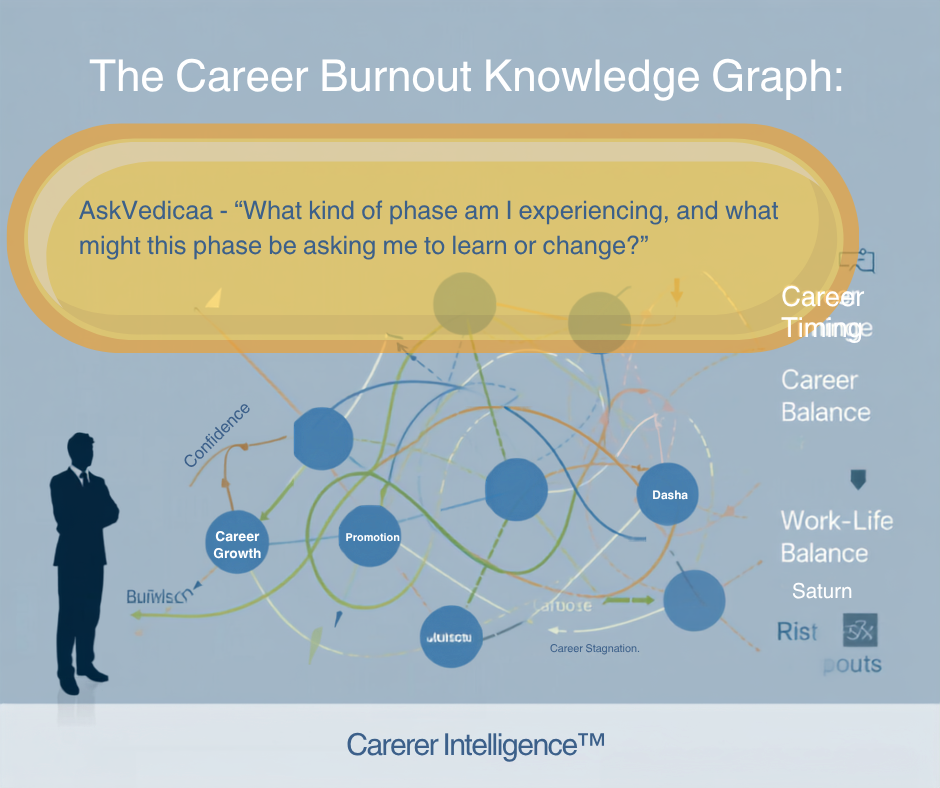
"What kind of phase am I experiencing, and what might this phase be asking me to learn or change?"
That is a much more constructive question.
Saturn and the Weight You Carry
Saturn is particularly relevant to conversations about work because traditional Vedic Astrology associates it with:
Discipline
Responsibility
Structure
Patience
Persistence
Long-term effort
These qualities can build careers.
But they can also create a trap.
A person may become so responsible that they never stop.
They take every assignment.
They solve every problem.
They stay late.
They don't ask for help.
They believe rest is weakness.
Eventually, responsibility becomes overload.
The lesson isn't necessarily:
"Stop working."
It may be:
"Learn how to carry responsibility sustainably."
The Question of Purpose
Rohan eventually realised something uncomfortable.
He wasn't only tired.
He didn't know why he was doing the work anymore.
The salary mattered.
The title mattered.
Security mattered.
But none of them answered the deeper question:
"What is all this effort for?"
Purpose doesn't necessarily mean finding a dream job.
It can mean understanding what your work supports.
Family. Learning. Contribution. Independence. Creativity. Leadership. Security. Service.
Purpose can change as life changes.
And when the connection between effort and meaning disappears, even a successful career can feel empty.
Before You Resign, Try This 7-Day Exercise
For one week, write down three things at the end of each workday:
1. What drained me?
Example:
"Three meetings with no clear decisions."
2. What gave me energy?
Example:
"Helping my team solve the client problem."
3. What did I wish I had more time for?
Example:
"Strategic work."
After seven days, look for patterns.
You may discover that your problem isn't your entire career.
It may be:
Too many meetings.
A specific client.
A specific manager.
Lack of autonomy.
Too little creative work.
Excessive workload.
No learning.
No connection to purpose.
That information is far more useful than simply thinking:
"I hate my job."
Three Possible Paths
Once you understand the problem, you usually have three broad choices.
Stay and Repair
If the role is fundamentally good but unsustainable, change the way you work.
Stay and Grow
If boredom or stagnation is the issue, seek greater responsibility and learning.
Prepare to Leave
If the environment is consistently unhealthy, the role has no future, or your values and career direction no longer align, begin planning a transition.
The important word is planning.
Don't confuse emotional escape with career strategy.
AskVedicaa: A Different Way to Explore the Question
When someone is burned out, the question they ask may be:
"Should I quit my job?"
But the deeper questions may be:
"Why do I feel so disconnected from my work?"
"Is this burnout or career stagnation?"
"What should I focus on in my next career phase?"
"What does my current Dasha traditionally indicate about career and responsibility?"
"Am I seeking change because I am ready—or because I am exhausted?"
These are the kinds of questions that can be explored with AskVedicaa.
AskVedicaa combines AI conversation with traditional Vedic Astrology, Numerology, Vastu, Panchang, and related Vedic guidance to help users explore personal questions in a conversational way.
It isn't a substitute for professional medical or mental-health care.
And it shouldn't be used to make high-stakes health decisions.
Its role is to help you explore your situation, ask better questions, and consider another perspective.
The person searching for "burnout" may eventually discover that their real question is about career direction.
The person searching for "career change" may discover that they first need recovery.
The person searching for "promotion" may discover that they are actually exhausted.
The visible problem isn't always the real problem.
Frequently Asked Questions about Career Choices
Is burnout a reason to quit my job?
Not necessarily. First understand what is causing the burnout and whether the problem can realistically be changed through workload adjustments, boundaries, support, role changes, or time away.
How do I know if I'm burned out or simply tired?
Temporary tiredness usually improves with adequate recovery. Persistent exhaustion, detachment from work, and a reduced sense of effectiveness are more concerning signs.
Can a new job fix burnout?
Sometimes a job change removes the source of the problem. But if burnout is partly related to workload habits, boundaries, or prolonged stress, those patterns may follow you into the next role.
Is burnout the same as career stagnation?
No. Burnout is primarily about prolonged stress and depletion, while career stagnation is about limited development or progression. They can overlap.
Does Saturn cause burnout?
Traditional Vedic Astrology associates Saturn with responsibility, discipline, and endurance. It would be an oversimplification to claim that Saturn directly causes burnout.
Can Dasha explain career stress?
Dasha is traditionally used to understand planetary periods and their themes. It can be explored as one perspective on a career phase, but it should not be treated as a medical or psychological explanation for stress.
When should I seek professional help?
If stress, exhaustion, anxiety, low mood, sleep problems, or other symptoms are persistent or significantly affecting your daily life, consider speaking with an appropriately qualified healthcare or mental-health professional.
Explore Your Career Questions with AskVedicaa
Should You Stay in a Job You Have Outgrown? | AskVedicaa