Vikram left his manager's office with mixed feelings. (Growth vs Promotion)
He had wanted a simple answer:
"Yes, you'll be promoted."
Instead, he got homework.
Lead a cross-functional project.
Develop two junior employees.
Present strategic recommendations to senior leadership.
His first reaction was frustration.
"Why should I have to prove myself again after seven years?"
Then he stopped.
Perhaps that was exactly the problem.
He was thinking about the promotion as a reward for his past.
The organisation was thinking about it as a decision about his future.
That distinction changed how he approached everything.
The Promotion Test Nobody Tells You About
If you want the next role, start behaving like the person who already has it.
Not by pretending.
By developing the capabilities the role requires.
If you want to become a manager, start developing people.
If you want to become a director, start thinking beyond your own function.
If you want to become an executive, learn to connect decisions with business outcomes.
The title should eventually become a reflection of the capability.
Not the source of it.
Vikram's First Challenge Wasn't Leadership
It was delegation.
He had always believed that doing important work himself was the safest option.
If something needed to be done properly, he did it.
That habit had helped him build his reputation.
It was now limiting him.
His manager noticed it immediately.
"You don't need to be the person who solves every problem," she told him.
"Your next role requires you to build people who can solve problems."
That sentence stayed with him.
Vikram had spent years becoming indispensable.
He now needed to become multipliable.
That is a difficult transition for many high performers.
From Performer to Leader
Individual contributors are often rewarded for personal excellence.
Leaders are judged differently.
They are expected to:
Create clarity. Develop people. Make decisions. Handle disagreements. Think strategically. Communicate effectively. Build trust.
Take responsibility when things go wrong.
The question changes from:
"How good are you?"
to:
"How much better does the team become because you are there?"
That is one of the biggest transitions in a professional career.
Then Came the Cross-Functional Project
The project involved three departments.
Marketing wanted speed.
Finance wanted control.
Technology wanted more time.
Vikram quickly discovered that being right wasn't enough.
Everyone had a different definition of success.
His job wasn't to win the argument.
His job was to create alignment.
That meant listening.
Negotiating.
Explaining.
Compromising.
And sometimes changing his own position.
At the end of the project, his manager told him:
"This is the first time I've seen you operate beyond your own function."
Vikram finally understood.
His previous work had proved he could execute.
This project was proving he could lead.
What About Office Politics?
Vikram also learned something else.
The people who were promoted weren't necessarily better than him.
But many of them were better at communicating their impact.
They knew how to build relationships.
They understood organisational priorities.
They could explain complex work simply.
They were visible to decision-makers.
This didn't mean they were manipulating the system.
They understood the system.
There is an important difference.
Healthy Professional Visibility
Healthy visibility means:
Sharing results.
Giving credit to your team.
Communicating business impact.
Building relationships.
Participating in important discussions.
Taking responsibility.
It does not mean:
Taking credit for others' work.
Manipulating colleagues.
Creating unnecessary alliances.
Playing people against one another.
The goal isn't to become political.
The goal is to become visible for the right reasons.
Knowledge Graph
Office Politics → Visibility → Reputation → Promotion
The Confidence Problem
Three months into the project, Vikram made a mistake.
A significant one.
His first instinct was to hide it.
Then he remembered something his manager had said:
"Leaders don't prove they never make mistakes. Leaders show people how to respond when mistakes happen."
So he acknowledged it.
Explained what went wrong.
Proposed a solution.
And took responsibility.
Something unexpected happened.
His team trusted him more.
Confidence isn't the belief that you'll never fail.
It's the belief that you can handle failure.
That distinction matters enormously when you're preparing for leadership.
Then Vikram Started Thinking About Timing
As the promotion process continued, Vikram became interested in another question.
Why do some career phases seem to move quickly while others feel painfully slow?
This is one reason people explore career timing in Vedic Astrology.
Traditional Jyotish may consider:
Planetary periods or Dasha
Transits
Career-related houses
Planetary strengths
Broader chart patterns
These are traditionally interpreted together rather than through a single planet or event.
For example, someone may explore whether a particular period is associated traditionally with greater responsibility, professional expansion, change, or consolidation.
But this should not be reduced to:
"My Dasha says promotion, therefore I will be promoted."
Real-world outcomes depend on performance, organisational circumstances, opportunity, preparation, and many other factors.
Vedic timing can provide context.
It cannot replace action.
Dasha Is About Periods, Not Guarantees
The idea of Dasha can be especially useful when people are trying to understand why different phases of life feel different.
A planetary period is traditionally interpreted as part of a larger sequence.
For career questions, someone may explore:
What themes are associated with the current period?
Is this traditionally viewed as a phase of responsibility?
Is it a period where learning or expansion receives greater emphasis?
How does it interact with the broader birth chart?
The important point is to avoid deterministic thinking.
A favourable period doesn't mean you can stop working.
A challenging period doesn't mean you should give up.
The more useful interpretation is:
Understand the phase. Prepare intelligently. Act responsibly.
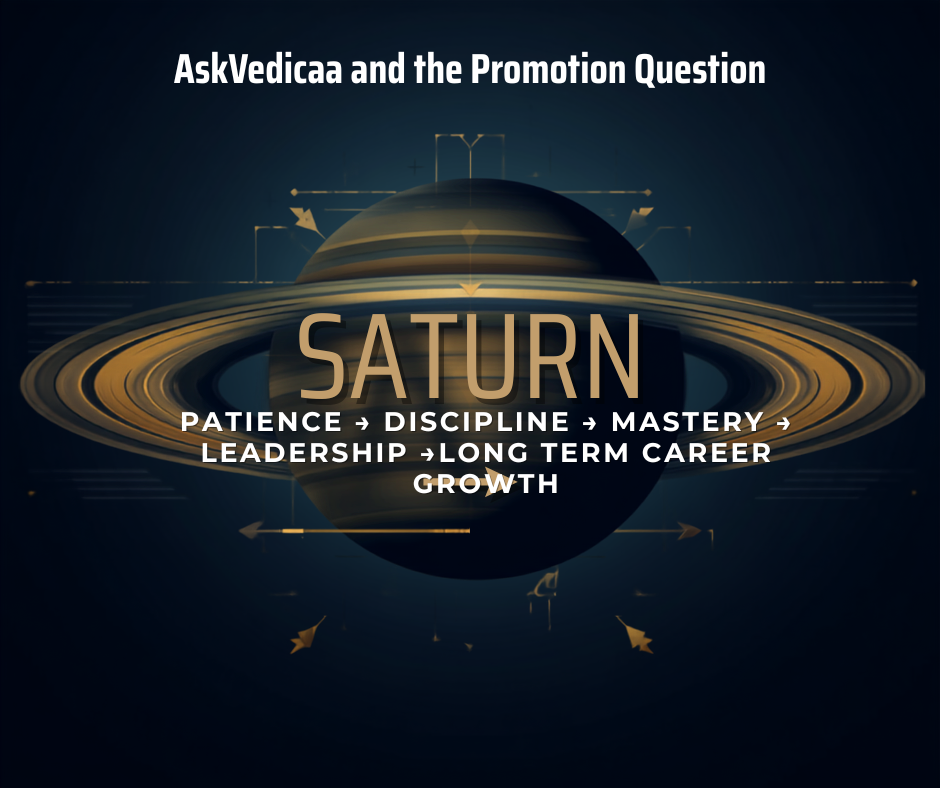
And Then There Was Saturn
Vikram returned to the same planet he had heard about throughout his life.
Saturn.
In traditional Vedic Astrology, Saturn is associated with discipline, responsibility, patience, structure, persistence, and gradual results.
That makes Saturn particularly interesting when thinking about career development.
Because professional mastery rarely happens quickly.
Consider almost any meaningful skill:
Leadership.
Medicine.
Engineering.
Management.
Entrepreneurship.
Public speaking.
Expertise takes time.
Saturn's traditional symbolism reminds us that some achievements are built through repetition rather than sudden breakthroughs.
So when career growth feels slow, one useful question is:
"What foundation am I building that will still matter five years from now?"
That question is often more productive than:
"Why is everyone else moving faster?"
Six Months Later
Vikram's manager called him into her office.
This time, he wasn't nervous.
She smiled.
"How do you think you've changed?"
Vikram thought about it.
He had learned to delegate.
He had learned to influence without authority.
He had become more comfortable presenting to senior leaders.
He had stopped measuring himself entirely through recognition.
And, perhaps most importantly, he had stopped waiting for someone to give him permission to lead.
His manager finally said:
"We're recommending you for the next level."
Vikram smiled.
But he noticed something surprising.
The promotion didn't feel like the victory he had imagined six months earlier.
Because he had already won something more important.
He had become ready.
The Promotion Was a Result, Not the Transformation
This is something many professionals misunderstand.
They believe:
Promotion → Confidence → Leadership
Often, it works the other way:
Leadership → Confidence → Capability → Visibility → Promotion
The title comes later.
That is why waiting for the promotion before behaving like a leader can keep you waiting indefinitely.
Build the capability first.
Make the impact visible.
Then let the organisation decide.
What If You Still Don't Get Promoted?
This is important.
Even after doing everything right, you may not get promoted.
Organisations have budgets.
Positions may be limited.
Business conditions change.
Someone else may be selected.
Timing can be imperfect.
If that happens, don't automatically conclude that your effort was wasted.
Ask:
What did I learn?
What capability did I build?
Is there a realistic path forward here?
Have I received clear feedback?
Would another organisation value these capabilities more?
Now the career decision becomes much clearer.
You aren't leaving because you're angry.
You're evaluating whether your current environment can support the person you've become.
When a Promotion Delay Becomes a Career Decision
There is a point where patience stops being strategic.
If you've:
Consistently performed well.
Asked for clear feedback.
Developed the required capabilities.
Increased your visibility.
Taken on greater responsibility.
Communicated your career goals.
Given the organisation reasonable time.
...and there is still no meaningful path forward, it's reasonable to explore alternatives.
That isn't failure.
It is career management.
Knowledge Graph
Promotion Delay → Career Stagnation → Career Change → Career Timing
AskVedicaa and the Promotion Question
This is where AskVedicaa can become useful as a thinking partner.
Instead of asking only:
"When will I get promoted?"
you can ask:
"Why might my career feel stuck?"
"What areas should I focus on for career growth?"
"How does my Vedic chart traditionally relate to leadership and professional development?"
"What does my current Dasha traditionally indicate about career responsibilities?"
"Should I consider changing organisations if my career has remained stagnant?"
These questions create a much richer conversation.
AskVedicaa can bring together traditional Vedic Astrology, Numerology, Vastu, Panchang, and AI-powered conversation to help users explore the issue from multiple perspectives.
The goal is not to promise a promotion.
The goal is to help the user understand the question behind the question.
This is exactly why the AskVedicaa Career Intelligence™ library should never be built as isolated articles.
Each question should open a door to the next question.
A Practical Promotion Plan
If you're currently waiting for a promotion, don't wait passively.
This Week
Ask your manager:
"What three things would I need to demonstrate to be considered ready for the next level?"
Write down the answer.
This Month
Choose one capability to demonstrate.
Don't simply learn it.
Use it.
Next 90 Days
Track:
Results.
Business impact.
Leadership examples.
Stakeholder feedback.
Team contributions.
Every Quarter
Have a career conversation.
Ask:
"Am I moving closer to the next level? What evidence is still missing?"
This turns promotion from a vague hope into a measurable development plan.
Frequently Asked Questions
Why am I not getting promoted despite working hard?
Hard work matters, but promotion decisions may also depend on leadership ability, visibility, strategic thinking, organisational needs, communication, and readiness for the next role.
Should I ask my manager directly about promotion?
Yes. A constructive conversation about expectations, skills, and evidence of readiness can be far more useful than silently waiting.
How long should I wait for a promotion?
There is no universal timeframe. Consider your performance history, development opportunities, organisational structure, and whether your employer has provided a credible path forward.
Can Saturn cause promotion delays?
In traditional Vedic Astrology, Saturn is associated with themes such as patience, responsibility, discipline, and gradual results. It is not accurate to assume that every promotion delay is caused by Saturn.
Can Dasha predict my promotion?
Dasha is traditionally used to understand planetary periods and their themes. It should not be treated as a guarantee of a specific promotion or career event.
What should I do if I am repeatedly passed over?
Ask for specific feedback, identify the capabilities needed for the next level, increase your visibility, and create a measurable development plan. If meaningful advancement remains unavailable despite sustained effort, consider external opportunities.
Explore Your Career Questions with AskVedicaa
If you're waiting for a promotion, feeling overlooked, struggling with career stagnation, or wondering whether it's time to move on, explore your situation with AskVedicaa.
Ask the difficult question.
Understand the practical reality.
Explore the traditional Vedic perspective.
Then decide your next step with greater clarity.
Your promotion may be delayed.
Your growth doesn't have to be.