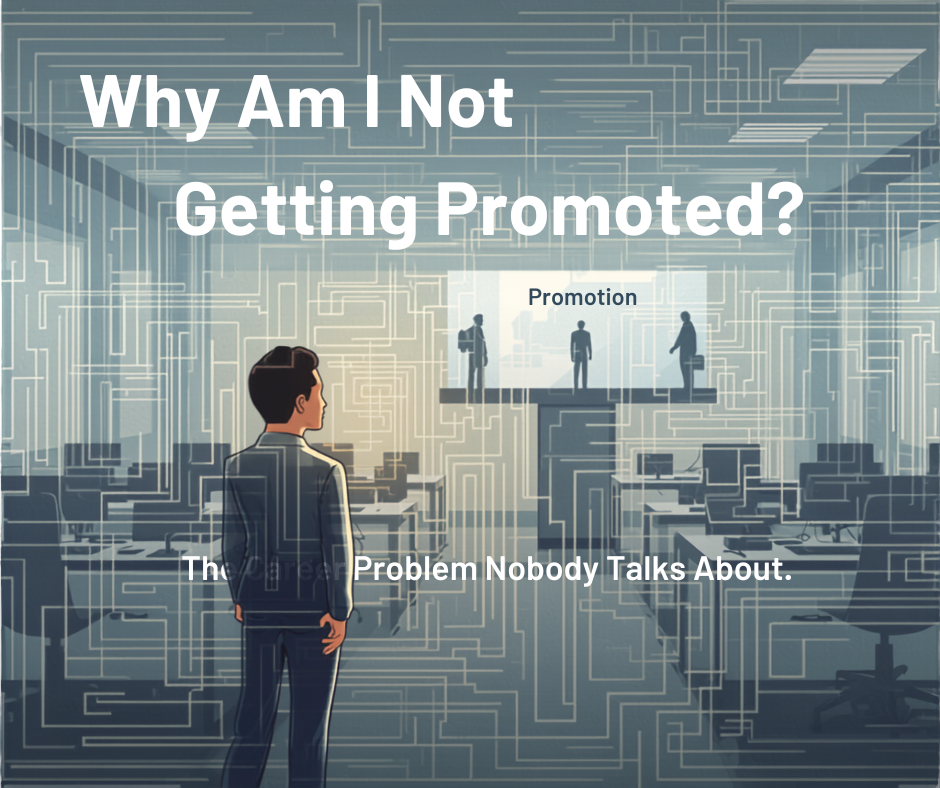
7 Reasons Your Career May Be Stuck
The Email Came at 6:13 PM
Vikram knew before he opened it.
He had been waiting for the promotion announcement for three weeks.
His phone buzzed.
Subject: Congratulations to our newly promoted leaders
He opened the email.
Scrolled.
Once.
Twice.
He closed it.
Opened it again.
Still nothing.
For a few seconds, he stared at the screen.
Then he leaned back in his chair.
Seven years.
Seven years of late nights.
Seven years of taking difficult projects.
Seven years of being the person everyone called when something went wrong.
He had trained new employees.
Stayed late for clients.
Covered for managers.
Delivered projects nobody else wanted.
And yet someone with less experience had been promoted.
Again.
His first thought was anger.
His second was embarrassment.
His third was much quieter.
"Maybe I'm just not good enough."
That thought hurt more than the email.
When Hard Work Stops Feeling Valuable
This is where many careers begin to change.
Not when someone resigns.
Not when they receive a bad appraisal.
But when they stop believing their effort matters.
You can work hard for years and still feel invisible.
And when that happens, two things usually follow.
You either become louder...
or you become quieter.
Some employees start fighting for recognition.
Others simply stop trying.
Both reactions can damage a career.
Because the real question isn't:
"Why didn't I get promoted?"
It is:
"What does the organisation need to see before it can trust me with the next level?"
That is a much more useful question.
Performance Is Not the Same as Promotion Readiness
Vikram had made a common mistake.
He assumed that doing his current job exceptionally well would automatically qualify him for the next job.
But promotions often work differently.
A company may ask:
Can this person perform their current responsibilities?
But leadership decisions often ask:
Can this person handle responsibilities they haven't handled before?
Those are different questions.
You can be the best individual contributor on the team and still not be ready—or perceived as ready—for leadership.
The next role may require:
Decision-making
Communication
Delegation
Influence
Strategic thinking
Conflict management
Stakeholder management
Coaching others
Your performance proves what you've done.
Leadership potential suggests what you can do next.
The Invisible Employee
A few days after the promotion announcement, Vikram's manager called him.
"I want you to know something," she said.
"You're one of our strongest performers."
Vikram waited.
"Then why wasn't I promoted?"
His manager paused.
"Because your work is excellent."
Another pause.
"But not enough people know how much you contribute."
Vikram didn't like the answer.
But he needed to hear it.
He had always believed that good work speaks for itself.
It doesn't always.
In large organisations, visibility matters.
Not self-promotion.
Visibility.
There is a difference.
Your manager needs to know what you achieved.
Senior leaders need to understand the impact.
Stakeholders need to trust you.
If your contribution remains invisible, someone else may receive credit for work you helped create.
The Office Politics Problem
The phrase "office politics" makes many good employees uncomfortable.
They imagine manipulation.
Favouritism.
Backroom conversations.
And sometimes those things exist.
But organisational politics has a broader meaning.
Whenever people make decisions about resources, promotions, budgets, influence, and priorities, relationships matter.
You don't need to become political.
But you do need to understand the environment in which your career operates.
Ask yourself:
Who influences promotion decisions?
Who knows the impact of your work?
Do senior stakeholders recognise your contribution?
Do colleagues trust you?
Are you known only as someone who executes—or someone who solves problems?
These questions aren't about playing games.
They're about understanding how organisations actually work.
Then Vikram Made Another Discovery
He looked at his last three performance reviews.
Something jumped out.
Every review praised the same things:
Reliable.
Hard-working.
Strong execution.
Consistent delivery.
But there was almost nothing about:
Leadership.
Strategic thinking.
Influence.
Team development.
That was his clue.
The company wasn't necessarily saying:
"You're not good enough."
It might have been saying:
"We're not yet seeing enough evidence that you're ready for the next role."
Those are very different messages.
Promotion Delays Can Become Confidence Problems
The longer promotion takes, the more personal it becomes.
First you think:
"Why didn't I get promoted?"
Then:
"Maybe my manager doesn't value me."
Then:
"Maybe I'm not leadership material."
Eventually:
"Maybe I'll never move forward."
This is where career confidence becomes important.
A promotion delay can become a self-fulfilling cycle.
Low confidence reduces visibility.
Lower visibility reduces opportunities.
Fewer opportunities reinforce low confidence.
And the cycle continues.
Breaking that cycle often begins with one decision:
Stop measuring your worth by one promotion.
A promotion is an organisational decision.
Your capability is something you can continue building.
A Vedic Perspective on Delayed Success
This is where Vikram became curious about something his father had mentioned many times.
Saturn.
In traditional Vedic Astrology, Saturn is often associated with discipline, responsibility, patience, persistence, and gradual results.
It is easy to reduce that to:
"Saturn causes delays."
But that misses the deeper idea.
A delayed result can sometimes become a period of preparation.
A person who receives responsibility too early may not be ready to carry it.
A person who spends years developing discipline may eventually be capable of handling much greater responsibility.
This doesn't mean every promotion delay is caused by Saturn.
Nor does it mean you should simply wait.
The more constructive question is:
"What capability is this period asking me to build?"
For Vikram, the answer seemed obvious.
He needed to move from being an excellent executor to becoming a visible leader.
The Question That Changed Vikram's Approach
Instead of asking his manager:
"When will I get promoted?"
he asked:
"What would you need to see from me to confidently recommend me for the next level?"
The conversation lasted forty minutes.
It was uncomfortable.
But it was useful.
His manager gave him three areas:
Lead a cross-functional project.
Develop two junior team members.
Present strategic recommendations to senior leadership.
For the first time, Vikram had something more valuable than a promise.
He had a roadmap.