
You work hard for a promotion, but keep checking whether your manager noticed.
You love someone, but constantly worry about whether they will stay.
You build a business, but become consumed by every sale, customer response and number.
You make an important decision, then replay it in your mind wondering whether everything will work out.
You may tell yourself:
“I need to stop caring so much.”
But perhaps caring is not the problem.
Perhaps you have become attached to an outcome you cannot completely control.
This is where the Vedic idea of detachment becomes much more useful than the way the word is commonly understood.
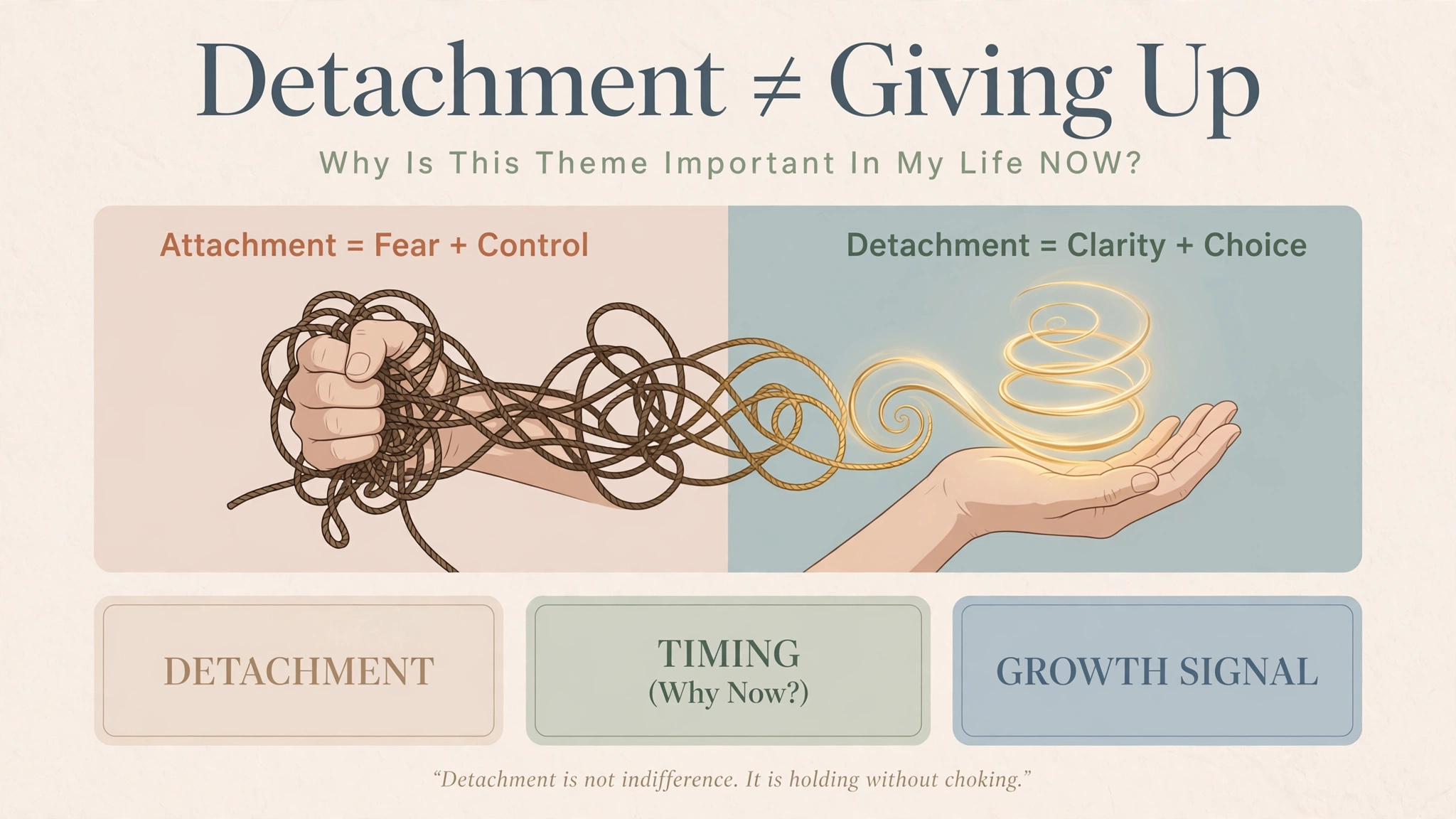
Detachment does not mean withdrawing from life. It means learning to act fully without allowing your inner peace to depend completely on the result.
What Does Detachment Actually Mean?
When people hear the word detachment, they may imagine someone who has stopped caring.
That is not the only way to understand it.
A practical interpretation is: Do what is yours to do. Give the outcome the space to unfold.
You can still have ambition.
You can love your family.
You can build wealth.
You can want recognition.
You can pursue a relationship.
You can work toward an important goal.
The difference is your relationship with the result.
Attachment says: “I need this outcome to happen for me to be okay.”
Detachment says: “I will give this my best effort, but I will not make my inner stability completely dependent on the outcome.”
That is a very different way of living.
Why Is Detachment So Difficult?
Because the mind wants certainty.
When something matters to you, you naturally want answers:
- Will I get the promotion?
- Will this relationship work?
- Will my business succeed?
- Will my investment pay off?
- Will my child make the right choice?
- Did I make the right decision?
- What if everything goes wrong?
When the outcome is uncertain, the mind often tries to regain control.
You check.
You analyse.
You seek reassurance.
You replay conversations.
You imagine future scenarios.
You try to predict what other people will do.
Eventually, something subtle can happen.
The original goal becomes secondary. Controlling the outcome becomes the goal.
That is where attachment can become exhausting.
Detachment Is Not the Same as Giving Up
This is one of the most important distinctions.
Giving up says: “It doesn't matter anymore.”
Detachment says: “It matters, but I cannot control everything about it.”
Imagine someone preparing for an important examination.
Attachment might sound like: “If I don't clear this exam, my future is finished.”
Detachment sounds more like: “This exam matters to me. I will prepare seriously, use my time well and give it my best effort. The final result is not entirely within my control.”
The second position does not reduce commitment.
It can reduce the psychological pressure created by making one result responsible for your entire future.
So detachment is not necessarily less effort.
It can mean less unnecessary mental struggle around the effort.
What Does the Bhagavad Gita Say About Detachment?
One of the best-known Vedic teachings related to this subject appears in the Bhagavad Gita.
The teaching associated with karma yoga emphasises action without excessive attachment to the fruits of action.
This does not mean that results are irrelevant.
It creates a distinction between what you can influence through your actions and what remains outside your complete control.
You can influence:
- how prepared you are
- how honestly you communicate
- how consistently you work
- whether you keep your commitments
- how you respond to setbacks
- whether you learn from mistakes
But you cannot completely control:
- another person's reaction
- market conditions
- organisational decisions
- exact timing
- unexpected events
- other people's choices
- every consequence of your actions
Detachment begins when you learn to separate the two.
What Are You Actually Attached To?
Sometimes the obvious goal is not the real attachment.
You may think:
“I want this promotion.”
But underneath that could be:
“I need recognition.”
You may think:
“I want this relationship to work.”
But underneath it could be:
“I am afraid of being alone.”
You may think:
“I need this business to succeed.”
But underneath it could be:
“I need to prove that I was right.”
This is why simply telling yourself to “let go” rarely solves the problem.
First ask: What am I actually holding on to?
A useful exercise is to complete this sentence: “If this does not happen, I am afraid that ______.”
Your answer may reveal more than the goal itself.
Detachment Can Exist Alongside Ambition
Detachment does not require you to stop wanting things.
Vedic thought recognises legitimate human pursuits through the framework of the Purusharthas:
- Dharma — responsibility, right conduct and purpose
- Artha — material security and prosperity
- Kama — desires, enjoyment and meaningful experiences
- Moksha — liberation and spiritual freedom
Wanting success, money, love or achievement is not automatically incompatible with Vedic wisdom.
The deeper question is:
Can you pursue these things without allowing them to completely define your inner state?
You can pursue Artha while practising detachment.
You can love someone deeply while recognising that another person cannot be completely controlled.
You can pursue professional achievement while understanding that your job title does not define your entire identity.
Detachment is therefore not necessarily about wanting less.
It can be about depending less on external outcomes for inner stability.
What Does Vedic Astrology Add to This?
Vedic astrology can provide a reflective framework for exploring themes involving attachment, security, uncertainty and letting go.
But the interpretation should come from the complete birth chart, not from one isolated planet or house.
Depending on the question, several factors may become relevant.
The Moon
The Moon is traditionally associated with the mind, emotional responses, habits and psychological experience.
Its placement, strength and associations may be examined when exploring emotional security, uncertainty and change.
The 4th House
The 4th house relates to home, emotional foundations, inner contentment and security.
It may therefore become relevant when attachment involves familiarity, comfort, home or emotional safety.
The 5th House
The 5th house has associations with intelligence, creativity, affection, personal expression and what we invest ourselves in emotionally.
It can become relevant when exploring attachment to recognition, relationships, personal achievement or one's creations.
The 8th House
The 8th house is traditionally associated with transformation, uncertainty, shared resources and experiences that can force us to confront what cannot be completely controlled.
It may therefore become relevant when examining how someone responds to major change or uncertainty.
The 12th House
The 12th house has traditional associations with release, withdrawal, expenditure, solitude and liberation.
In a spiritual context, it can offer another perspective on surrender and letting go.
Mahadasha and Antardasha
Timing also matters.
A birth chart may contain many tendencies, but particular themes can become more noticeable during certain Mahadasha and Antardasha periods.
That changes the question.
Instead of only asking: “Why am I like this?”
you may also ask: “Why is this particular theme becoming important in my life now?”
That creates room for context instead of reducing your entire experience to one astrological placement.
Detachment Does Not Mean Accepting Everything
This is another important distinction.
Detachment does not mean:
- staying in an unhealthy situation
- tolerating disrespect
- abandoning your ambitions
- avoiding difficult conversations
- accepting financial irresponsibility
- allowing people to repeatedly cross your boundaries
- refusing to make decisions
You can detach from an outcome while still taking decisive action.
Consider the difference.
Attachment: “I need this person to understand my position.”
Detachment: “I will explain my position clearly. Whether they agree is their choice.”
Attachment: “My business must succeed exactly as planned.”
Detachment: “I will build it seriously, measure what works and change course when evidence requires it.”
Attachment: “My child must make the decision I believe is right.”
Detachment: “I will guide, support and communicate my concerns. My child ultimately has a life to live.”
Detachment can actually create better boundaries, not weaker ones.
A Simple Detachment Test: What Can You Control?
When uncertainty is consuming your attention, divide the situation into two columns:
| Within Your Control | Not Fully Within Your Control |
|---|---|
| Your preparation | Other people's decisions |
| Your communication | Their reaction |
| Your effort | Exact timing |
| Your behaviour | Market conditions |
| Your boundaries | Someone else's feelings |
| Your next action | The final outcome |
Then ask: “Why am I spending most of my mental energy on the second column?”
You may discover that much of your anxiety is focused not on what you need to do, but on trying to mentally control what happens afterward.
That is exactly where detachment can become useful.
Five Practical Ways to Practise Detachment
1. Separate Effort From Outcome
Before starting something important, define what good effort looks like.
Ask: “What would I need to do to know that I handled my part well?”
That gives you something you can actually work on.
2. Stop Rehearsing Imaginary Futures
The mind can create dozens of possible futures.
Most never happen.
When you notice yourself repeatedly imagining what might go wrong, return to the next action you can actually take.
3. Allow Other People to Own Their Choices
You can advise someone without controlling them.
You can love someone without managing every decision they make.
You can communicate clearly without demanding a particular response.
4. Build an Identity Beyond Achievement
Your job, business, relationship, income and social status may all matter.
They do not have to become the complete definition of who you are.
When your entire identity depends on one external role, losing or changing that role becomes much more frightening.
5. Practise Small Acts of Letting Go
Detachment becomes easier when practised in ordinary situations.
You sent the message.
You don't need to check constantly for the reply.
You explained your position.
You don't need to replay the conversation ten times.
You prepared properly.
You don't need to mentally live inside tomorrow's result. Do what is yours to do. Then allow some space.
A Better Question to Ask Yourself
Instead of asking:
“How do I stop caring?”
ask: “How can I care deeply without losing myself in the outcome?”
That is much closer to the practical meaning of detachment.
You do not necessarily need to become less passionate.
You may need to become less dependent on certainty.
Sometimes the most important form of detachment is accepting that you cannot know everything before you act.
You make the best decision available to you.
You act.
You observe.
You learn.
You adjust.
And you continue.
AskVedicaa: When Detachment Becomes a Personal Question
Understanding the philosophy is one thing.
Applying it to a situation that matters deeply to you can be very different.
You may understand detachment intellectually and still find yourself unable to let go of one particular situation.
That is where the real question begins.
For example:
- Why am I unable to stop worrying about this career decision?
- Why do I keep needing reassurance in my relationship?
- Why am I finding it difficult to let go of something that has already ended?
- Why am I so attached to achieving this particular goal?
- Is this a period where I should push harder or learn to release control?
- What does my current Mahadasha and Antardasha suggest about this phase?
- Why does uncertainty affect me so strongly right now?
These are not generic horoscope questions.
They are questions about you, your circumstances and the phase of life you are experiencing.
With AskVedicaa, you can bring that real-life question into a Vedic conversation and explore relevant factors such as your birth chart, planetary positions, houses, Mahadasha, Antardasha, numerology and other Vedic principles in the context of what you are actually experiencing.
The purpose is not to make the decision for you.
It is to help you understand the Vedic reasoning around your question so you can see the situation from another perspective.
And perhaps that is the deeper question behind detachment: “What is mine to do — and what do I need to release?”