
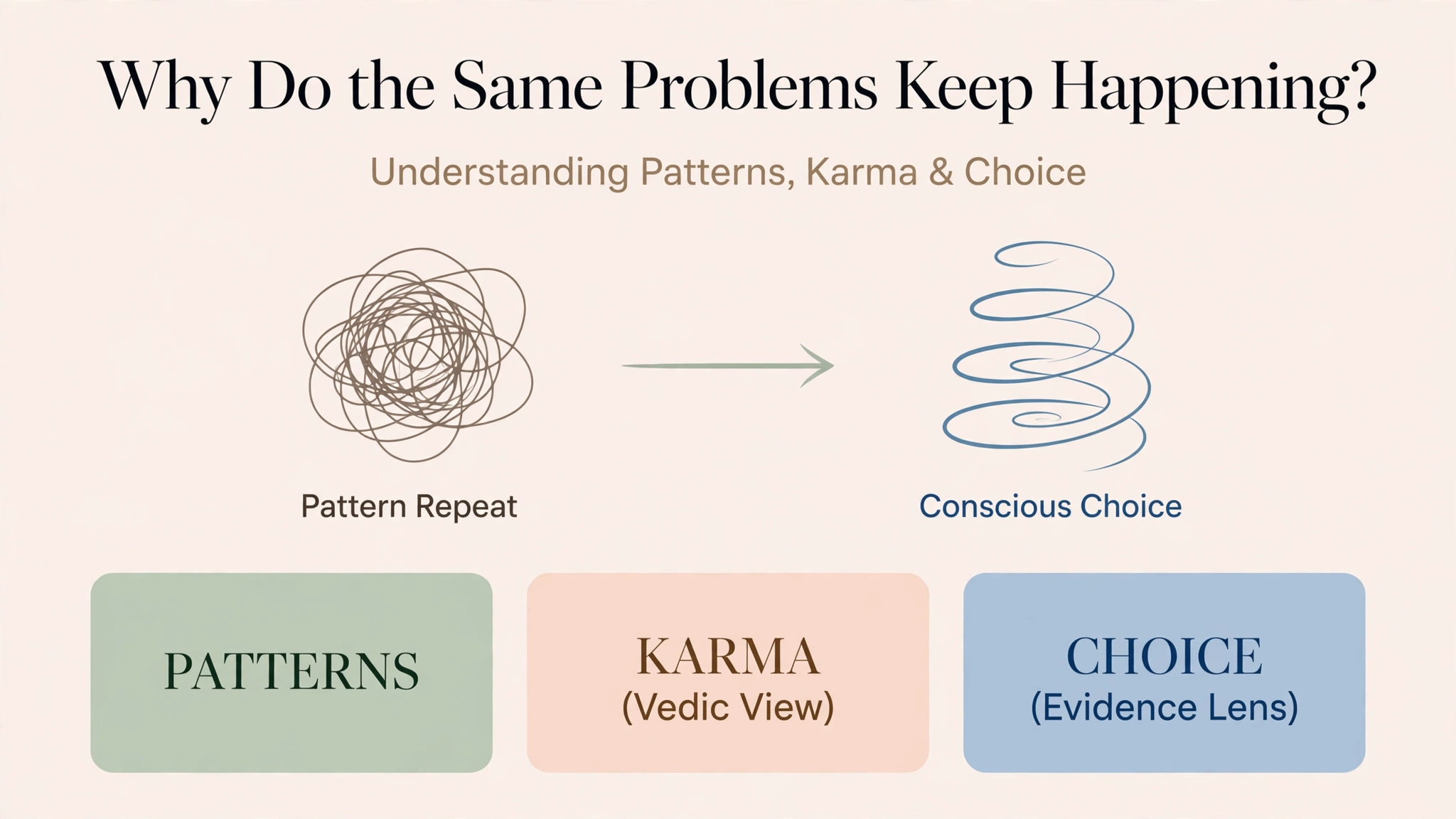
Understanding Patterns, Karma and Choice
It can be unsettling when you realise you've been here before.
A new job, but the same difficult manager.
A new relationship, but the same communication problem.
A new business, but the same difficulty trusting people.
A new group of friends, but somehow you feel overlooked again.
You tell yourself:
“This time will be different.”
For a while, it is.
Then something happens. The people and circumstances change, but the emotional experience feels strangely familiar.
Eventually, the question changes from:
“Why is this happening?”
to:
“Why does this keep happening to me?”
It is tempting to call it fate.
A more useful starting point is: “What pattern can I actually see?”
When Different Situations Feel the Same
Patterns become easier to recognise after several experiences.
Perhaps three different bosses eventually make you feel undervalued. Perhaps several relationships become one-sided. Perhaps every time your finances improve, an unexpected expense pulls you back. Or perhaps you repeatedly begin something enthusiastically and lose momentum once the excitement disappears.
The circumstances are different.
The pattern is not.
When something keeps repeating, look at five things:
- What type of situation keeps appearing?
- What triggers it?
- How do you normally respond?
- What happens afterward?
- What emotion are you left with?
That turns a vague feeling into something you can examine.
A Pattern Is Not a Destiny
Repeated experiences can make you think:
“This is just my fate.”
But repetition does not prove that an outcome is permanent.
Sometimes we make similar choices. Sometimes we respond to similar situations in similar ways. Sometimes we miss early warning signs. And sometimes circumstances genuinely are outside our control.
Recognising a pattern does not mean accepting it as inevitable.
It means finding the part of the pattern you may be able to change.
Look at Your Part Without Blaming Yourself
Suppose you repeatedly find yourself in demanding relationships.
You might say:
“I always meet people who need too much from me.”
That may be true.
But another useful question is:
“What makes me comfortable giving too much before I notice the imbalance?”
Or perhaps you repeatedly leave jobs because you feel undervalued.
The workplaces may genuinely have been difficult. But you could also ask:
“Why do I stay until resentment becomes unbearable instead of addressing the problem earlier?”
This is not about blaming yourself for everything that happens.
It is about identifying the part within your influence.
That is the part you can work with.
Why Familiar Patterns Can Be Hard to Break
We do not necessarily repeat something because we like it.
Sometimes we repeat it because it is familiar.
Someone who grew up taking responsibility for everyone may feel useful when everyone depends on them.
Someone who learned to avoid conflict may tolerate problems until they become much larger.
Someone who became highly independent may find asking for help uncomfortable.
The pattern can be exhausting and still feel normal.
That is why awareness often has to come before change.
What Does Karma Have to Do With Repeating Patterns?
Karma is often simplified into:
“Good things happen because you did good things. Bad things happen because you did bad things.”
Traditional Indian thought is more nuanced.
Karma involves action and its consequences, including intention, conduct and the effects of actions.
It should not casually become:
“You are suffering because of something you did in a past life.”
That turns a complex philosophical idea into blame.
A more constructive question is: “What can I learn from the consequences of my actions and responses?”
This keeps karma relevant without making it fatalistic.
Samskara: Why Old Patterns Can Feel Automatic
Another useful traditional concept is samskara.
Broadly, samskaras can refer to impressions or conditioning formed through experience and repeated tendencies.
One way to understand the process is:
Experience → impression → tendency → behaviour → familiar outcome
For example:
You learn that people cannot be trusted.
You become guarded.
Emotional closeness becomes difficult.
The resulting distance seems to confirm your original belief.
The cycle continues.
This does not mean every behaviour comes from a samskara. It simply offers a way of thinking about how repeated experiences can influence future responses.
How Vedic Astrology Can Explore Recurring Patterns
Vedic astrology can provide another framework for examining recurring themes.
It should not be understood as a system where one planet mechanically causes every difficult experience.
Depending on the question, a Vedic analysis may consider:
- Ascendant: identity, temperament and habitual ways of approaching life
- Moon: emotional responses, attachment and mental patterns
- 4th house: emotional foundations, home and inner security
- 6th house: challenges, conflict, service and recurring difficulties
- 7th house: relationships and partnerships
- 8th house: transformation, vulnerability and disruption
- 12th house: withdrawal, loss, expenditure and areas outside immediate awareness
- Rahu and Ketu: traditionally examined in relation to strong attachments, unusual tendencies, fixation and detachment
- Mahadasha and Antardasha: planetary periods that can provide timing context for when particular themes may become more prominent
None of these should be read in isolation.
The chart provides a framework. Your actual life provides the context.
Ask a Better Question Than “Why Me?”
When the same problem returns, the natural question is:
“Why does this always happen to me?”
Try asking: “What is my role in this pattern?”
That does not mean you caused everything.
It means you are looking for the part you can understand and potentially change.
For example:
- Repeated work conflict → How are expectations being communicated?
- Repeated relationship imbalance → When does the imbalance first appear?
- Repeated financial stress → What happens immediately before the setback?
- Repeatedly abandoning goals → What changes after the initial excitement disappears?
- Repeated family conflict → What happens just before the argument?
Move from:
“Why me?”
to:
“What repeats?”
Find the Earliest Warning Sign
Patterns become harder to change once the outcome is already obvious.
Look backward.
What was the first signal?
It might have been:
- Saying yes when you wanted to say no
- Avoiding an important conversation
- Ignoring something uncomfortable
- Taking on too much responsibility
- Spending impulsively when stressed
- Trusting before enough evidence existed
- Abandoning your own priorities
- Staying silent because you feared conflict
The earlier you recognise the pattern, the more choices you have.
Not Every Repeating Problem Is Your Fault
This distinction matters.
People can repeatedly experience difficult circumstances because of other people's behaviour, unsafe environments, discrimination, financial shocks, loss or events outside their control.
So pattern analysis should create agency, not blame.
Separate three things:
What happened to you.
How you responded.
What you may be able to do differently next time.
You Don't Have to Change Everything
If you recognise several patterns, choose one.
Track the trigger.
Notice your automatic response.
Identify the earliest point where you have a choice.
Then try a different response.
Sometimes the change is small:
A conversation handled earlier.
A boundary established sooner.
A decision no longer postponed.
A request for help.
A financial choice made differently.
A warning sign taken seriously.
You do not have to transform your entire life to interrupt a pattern.
Sometimes you only need to interrupt the next repetition.
A Simple Pattern-Mapping Exercise
Take one recurring problem and write down:
| Question | Your Answer |
|---|---|
| What keeps happening? | |
| When did I first notice it? | |
| What usually happens just before it? | |
| How do I normally respond? | |
| What happens afterward? |
Then ask: “What could I do differently at the earliest point in the pattern?”
That question may be more useful than trying to control the entire situation.
When a Pattern Becomes a Question About Growth
Sometimes a recurring problem exposes something you could not previously see.
Perhaps you repeatedly choose security and later feel restricted.
Perhaps you avoid conflict and later face larger conflicts.
Perhaps you keep putting everyone else first and eventually feel depleted.
Perhaps you chase recognition and discover that recognition does not resolve the deeper need.
The pattern itself may not be the answer.
But it can point toward a better question: “What am I seeing now that I could not see before?”
That shifts the focus from punishment to understanding.
AskVedicaa: Start With the Pattern, Not a Generic Horoscope
A generic horoscope cannot address the specific situation you are actually experiencing.
The useful conversation starts with the question.
With AskVedicaa, you can explore questions such as:
- Why do I keep experiencing similar relationship patterns?
- What recurring themes can be explored in my birth chart?
- Why do similar career problems keep appearing in different workplaces?
- What does my current Mahadasha and Antardasha suggest about this recurring issue?
- Are there traditional Vedic indicators I should explore around this pattern?
- What part of this situation is within my control?
- How can I distinguish a recurring pattern from a temporary difficult phase?
- What should I pay attention to before the same situation repeats?
AskVedicaa can bring together your birth chart, planetary periods, numerology and the circumstances you describe. You can explain what happened, ask follow-up questions and explore different possibilities rather than receiving a generic prediction.
The goal is not to tell you that everything is karma.
It is not to tell you that your future is fixed.
It is to help you examine a Vedic perspective on the pattern and think more clearly about what you can do with that understanding.
Because the most useful question may not be:
“Why does this always happen to me?”
It may be: “What am I seeing now that I could not see the last time?”
Your question. Your birth chart. Your context. Your patterns.
If the same kind of problem keeps appearing in different forms, don't immediately call it fate.
Look for the pattern. Ask the question behind it. AskVedicaa.
Why Do I Feel Lost in Life? I Why Do I Feel Guilty When I Choose Myself?
YouTube - https://youtu.be/MSYxUktgFdk