
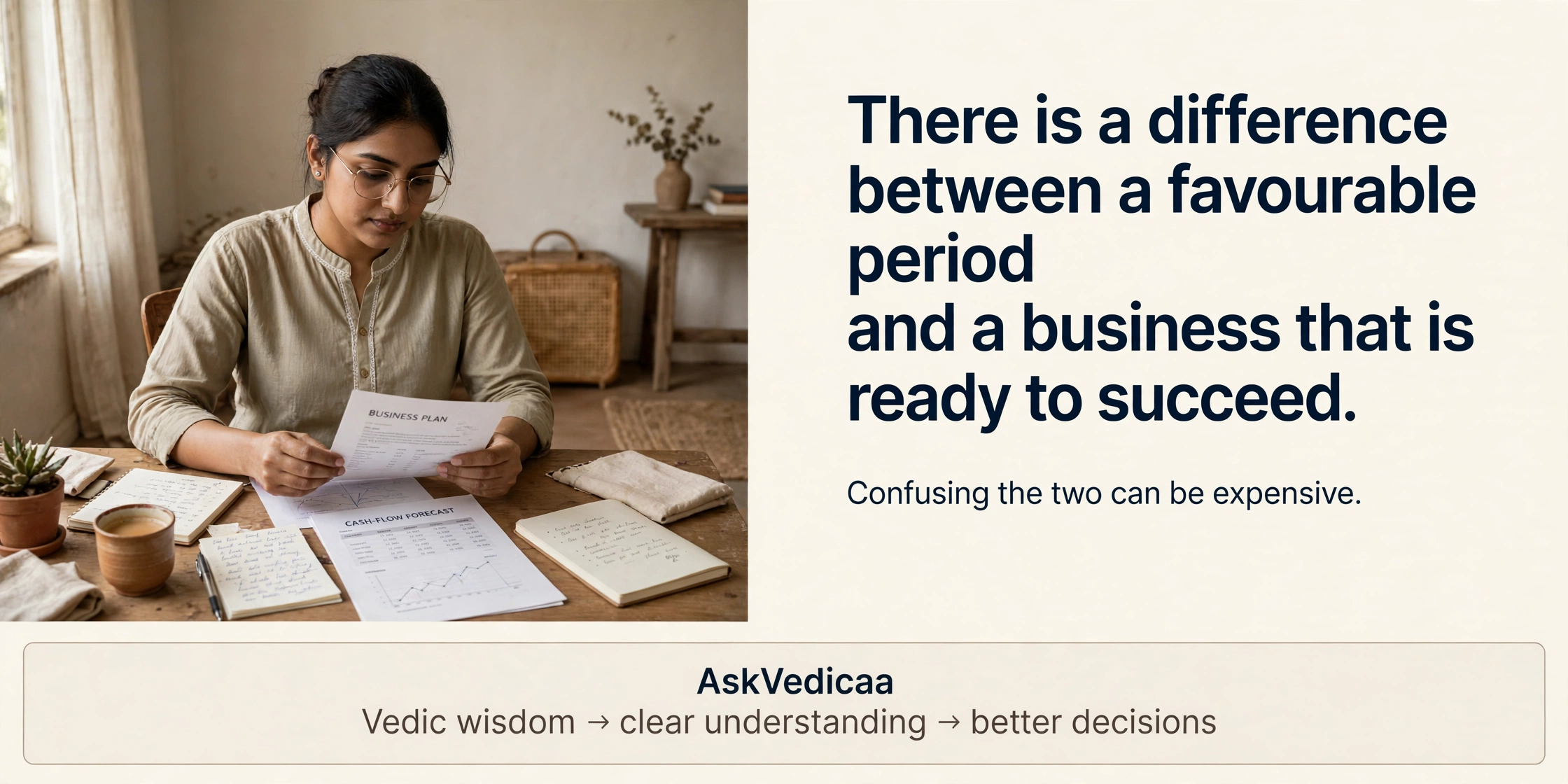
You have an idea. Perhaps you have customers showing interest, some savings in the bank and a growing feeling that you should finally take the leap.
But there is another voice asking: What if the timing is wrong? What if I lose what I have built? What if I wait too long and miss the opportunity?
It is tempting to look for one reassuring answer in your birth chart. But a business decision needs more than a favourable planetary period.
Quick answer
Vedic astrology can offer a traditional perspective on business tendencies, professional direction and periods that may deserve closer attention. However, a favourable Dasha does not establish that a business will succeed.
The decision should begin with your business model, customer demand, financial runway, execution ability and risk exposure. Your birth chart may provide an additional perspective—not a substitute for commercial preparation.
The real question is not just whether the timing is favourable
People often confuse three different things:
-
Opportunity: Is there a genuine demand for what I want to offer?
-
Readiness: Do I have the resources, skills and systems to deliver?
-
Timing: Is this a sensible period to take the next step?
A promising opportunity does not automatically mean you are ready. And feeling ready does not guarantee that the market is waiting for you.
This is where optimism bias can become expensive. You may give more weight to encouraging conversations than to actual orders, underestimate operating costs or assume that a business will become profitable quickly.
The opposite can happen too. You may have a viable opportunity but remain stuck because the possibility of losing financial security feels overwhelming.
A useful decision requires both courage and evidence.
What does Vedic astrology examine when it comes to business?
A business reading should not simply identify a favourable planet and declare that someone is destined to become an entrepreneur.
An astrologer traditionally examines the relationship between relevant houses, their lords, planetary influences and operating Dashas. The question being asked matters because starting a business, managing one and expanding one are not identical activities.
1. Starting an independent business: the 3rd, 10th and 7th houses
The 3rd house is associated with initiative, effort, enterprise and the willingness to act independently. It can be relevant when examining whether someone is inclined to take personal initiative rather than depend entirely on an established structure.
The 10th house concerns profession, responsibility, public work and professional standing. Its condition and relationship with the 3rd house can help an astrologer examine how individual initiative may translate into sustained professional activity.
The 7th house is traditionally associated with trade, business dealings, clients and partnerships. It becomes particularly relevant when the proposed business depends on customers, commercial agreements or collaboration.
These houses should be read together, not as isolated promises.
For example, a chart may show strong initiative but require careful examination of the 7th house and its lord before drawing conclusions about commercial relationships. Another chart may show a stronger connection between professional responsibility and independent effort, suggesting a different way of approaching self-employment.
Neither combination proves business success. The actual offer, market and ability to execute remain decisive.
2. Running an established business: the 2nd, 6th, 10th and 11th houses
Starting a business and keeping it financially sustainable are different challenges.
The 2nd house is considered in relation to accumulated resources, financial stability and the ability to retain wealth. In a business context, it can form part of an assessment of financial continuity.
The 6th house relates to service, competition, obligations, employees, operational difficulties and debt-related pressures. Its connection with business houses may be examined when the concern is day-to-day management rather than simply starting an enterprise.
The 10th house remains relevant to responsibility, execution and professional activity. The 11th house is traditionally associated with gains, fulfilment of objectives and the results of sustained efforts.
Consider the difference:
-
A person may have the initiative to establish a business but struggle with operational discipline.
-
Another may manage operations competently but find customer acquisition or commercial growth difficult.
-
Someone else may generate revenue but struggle to retain profits because of costs, liabilities or poor financial controls.
A responsible reading should investigate these distinctions instead of treating every business difficulty as a single planetary problem.
3. Expanding an existing business: the 11th, 10th, 2nd and 6th houses
Expansion brings a different set of questions.
Can the business handle more customers? Will additional staff and infrastructure create sustainable returns? Can working capital support the increased scale? Will the owner be able to manage greater responsibility?
The 11th house may be examined for gains and the fulfilment of objectives. The 10th relates to professional responsibility and execution, while the 2nd and 6th can bring financial resources, operating costs and obligations into the picture.
A chart that appears supportive of professional growth should not automatically be interpreted as support for borrowing heavily, opening multiple locations or increasing fixed costs.
The scale and nature of the proposed expansion matter.
4. Entering a partnership: the 7th house and its connections
A partnership is not simply a business opportunity. It is a relationship involving money, authority, trust, accountability and shared decisions.
The 7th house and its lord are important traditional considerations. An astrologer may also examine how they connect with the 2nd, 10th and 11th houses to understand the broader financial and professional context.
The practical question is equally important: are the partners bringing complementary skills, clearly defined responsibilities and compatible expectations?
A favourable interpretation of partnership themes cannot establish that a particular person is trustworthy. Due diligence, written agreements and independent legal advice remain essential.
Why the Dasha and Antardasha matter
The birth chart describes the broader planetary framework. The operating Mahadasha and Antardasha provide the traditional timing layer.
An astrologer examines which houses the operating planets own, occupy and influence, and how they connect with the business-related houses.
For example:
-
A period involving planets connected with the 3rd and 10th houses may be examined for themes of initiative, professional action or a change in working structure.
-
Connections with the 7th and 11th houses may bring commercial relationships, clients, agreements or gains into the interpretation.
-
Connections involving the 2nd and 6th houses may make financial resources, operating obligations, competition or debt more relevant to the assessment.
-
A period involving challenging connections may call for closer examination of risk, cash flow and existing responsibilities rather than an automatic instruction to stop.
These are traditional interpretive possibilities, not guaranteed events.
A favourable Mahadasha does not mean every Antardasha will be equally supportive. Nor does a difficult period mean that a business must fail. The full chart, planetary relationships and the nature of the decision must be considered together.
Why the Dashamsha (D10) deserves attention
The Dashamsha, or D10, is traditionally used to examine professional activity, career responsibilities and work-related themes.
For a business question, it can add context to the birth chart. An astrologer may examine whether professional themes in the D10 reinforce or complicate what is indicated in the main chart.
However, D10 should not be treated as a standalone business-success chart. It does not replace the birth chart, Dasha analysis or commercial evidence.
The useful question is not simply whether the D10 looks favourable. It is whether the broader professional picture offers a coherent interpretation of the particular decision being considered.
A realistic example: the difference between starting and scaling
Imagine a 41-year-old professional who has worked in technology for 15 years. Three former colleagues have expressed interest in hiring him for consulting work.
He is considering investing ₹25 lakh in an office, a small team and new infrastructure.
His chart may be interpreted as showing a period that supports professional initiative and commercial activity. But that alone does not justify the investment.
He should first ask:
-
Have any customers signed contracts?
-
Can he begin with a smaller team or work from home?
-
How many months of operating expenses can he cover?
-
What happens if the first two customers leave?
-
Can the business generate enough cash to meet salaries and other commitments?
A staged launch may be more sensible than committing the full amount immediately.
The astrological interpretation may help him reflect on his professional tendencies and timing. It cannot turn expressions of interest into guaranteed revenue.
A business-readiness scorecard: answer these before you look at your Dasha
| Area | Question to answer honestly |
|---|---|
| Offer | Can you explain exactly what you are selling and why someone would pay for it? |
| Customers | Do you have paying customers, signed orders or only encouraging conversations? |
| Cash | Can you meet personal and business expenses during a slow start? |
| Execution | Do you have the skills, systems and people needed to deliver? |
| Risk | What is the maximum amount you can afford to lose without damaging your financial stability? |
| Partnership | Are roles, ownership, decision rights and exit terms documented? |
If several answers are unclear, the immediate task is not finding a more favourable date. It is reducing uncertainty.
When should you wait?
Consider delaying a major commitment when:
-
You are relying on verbal interest rather than validated demand.
-
You would need to use emergency savings or high-cost borrowing to begin.
-
Your business depends entirely on one customer or one partner.
-
You have not calculated realistic operating costs.
-
You are expanding because competitors are doing so, not because your own business can support it.
Waiting does not have to mean doing nothing. You can test the offer, acquire your first customers, build a prototype, negotiate a smaller commitment or start alongside your current employment where practical.
What does the Bhagavad Gita teach us about action?
The Bhagavad Gita, Chapter 18, Verse 26, describes a person engaged in action with enthusiasm, steadiness and freedom from excessive attachment to outcomes.
This is not a business formula, nor does the verse promise commercial success. But it offers a useful principle: act with commitment and discipline without allowing the desire for a particular result to cloud your judgment.
In business, that can mean preparing carefully, accepting uncertainty and remaining willing to correct your approach when evidence changes.
A favourable period should not make you careless. An uncertain period should not automatically make you inactive.
What astrology cannot decide for you
A birth chart cannot establish:
-
Whether customers will buy your product.
-
Whether a particular partner will honour an agreement.
-
Whether a loan will be repaid on schedule.
-
Whether a competitor will outperform you.
-
Whether a business will generate a particular profit.
-
Whether a specific investment will be recovered.
These depend on market conditions, execution, financial decisions, people and events that cannot be reliably settled by a horoscope.
Do not borrow money, resign from secure employment or commit substantial capital solely because someone describes a planetary period as favourable. For significant financial commitments, use qualified financial, legal and business advice where appropriate.
How AskVedicaa can help you examine the question
Sometimes the uncertainty is not simply, “Will my business succeed?”
It is more specific:
-
Am I better suited to independent work or a structured professional role?
-
Does my chart offer a different perspective on expansion versus consolidation?
-
What should I examine before entering a partnership?
-
Is the current period traditionally supportive of professional initiative, or should I pay closer attention to existing responsibilities?
AskVedicaa can help you explore these questions through a personalised Vedic perspective, examining relevant birth-chart factors, planetary periods and professional indicators, including the Dashamsha where appropriate.
The purpose is not to give you a guaranteed business outcome or replace commercial due diligence. It is to help you understand the traditional chart interpretation in the context of the decision you are actually facing.
Before you commit your savings, ask a more useful question:
Am I considering the right kind of business move for my present circumstances—and what should I examine before taking the next step?
Your decision should rest on preparation, evidence and judgment. Astrology can offer another perspective, but it should never carry the financial risk on your behalf.
Frequently Asked Questions
Can Vedic astrology show whether I should start a business?
Vedic astrology traditionally examines houses such as the 3rd, 7th, 10th and 11th, their lords and planetary periods when assessing business-related themes. It may offer a perspective on initiative, trade and professional activity, but it cannot establish whether a business will succeed.
Which house is important for business in Vedic astrology?
There is no single business house. The 3rd, 7th, 10th and 11th houses are commonly examined for initiative, trade, professional activity and gains. The 2nd and 6th may also matter when assessing financial resources and operational obligations.
Does a favourable Mahadasha mean I should expand my business?
No. A favourable interpretation of a planetary period is not a guarantee of commercial success. Expansion should depend on customer demand, cash flow, operating capacity and the financial risks involved.
Is the Dashamsha chart important for business?
The D10 chart is traditionally used to examine professional activity and responsibilities. It can add context to a business-related reading, but should be interpreted alongside the birth chart and relevant planetary periods.
Should I start a business during a difficult Saturn or Rahu period?
Not automatically. Saturn and Rahu should not be treated as universal indicators of business failure. Their interpretation depends on their house ownership, placement, relationships and operating periods in the full chart. Practical readiness remains essential.
Can astrology tell me whether a business partnership will work?
Astrology may provide a traditional perspective on partnership themes, but it cannot verify another person's honesty, competence or financial intentions. Background checks, clear agreements and legal safeguards are indispensable.
Explore