Should I Change My Job? Career Change Guide with Vedic Perspective
Use Vedic wisdom to inform your decision—not to surrender your decision.
There is a point in many careers when a simple thought keeps returning:
“Should I change my job?”
Sometimes it appears after a bad day.
Sometimes after months of frustration.
Sometimes when a better opportunity arrives.
And sometimes when everything looks fine on paper, yet something inside you says:
“This isn't where I want to be anymore.”
That makes the decision difficult.
You may have a stable salary but no growth.
A good title but a poor work environment.
A comfortable job but no excitement.
A new opportunity but significant uncertainty.
Or you may simply feel stuck and not know whether the problem is your current job—or your current phase of life.
So the real question may not be:
“Should I resign?”
It may be:
“What am I actually trying to change, and is changing jobs the right way to change it?”
That is a much better question.
Why Is Changing Jobs Such a Difficult Decision?
A career move rarely affects only your career.
It can affect:
- Income
- Family responsibilities
- Location
- Lifestyle
- Work-life balance
- Professional identity
- Confidence
- Future opportunities
- Financial security
That is why people often become emotionally divided.
One part of you says:
“Take the opportunity.”
Another says:
“Don't take the risk.”
Your colleagues may say:
“Stay. The company is stable.”
Your friends may say:
“Leave. You deserve better.”
Your family may say:
“Why give up a secure job?”
And you are left asking:
“What should I actually do?”
There is no universal answer.
A job that is wrong for one person may be exactly right for another.
The decision needs context.
Before Asking “Should I Leave?”, Ask What Is Actually Wrong
This is one of the most important steps.
Are you unhappy because:
The work itself is no longer interesting?
Or is the problem:
Your manager?
Or:
The organisation's culture?
Or:
Lack of growth?
Or:
Compensation?
Or:
Burnout?
Or:
Lack of recognition?
Or:
A desire for something completely different?
These problems may look similar from the outside.
They aren't.
If you dislike your manager, changing teams might solve the problem.
If you dislike the work itself, a new company doing the same work may not help.
If you are burned out, quitting immediately may not solve the underlying issue.
If you have genuinely outgrown your career, staying may create a different kind of frustration.
So before changing the job, identify what you are actually trying to change.
The Better Career Question
Instead of: “Should I change my job?”
try breaking the question into smaller ones.
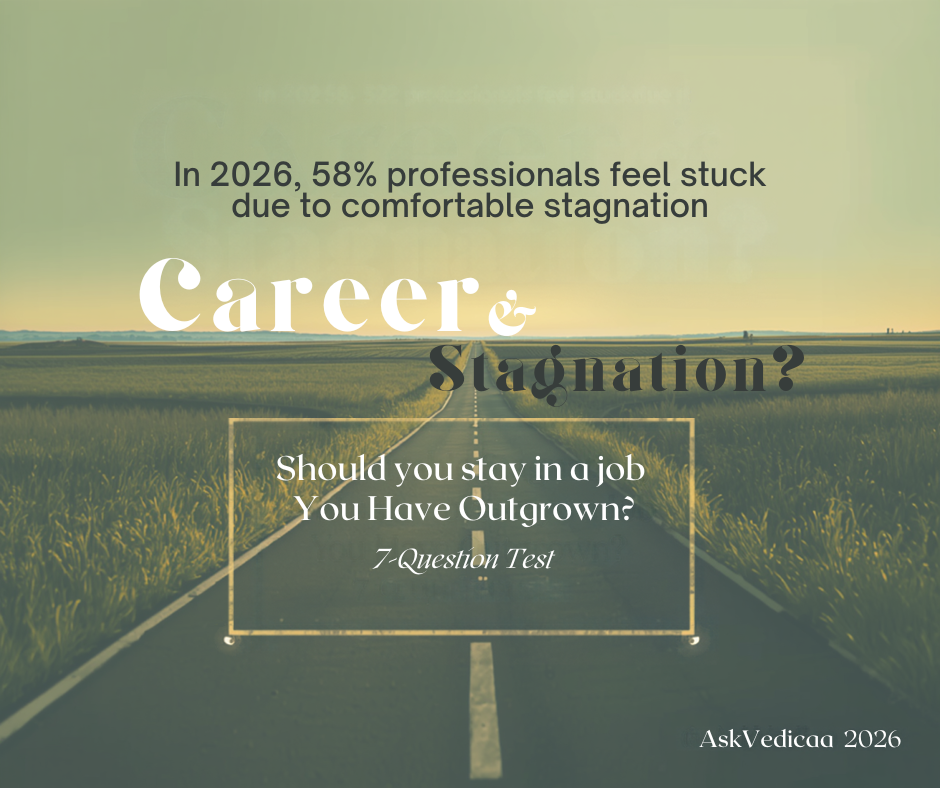
Question 1
What is making me unhappy in my current role?
Question 2
Is the problem temporary or structural?
Question 3
Would changing companies solve it?
Question 4
What am I moving toward—not simply running away from?
Question 5
What risks would the new opportunity create?
Question 6
Is this the right time to make the move?
This transforms an emotional decision into a structured one.
Don't Confuse a Bad Phase With a Bad Career
This is particularly important.
Every career has difficult periods.
A difficult manager.
A failed project.
A missed promotion.
A disappointing appraisal.
A difficult quarter.
A period of uncertainty.
One bad phase does not necessarily mean your entire career is wrong.
But the opposite can also be true.
Sometimes people remain in unsuitable careers for years because they keep telling themselves:
“Things will get better.”
The useful question is:
“Is this a temporary situation—or a repeating pattern?”
If the same problem keeps returning despite reasonable attempts to address it, it deserves deeper consideration.
What Does Vedic Astrology Add to a Career Decision?
Vedic astrology can provide another perspective when someone is trying to understand their professional direction or the timing of a career decision.
Depending on the question, a Vedic analysis may consider factors such as:
- Ascendant and its lord
- 10th house and its lord
- 6th house
- 2nd house
- 11th house
- Relevant planetary influences
- Planetary strengths
- Relevant divisional charts
- Mahadasha and Antardasha
- Transits when timing is specifically being considered
The exact factors should depend on the question and the chart.
This matters because:
Career analysis is not simply “Which planet represents my profession?”
A meaningful interpretation requires context.
For example, a career question may involve both professional direction and timing.
Those are related, but they are not identical questions.
Your Career Chart Does Not Give You a Job Description
One of the most common misunderstandings about astrology is the idea that a particular planet automatically equals a particular profession.
For example:
Mercury = business
Mars = engineering
Venus = design
Saturn = government
Such shortcuts may be useful as broad associations, but they are not sufficient for individual career guidance.
Professional tendencies need to be interpreted in context.
A chart may suggest certain themes.
But themes are not the same as job titles.
Someone may express analytical tendencies through:
- Technology
- Finance
- Research
- Consulting
- Operations
- Data
- Strategy
Similarly, leadership tendencies can appear in many different professions.
The purpose of analysis should therefore be to understand patterns and possibilities, not force someone into a predefined occupation.
Career Timing Matters—But Timing Is Not a Guarantee
Sometimes the question isn't:
“What career suits me?”
You already know what you want.
The question is:
“Is this a good time to make the move?”
This is where planetary periods and transits can become relevant within a Vedic framework.
A timing-oriented analysis may explore whether the current period is traditionally associated with themes such as:
- Career change
- Expansion
- Responsibility
- Recognition
- Professional transition
- New opportunities
- Greater uncertainty
- Consolidation
But timing should not be interpreted as:
“You will definitely get the job in October.”
A better interpretation is:
“This period may be more supportive for exploring or pursuing a professional transition, subject to the actual opportunity and circumstances.”
That distinction keeps the guidance useful without turning it into false certainty.
What If I Have Two Job Offers?
This is where a question-led approach becomes particularly powerful.
Suppose you have:
Job A
Higher salary.
Better brand.
Longer commute.
More pressure.
Job B
Lower salary.
Smaller company.
Greater flexibility.
More responsibility.
A generic horoscope cannot meaningfully answer this comparison.
But you can ask a much better question:
“I have two job offers. How do they compare with my current career phase from a Vedic perspective, and what factors should I consider before choosing between them?”
Now the analysis has:
A real decision.
Specific options.
A timeframe.
Trade-offs.
That makes the guidance much more meaningful.
What If I Am Thinking About Starting a Business?
The same principle applies.
Don't simply ask:
“Will I be successful in business?”
That is too broad.
Instead:
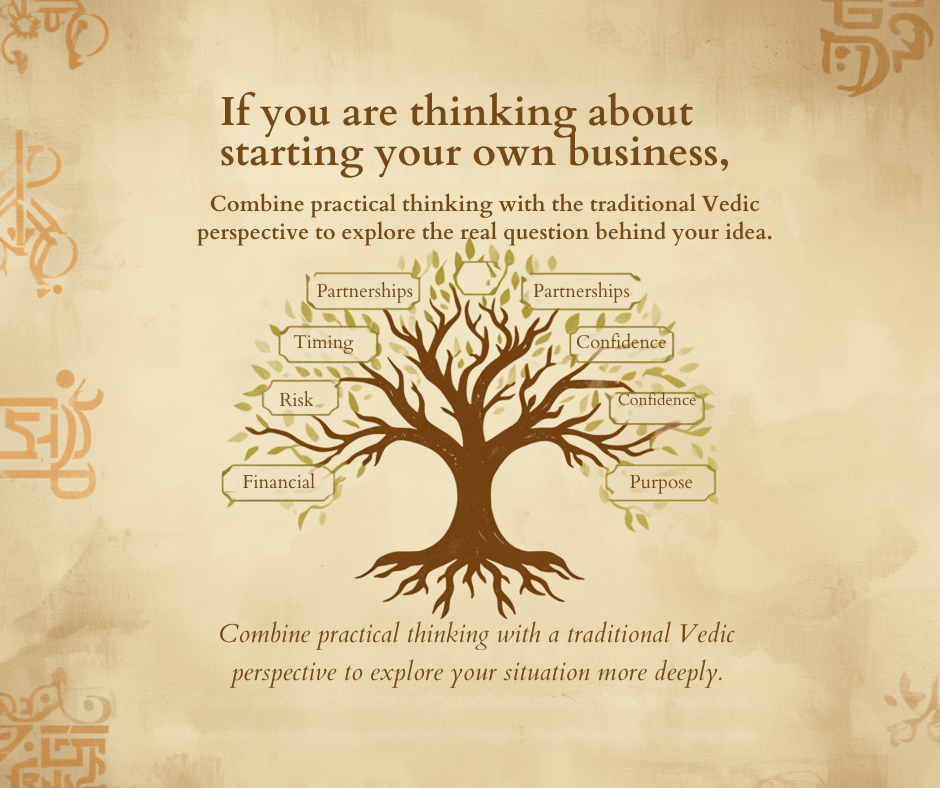
“I have been employed for 12 years and am considering starting my own business. Does my current Vedic period support a transition toward entrepreneurship, what strengths could support the move, what challenges should I consider, and what should I prepare before leaving my current job?”
That is a much richer question.
It allows the analysis to explore:
- Entrepreneurial tendencies
- Risk
- Timing
- Professional independence
- Financial considerations
- Preparation
- Transition
The answer still cannot guarantee success.
But it can provide another perspective for the decision.
What If I Hate My Job But Don't Know What I Want Next?
This may be one of the most difficult career situations.
You know:
“I don't want this anymore.”
But you don't know:
“What do I want instead?”
Don't rush directly into another job.
Start with understanding what has changed.
Ask yourself:
- What parts of my current work do I still enjoy?
- What am I tired of?
- What skills do I want to use more?
- What responsibilities do I want less of?
- Do I want more autonomy?
- More money?
- More stability?
- More creativity?
- More meaningful work?
- More flexibility?
- More leadership?
Sometimes the next career direction is hidden inside the parts of the current career that you still enjoy.
A Career Change Should Be a Move Toward Something
This is perhaps the most useful practical principle in the entire discussion.
There is a difference between:
“I need to escape this job.”
and:
“I have identified a direction that better fits what I want from my career.”
The first is driven primarily by pain.
The second is driven by direction.
Sometimes leaving is absolutely the right decision.
But whenever possible, understand what you are moving toward before you make the move.
How AskVedicaa Approaches Career Questions
AskVedicaa is designed around the idea that the question matters.
Instead of giving you a generic career horoscope, you can bring a specific situation.
For example:
“I've been offered a new job. Should I make the move in the next three months?”
Or:
“I'm unhappy in my current role but have no offer yet. Is this a good period to actively search for a change?”
Or:
“I have two career options. Which one appears more aligned with my current Vedic period, and what trade-offs should I consider?”
Or:
“I'm considering leaving employment and starting a business. What does my current career phase suggest, and what should I prepare before making the transition?”
The analysis can then focus on the specific question, relevant Vedic factors, timing and context.
The objective isn't to tell you:
“Quit.”
Or:
“Stay.”
The objective is to help you understand the situation more clearly.
The Decision Still Belongs to You
This is important enough to say directly.
Astrology cannot know everything about a job offer.
It doesn't know your company's financial position unless you tell it.
It doesn't know your manager.
It doesn't know the actual contract.
It doesn't know whether the new company will keep its promises.
It doesn't know every financial obligation you have.
Those are real-world factors.
Use them.
Vedic guidance can provide another perspective.
It should not replace due diligence.
Before accepting a new role, consider:
- Compensation
- Role clarity
- Reporting structure
- Company stability
- Growth opportunity
- Location
- Work culture
- Benefits
- Notice period
- Family implications
- Financial runway
Then combine those facts with your own judgment and whatever additional perspective you find useful.
Use Vedic wisdom to inform your decision—not to surrender your decision.
Quick Answer: Should I Change My Job?
Change your job when the move addresses a genuine problem or takes you meaningfully toward the career and life you want to build—not simply because you are having a difficult week.
Before deciding, understand:
- What is wrong with your current situation?
- Is the problem temporary or structural?
- What are you moving toward?
- What does the new opportunity actually offer?
- What risks are involved?
- Is the timing appropriate?
- What does your own judgment tell you?
Vedic astrology can provide an additional perspective on professional tendencies and timing, but it should complement—not replace—real-world evaluation.
Frequently Asked Questions
How do I know if I should change my job?
Look at whether your dissatisfaction is temporary or structural, whether the new opportunity solves the underlying problem, and whether it moves you toward the career and life you want.
Is it a good time to change jobs?
There is no universal “best time.” From a Vedic perspective, relevant planetary periods and transits can be examined when the question is specifically about timing. Real-world conditions should also be considered.
Can Vedic astrology predict career changes?
Vedic astrology can be used to explore professional tendencies and periods traditionally associated with change or transition. It should not be treated as a guarantee that a specific career event will occur.
Should I quit my job without another offer?
That depends on your financial position, circumstances, health and the reasons for leaving. Astrology should not be the sole basis for such a decision.
Can astrology compare two job offers?
A specific question can ask for a Vedic comparison of two career options. The analysis should be treated as one perspective alongside salary, responsibilities, culture, stability, growth and other practical factors.
Can Vedic astrology help with starting a business?
It can provide a perspective on entrepreneurial tendencies and timing. But business viability, capital, market demand, skills and execution remain essential.
What if I don't know what career I want?
Start by identifying the kind of work, problems, responsibilities and environment you enjoy. Career direction is often easier to discover by understanding these patterns than by searching for one perfect job title.
Is AskVedicaa a career prediction tool?
AskVedicaa is better understood as a question-led Vedic guidance platform. You bring a real career question, and the analysis focuses on the relevant Vedic factors and context rather than giving a generic horoscope.
The Better Career Question
Perhaps the biggest mistake we make with careers is asking:
before asking:
“What kind of life am I trying to build through my career?”
Those are not the same question.
A career is not just a job.
It affects:
How you spend your days.
Who you become.
What you can afford.
How much freedom you have.
What pressures you carry.
And what kind of life you build outside work.
So before making your next career decision, step back.
Understand the problem.
Explore the options.
Consider the timing.
Check the facts.
Then make your decision.
Vedic wisdom can provide perspective along the way.
But the final decision is yours.
Education before prediction.
Guidance before certainty.
Have a question? Ask Vedicaa.
Explore your question through Vedic wisdom, understand the relevant factors, and make your own informed decision.
Relationship I Financial Stress I Business / Entrepreuners I Why is my career stuck I Wealth corner you house is missing I