Understanding Validation, Confidence and Vedic Wisdom
You know what you want to say.
But you stop because you are wondering how someone will react.
You make a decision.
Then immediately ask someone else:
“Do you think I’m doing the right thing?”
You achieve something important.
Instead of enjoying it, you wonder:
“Did anyone notice?”
Someone disagrees with you, and suddenly you begin questioning your own judgment.
A family member disapproves.
Your manager doesn't recognise your effort.
A friend becomes distant.
And almost automatically, a thought appears:
“Did I do something wrong?”
You may even tell yourself: “I shouldn't care what people think.”
But knowing that intellectually and actually feeling secure in your own decisions are two different things.
The deeper question is: Why does someone else's approval have so much power over how I see myself?
What Does Seeking Approval Actually Look Like?
Approval-seeking isn't always obvious.
It can look like:
- asking several people before making a decision
- changing your opinion when someone disagrees
- saying yes when you really want to say no
- avoiding difficult conversations
- constantly checking whether someone is happy with you
- needing praise before believing you did something well
- over-explaining your choices
- comparing yourself with others
- staying somewhere because you fear disappointing people
Sometimes it even looks like being “nice.”
You become agreeable.
Helpful.
Flexible.
Easy to work with.
But there can be a hidden cost:
You slowly lose contact with your own judgment.
When Other People's Opinions Become Your Mirror
Imagine you're considering a career move.
You are reasonably confident about your decision.
Then someone you respect says:
“Are you sure that's a good idea?”
Suddenly, doubt appears.
You research again.
Ask another person.
Then another.
You look at what everyone else is doing.
You imagine what people might say if your decision fails.
The question has quietly changed.
It started as: “What do I think is right for me?”
And became: “What will everyone else think is right for me?”
That shift can happen without you noticing.
Approval Feels Good. That Isn't the Problem.
Human beings naturally need connection and acceptance.
Praise feels good.
Recognition can motivate us.
Being appreciated by people we love matters.
The problem begins when approval changes from something you enjoy into something you need to feel secure.
There is a big difference between:
“I appreciate that you support my decision.”
and:
“I cannot feel confident about my decision unless you support it.”
The first is connection.
The second can become dependence.
What Is the Fear Behind the Approval?
Often, approval-seeking isn't really about praise.
It is about avoiding something you fear.
Perhaps:
- rejection
- criticism
- conflict
- failure
- embarrassment
- disappointing your family
- being misunderstood
- losing someone's affection
- being seen as selfish
The mind can develop a simple strategy: “If I keep everyone happy, I will stay safe.”
It works temporarily.
But nobody can keep everyone happy forever.
Eventually, two people's expectations conflict.
And you have to choose.
That is when approval-seeking becomes exhausting.
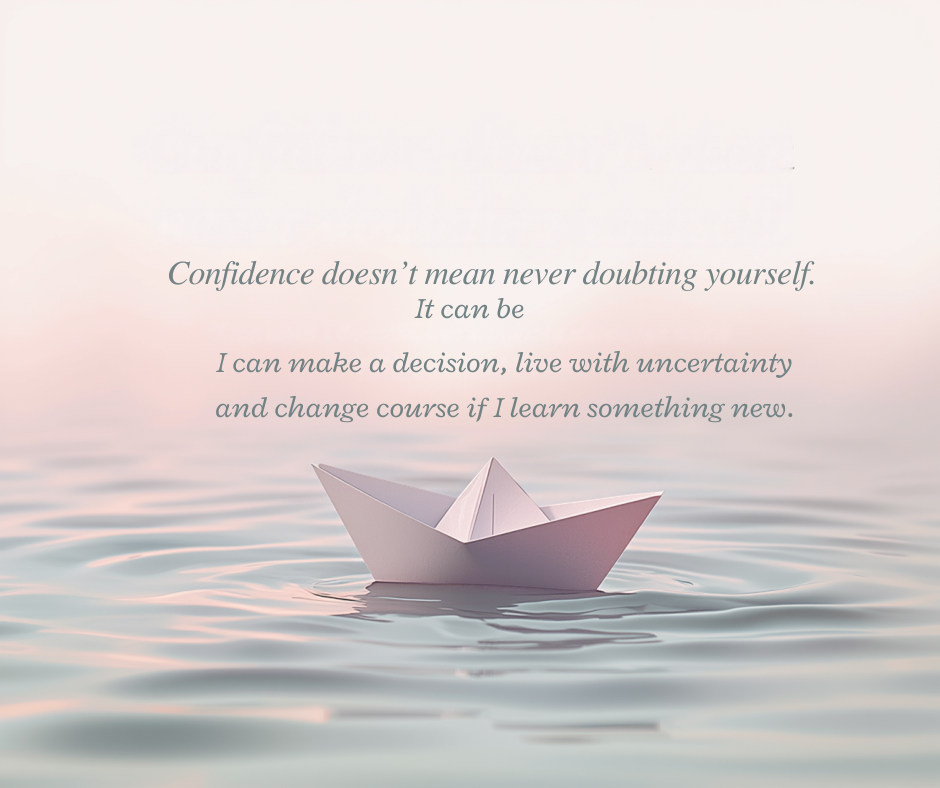
Confidence Does Not Mean Never Doubting Yourself
Confident people question themselves too.
Confidence isn't necessarily: “I know I am right.”
A more useful definition is: “I can make a decision, live with uncertainty and change course if I learn something new.”
You don't need complete certainty before every decision.
You need enough trust in yourself to make the decision and respond intelligently to what happens next.
That is a much more sustainable form of confidence.
What Does Vedic Wisdom Say About Inner Confidence?
Vedic thought places importance on understanding the Self, rather than defining yourself entirely through external circumstances.
This creates a powerful question: “Who am I when nobody is approving of me?”
Not your:
- job title
- income
- social status
- achievements
- family's opinion
- successes
- failures
External feedback can provide useful information.
But it does not have to become the final authority on your worth.
This is an important shift:
Listen to others without handing them ownership of your self-worth.
What Can Vedic Astrology Add?
Vedic astrology can provide a traditional framework for exploring themes around identity, confidence, recognition, emotional security and social expectations.
The complete birth chart matters.
Depending on the question, relevant factors may include:
The Sun
Traditionally associated with selfhood, authority, confidence, vitality and recognition.
The Moon
Associated with the mind, emotional responses, habits and emotional security.
The 1st House
Connected with identity, self-expression and how you approach life.
The 5th House
Associated with intelligence, creativity, individual judgment and self-expression.
The 10th House
Connected with profession, authority, reputation and public standing.
The 11th House
Associated with networks, social circles, gains and recognition.
Mahadasha and Antardasha
These can provide timing context. A lifelong tendency may become particularly noticeable during a period when themes of recognition, authority, belonging or self-expression become more prominent.
The important point is not: “My chart makes me insecure.”
That is far too simplistic.
The better question is: “What themes does my chart suggest exploring, and how do they relate to what is actually happening in my life?”
Approval-Seeking Can Affect Your Career
Imagine you're offered a bigger role.
You want it.
Then someone questions whether you're ready.
Suddenly you begin doubting yourself.
You might decline the opportunity.
Or accept it and spend months desperately trying to prove that everyone made the right decision.
Instead, ask:
- Do I have the required skills?
- What do I need to learn?
- What are the actual risks?
- What evidence do I have?
- What support would help?
- What do I genuinely want?
Those are decision questions. “Will everyone approve?” isn't.
Approval-Seeking Can Affect Relationships Too
Some reassurance is completely normal.
But when your emotional stability depends on repeatedly receiving reassurance, a cycle can develop:
Uncertainty → reassurance → temporary relief → uncertainty again.
You may constantly ask:
“Are you okay with me?”
“Are you angry?”
“Did I upset you?”
Learning to tolerate some uncertainty without immediately seeking external confirmation can gradually change that pattern.
Ask Yourself These 3 Questions
The next time you're about to ask:
“What do you think I should do?”
Pause.
1. What do I actually think?
Write your answer before hearing someone else's opinion.
2. What evidence supports my view?
Separate facts from assumptions.
3. Am I asking for perspective—or permission?
This is the crucial distinction.
Perspective can strengthen your decision.
Permission can weaken your trust in yourself.
You don't need to reject other people's opinions.
Use this sequence instead:
Listen → Evaluate → Decide.
Not:
Listen → Doubt yourself → Change your decision.
The Goal Isn't to Stop Caring What People Think
You don't need to reach: “I don't care what anyone thinks.”
That can become another form of rigidity.
A healthier goal is: “I can listen to what others think without automatically surrendering my own judgment.”
You can respect your parents.
Value your partner's feelings.
Listen to your manager.
Learn from criticism.
And still make room for your own voice.
That is closer to inner confidence.
AskVedicaa: Why Does Their Opinion Matter So Much to Me?
Sometimes the surface question is:
“How do I become more confident?”
But the deeper question may be: “Why does this particular person's opinion have so much power over me?”
That is where a personalised Vedic conversation can become useful.
You could ask:
- Why do I constantly seek approval from my family?
- Why do I doubt myself when someone disagrees with me?
- What does my Vedic chart suggest about confidence and recognition?
- Why am I particularly sensitive to criticism at work?
- What does my current Mahadasha and Antardasha suggest about this phase?
- Why do I need so much reassurance in relationships?
AskVedicaa can explore your birth chart, planetary periods, numerology and the real-life situation behind your question.
The goal isn't to label you.
It isn't to blame a planet.
It is to explore relevant patterns and give you another perspective on the question you are actually living with.
Because confidence isn't reaching a point where nobody's opinion matters.
It is reaching a point where:
Someone else's opinion can be heard without automatically becoming your opinion of yourself.
Your question. Your chart. Your context.
AskVedicaa.
“I need to stop caring so much.”