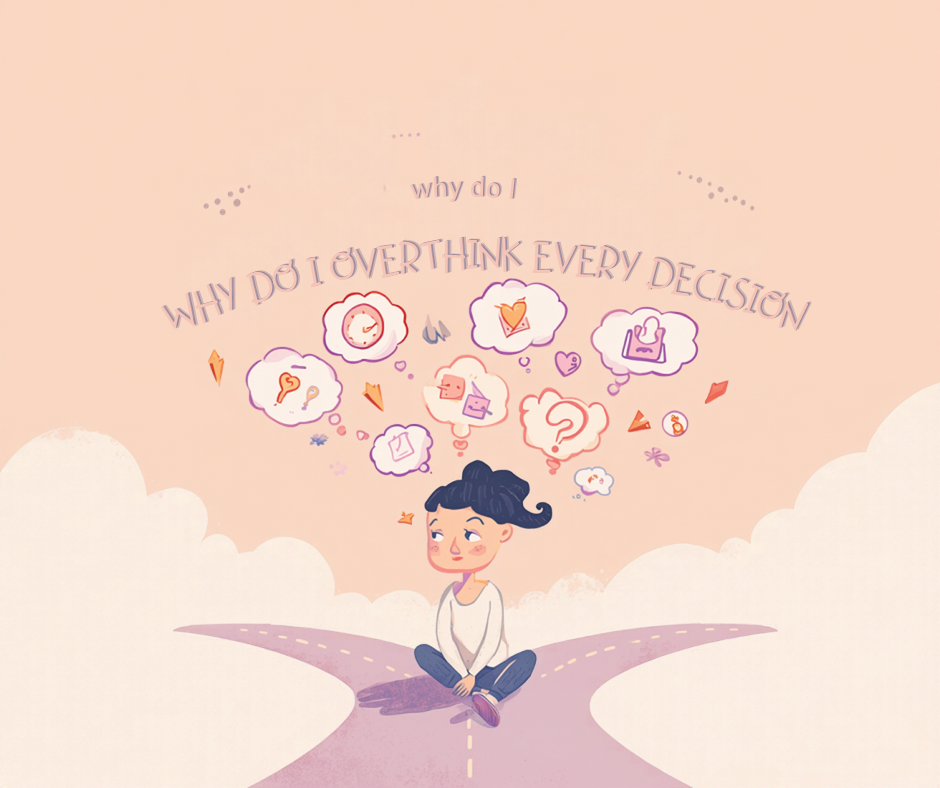
You have a decision to make.
It should be simple.
So you research.
Then research again.
You ask someone.
Then ask someone else.
You finally decide.
A few hours later, the doubt returns:
“What if I made the wrong choice?”
So you reopen the question.
Maybe there was another option.
Maybe you missed something.
Maybe you should wait.
Maybe you should ask one more person.
And suddenly, a decision that should have taken an hour has occupied your mind for three days.
The frustrating part is that you may actually be a thoughtful person. You want to make a good decision.
But somewhere along the way, careful thinking has become mental looping.
And the more you think, the less certain you feel.
Why Does Overthinking Happen?
Overthinking is often confused with deep thinking.
They are not the same.
Thinking helps you understand a problem.
Overthinking keeps reopening a problem after you already have enough information to act.
You may find yourself:
- replaying conversations
- imagining every possible outcome
- endlessly searching for information
- asking several people for opinions
- repeatedly changing your decision
- worrying about future consequences
- waiting for complete certainty
- avoiding action because the decision feels too risky
The common thread is often this: You are trying to eliminate uncertainty before you act.
But uncertainty is part of almost every meaningful decision.
The Real Problem May Not Be the Decision
Imagine you are considering changing jobs.
The new role offers better growth.
Your current role has become limiting.
You have researched the company, considered the financial implications and spoken with people you trust.
You have enough information to make a reasonable decision.
Yet you still cannot decide.
Perhaps the question is no longer:
“Which job is better?”
It has become:
“How can I guarantee that I will never regret this decision?”
That guarantee doesn't exist.
And once you demand certainty, almost any decision can become impossible.
Overthinking Often Hides Fear
The mind may keep analysing because it believes more analysis will make you safer.
Underneath the thinking may be fear of:
- making a mistake
- losing money
- disappointing someone
- choosing the wrong partner
- damaging your career
- missing a better opportunity
- regretting the decision
- losing control
- being blamed
So the mind keeps searching: “Maybe if I think about this a little more, I can prevent the mistake.”
But eventually, thinking stops being preparation.
It becomes avoidance.
Is It Intuition or Anxiety?
This is one of the hardest questions when making an important decision:
“Is my intuition telling me not to do this, or am I simply afraid?”
When the mind is noisy, the two can feel similar.
Try separating evidence from emotional noise.
What are the actual facts?
Write them down.
What am I imagining?
Separate possibilities from evidence.
What specifically am I afraid will happen?
Give the fear a name.
What would I do if I knew I could handle the consequences?
That last question can be revealing.
Sometimes you don't lack clarity.
You know what you want.
You are simply afraid of what choosing it might cost.
Why More Information Doesn't Always Create More Clarity
We have access to almost unlimited information.
Reviews.
Opinions.
Videos.
Expert advice.
Statistics.
Social media discussions.
Case studies.
It sounds helpful.
But too much information can create decision fatigue.
Every new piece of information introduces another possibility.
Another exception.
Another “what if?”
Another reason to reconsider.
At some point, you are no longer gathering information.
You are feeding uncertainty.
You Don't Need the Perfect Decision
One of the most useful shifts is to stop asking: “What is the perfect decision?”
Instead ask: “What is the most reasonable decision with the information I have today?”
That is a much more realistic standard.
You can make a good decision and still experience an unexpected outcome.
That doesn't automatically mean the decision was bad.
A decision should be judged partly by the quality of the reasoning available when you made it, not only by what happened afterwards.
What Does Vedic Wisdom Say About a Restless Mind?
Vedic thought has long explored the nature of the mind, its fluctuations and its relationship with desire, fear and perception.
The Bhagavad Gita describes the restless nature of the mind and the importance of cultivating steadiness.
This doesn't mean suppressing thought.
It means developing the ability to observe thoughts without allowing every thought to dictate your action.
A thought says: “What if this goes wrong?”
You don't necessarily have to obey it.
You can notice it.
Evaluate it.
Then return to the decision.
The Vedic Astrology Perspective
Vedic astrology can provide a traditional framework for exploring patterns associated with mental activity, analysis, uncertainty, communication and decision-making.
It should not be reduced to: “This planet makes you overthink.”
The complete birth chart and your real-life circumstances matter.
Several factors may become relevant.
The Moon
Traditionally associated with the mind, emotional responses, habits and subjective experience.
Mercury
Associated with intellect, reasoning, communication, analysis and information processing.
The 3rd House
Associated with thought, communication, initiative and mental effort.
The 5th House
Traditionally connected with intelligence, judgement, creativity and discrimination.
The 6th House
Can become relevant when worry, conflict, problem-solving or repetitive mental engagement dominate a situation.
The 12th House
Associated with withdrawal, sleep, isolation and expenditure, and can become relevant when mental activity becomes difficult to switch off.
Mahadasha and Antardasha
Timing adds another layer.
Someone may generally be analytical, but during a particular planetary period, themes involving decision-making, communication, uncertainty or mental restlessness may become more prominent.
So the question isn't simply:
“Why am I an overthinker?”
It can also be: “Why does my mind feel particularly unsettled during this phase of my life?”
A Simple Framework for Breaking an Overthinking Loop
When you notice yourself going around the same decision repeatedly, try this:
1. Define the decision in one sentence
Instead of:
“What should I do with my entire career?”
ask:
“Should I accept this job?”
Make the question smaller.
2. List the facts
Write only what you know.
No predictions.
No assumptions.
3. List the real risks
Ask:
“What could genuinely go wrong?”
Then:
“Can I manage those risks?”
4. Set a decision deadline
Without a deadline, the mind can keep analysing indefinitely.
5. Decide what is enough
You don't need 100% certainty.
You need enough information to act responsibly.
What If You Make the Wrong Decision?
This is often the deepest fear.
But remember:
You are not only choosing an outcome. You are choosing a direction.
Some decisions can be reversed.
Some can be adjusted.
Some can be corrected.
And some teach you what analysis alone could never teach you.
This is why clarity sometimes comes after action, not before it.
You cannot always think your way into certainty.
Sometimes you have to move and learn.
AskVedicaa: Why Is My Mind So Uncertain Right Now?
Generic advice about overthinking may not explain your particular situation.
You may want to ask:
- Why am I unable to make this particular decision?
- Why do I keep changing my mind?
- Why am I overthinking my career decision?
- What does my Vedic chart suggest about my decision-making style?
- Why does my mind feel particularly restless right now?
- What does my current Mahadasha and Antardasha indicate about this phase?
- Should I wait or act on this decision?
AskVedicaa allows you to bring your actual question and circumstances into a personalised Vedic conversation.
Your birth chart, planetary positions, Mahadasha, Antardasha, numerology and the context you provide can be considered together rather than reducing your situation to a generic prediction.
The purpose isn't to remove uncertainty from life.
It is to help you understand the Vedic perspective around the question you are facing.
Because sometimes the problem isn't that you lack information.
You already have enough.
You are simply waiting for a level of certainty that no decision can provide.
You don't need to know everything before you move.
You need enough clarity to take the next responsible step.
Your question. Your chart. Your context.